Representative End User Clients







Representative Automation Clients







Representative Software Clients








In the rapidly evolving landscape of automation technology, one might think that the industry is predominantly focused on the cloud. However, this is not the case. While the cloud offers unparalleled scalability, storage, and computing power, it is important to also recognize the transformative potential at the edge. The edge, often overshadowed by the cloud, is where the convergence of information technology (IT) and operational technology (OT) takes place, and where Edge AI emerges as a key component in conjunction with cloud AI.
The Industrial Edge, a Crucial Development in Automation
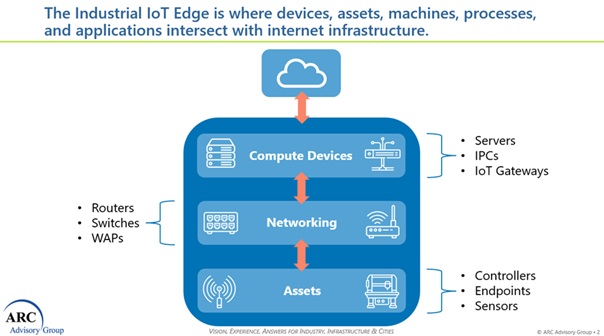
The industrial edge is where devices, machines, processes, and applications intersect with internet infrastructure. In other words, edge computing refers to a mostly decentralized computing infrastructure located near data sources. Unlike the cloud, which centralizes data processing in remote data centers, edge computing processes data locally, near the source, where the data originates.
This proximity to data sources offers several advantages, including reduced latency, increased security, and improved reliability. Latency is particularly significant for control tasks in automation.
IT/OT Convergence at the Edge
The convergence of IT and OT is a significant trend in the automation industry. IT encompasses the systems and technologies used for data processing and management, while OT includes classic hardware and software that monitor and control physical devices and processes. Traditionally, these two areas operated in silos, but new edge devices and solutions bridge this gap.
At the edge, IT and OT systems can be seamlessly integrated, enabling real-time data processing and decision-making. This convergence enhances operational efficiency, reduces downtime, and enables e.g. predictive maintenance. With the help of edge computing, organizations can achieve a more unified, reliable view of their operations, leading to more informed and timely decisions.
AI, Edge, and Cloud
Edge AI refers to the use of algorithms at the edge of the network, closer to where data is generated, while cloud AI offers powerful analytics and machine learning capabilities that require much more computing power. Edge AI complements this by enabling real-time insights and actions. This combination of cloud and edge AI creates a robust and flexible architecture capable of handling diverse and dynamic workloads.
Embedded Devices Support the Edge Transformation
Put simply, an industrial embedded device, is a device where hardware and software are perfectly tailor-made for certain tasks or applications. Industrial embedded devices will play a crucial role in transforming the industrial environment by enabling more efficient, smarter, and more adaptable operations. For example, embedded devices at the edge can process data locally, reducing latency. This is especially important for applications that require immediate responses, in real time such as in safety applications, in packaging, handling, robotics and a lot of other industrial applications and systems.
Embedded devices facilitate seamless communication between different components of an industrial system by interacting with sensors, actuators, and controllers from different manufacturers. This connectivity supports the industrial Internet of Things (IIoT) and helps create better-connected and more responsive systems.
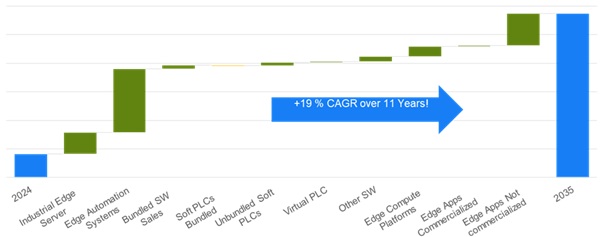
The graph illustrates the impressive growth potential that ARC sees for various products at the edge. We currently expect an average annual growth rate (CAGR) of at least 19 percent over the next 11 years. This growth potential underscores the increasing importance of the edge in further transforming automation technology.
In conclusion, while the cloud remains a cornerstone of modern automation technology, the edge is an equally important component in the modern automation industry. The convergence of IT and OT at the edge, along with incredible developments in AI, is driving innovation and efficiency in the automation industry. My colleagues and I are excited to see what will happen next in the automation industry.