Representative End User Clients







Representative Automation Clients







Representative Software Clients










Hitachi introduced an expanded portfolio of HMAX solutions, outlining how it is applying artificial intelligence across multiple industries. HMAX is designed to combine data from physical and digital assets with advanced AI and operational domain knowledge to help support complex infrastructure environments.
HMAX integrates data collected from assets, such as sensors, industrial equipment, and machinery with experience gained through long-term deployment and maintenance of operational systems. These inputs are used to apply perception, generative, agentic, and physical AI capabilities in ways that directly interact with physical systems rather than remaining confined to analytical or informational layers.
The HMAX portfolio has expanded across three infrastructure categories where operational complexity and system reliability are increasingly critical:
HMAX Mobility: Supporting transportation systems through AI-enabled asset visibility, autonomous operations, and IoT-based mobility use cases.
HMAX Energy: Applying AI-driven monitoring, prediction, and optimization to support more reliable and sustainable operation of energy infrastructure across the value chain.
HMAX Industry: Addressing safety, productivity, quality, and environmental performance in factories and buildings, with a focus on frontline operations and workforce support.
Hitachi indicated that HMAX is expected to extend into additional mission-critical domains, including data centers and financial institutions, where system resilience and real-time operational insight are essential.
In physical domains, such as manufacturing and infrastructure, labor shortages and aging assets continue to increase operational risks. Hitachi positions physical AI as a means of collecting, analyzing, and operationalizing field data in real time. Unlike some traditional AI approaches that primarily process information or generate content, physical AI interacts directly with operational systems to help support functions, such as predictive maintenance, system optimization, and autonomous control.
Drawing on its experience in operational technology and infrastructure management, Hitachi framed HMAX as an approach grounded in real-world deployment rather than experimental or isolated AI applications.
HMAX is structured around four core principles that guide how AI is applied in physical systems:
Data from Digitalized Assets: Continuous data streams from infrastructure assets provide the foundation for AI-driven insight and control.
Domain Knowledge: Operational expertise is embedded into AI-ready models to help ensure outputs align with real-world system behavior.
Artificial Intelligence: A combination of perception, generative, agentic, and physical AI helps to support detection, reasoning, decision-making, and autonomous execution.
Partner Ecosystem: HMAX incorporates technologies from external partners to help support robust, production-grade deployments.
HMAX solutions are already deployed across multiple infrastructure environments:
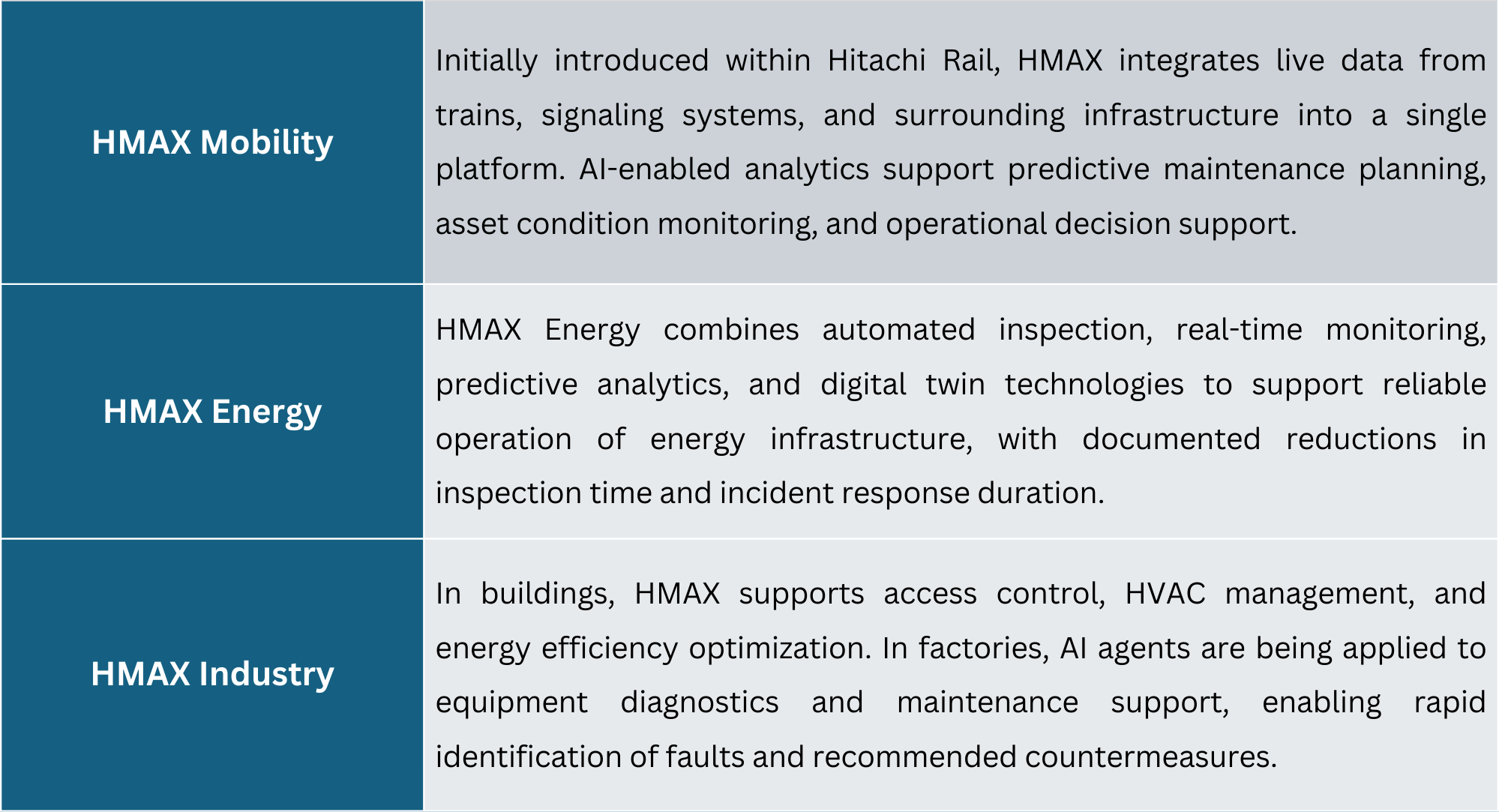
Across these deployments, HMAX is positioned as a framework for embedding AI directly into operational processes rather than layering it on as an external analytics tool.
Follow ARC Advisory Group for the latest trends in sustainability, automation, and next generation technology.