Representative End User Clients







Representative Automation Clients







Representative Software Clients








In my recent blogs, I've shared insights gleaned from ARC Advisory Group's Q4 2024 Survey of nearly 600 industrial sector respondents. One key takeaway, echoing our 2023 advice, is the increasing sophistication in Industrial AI deployments. Respondents are moving beyond the initial GenAI buzz and strategically selecting the right data science and AI/ML tools for each specific use case. As I highlighted in my last blog, this nuanced approach, encompassing a broader AI/ML toolkit beyond just GenAI, sets the stage for Agentic AI to truly unleash the FULL Industrial AI Toolbox in 2025.
This shift was palpable at last week's ARC Advisory Group Industry Leadership Forum 2025 in Orlando. It was incredibly rewarding to witness our industrial customers sharing concrete progress on their Industrial AI journeys across all four tracks of the Forum. The atmosphere was a stark contrast to the 2024 Forum. Just a year ago, industrial end users were largely observers, eager to learn about GenAI plans from cloud hyperscalers and foundation model pioneers, as well as industrial automation and software vendors.
Fast forward to 2025, and the Forum was dominated by end user success stories. From keynotes to breakout sessions, industrial leaders took center stage, detailing their journeys in building industrial-grade data fabrics to ensure data quality, and scaling Industrial Copilots powered by GenAI interfaces—but crucially, orchestrating a diverse set of AI Agents underneath. These agents utilize fine-tuned LLMs, multi-modal models, traditional machine learning, neural networks, and computer vision to perform specialized tasks across machines, equipment, and industrial processes, ensuring accuracy, low latency, predictability, and explainability.
One particularly impressive session, (hosted by yours truly, the author of this blog) featured Don Morrison, Real-time System Architect at Devon Energy, who explained how their data scientists now access time-series data with a mere two-second latency—a testament to their advancements in assembling their Industrial-grade Data Fabric. Later, in that same session, the audience and I were captivated by Ibrahim Al-Syed, Director of Digital Transformation for Manufacturing at Celanese, who showcased JO.AI, Celanese's Industrial Copilot. JO.AI stands out as a prime example of GenAI in action, tackling a wide spectrum of Industrial AI use cases with remarkable efficacy.


The panel discussions, mirroring countless other sessions at the Forum, consistently circled back to critical themes I’ve discussed in recent blogs: ensuring robust data quality, fostering true IT/OT convergence (or at least seamless collaboration), and the strategic imperative of deploying the right AI/ML tool for each specific job. However, one recurring theme, perhaps less frequently discussed in my recent blogs, truly resonated: the sheer diversity of data types required to effectively train AI/ML models and fuel GenAI copilots and agents. It's not just about more data, but about more kinds of data.
This brings me to some more data from our Q4 2024 Survey that I shared in my sessions at the ARC Forum in Orlando; a chart that powerfully underscores this very point. It vividly illustrates the diverse data types considered essential for various Industrial AI skills and use cases.
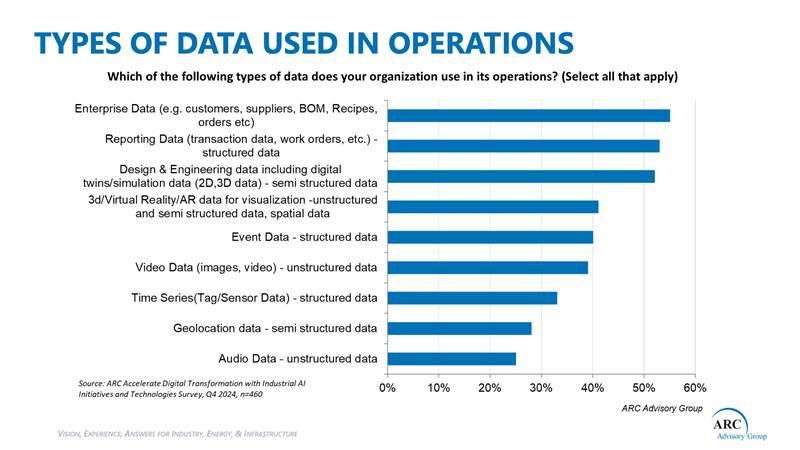
Let's break down some of the systems in the above chart, exploring the data types and understand their significance in more detail:
Sensor Data: This is the bedrock of Industrial AI, encompassing real-time measurements from a vast array of sensors monitoring temperature, pressure, flow rates, vibration, electrical signals, and much more. This time-series data is crucial for predictive maintenance, process optimization, and real-time anomaly detection. Consider sensors embedded in pumps, motors, turbines, and chemical reactors—functioning as the eyes and ears of the industrial plant floor.
Process Data (Historian Data): Going beyond raw sensor readings, process data captures aggregated and contextualized information from historians and process databases. This includes event data, KPIs, production metrics, batch records, and operational logs. Understanding process trends and historical performance is vital for optimizing workflows, improving product quality, and identifying bottlenecks.
Asset Data (CMMS/EAM Data): This encompasses information about physical assets—equipment, machinery, infrastructure—including maintenance history, work orders, asset hierarchy, specifications, and criticality assessments. This data is indispensable for asset performance management, predictive maintenance scheduling, and optimizing asset lifecycles.
Quality Data (LIMS/Quality Systems Data): Quality data focuses on product and process quality metrics captured through Laboratory Information Management Systems (LIMS), quality management systems, and inline quality checks. This includes inspection results, defect tracking, compliance data, and customer feedback. AI models trained on this data can optimize quality control processes, reduce waste, and ensure product consistency.
Engineering Drawings & Diagrams (CAD/PDM Data): This is where the discussion gets particularly interesting. Visual data is often the key to unlocking significant value in industrial settings. Engineering drawings, diagrams, and schematics—typically stored in CAD and product data management (PDM) systems—contain valuable information on equipment design, plant layout, process flow, and electrical wiring. Understanding these visuals is critical for tasks like automated equipment inspection, digital twins, and streamlined maintenance procedures.
Video & Images (Vision Systems, Security Cameras): The proliferation of cameras across industrial facilities presents a massive opportunity. Video feeds from vision systems on production lines, security cameras monitoring plant perimeter, and inspection images captured by drones or handheld devices, are incredibly valuable for tasks ranging from visual quality inspection and safety monitoring to anomaly detection and robotic guidance.
Text Data (Operator Logs, Manuals, Procedures, Work Instructions): Don't underestimate the power of text! Operator logs, maintenance manuals, standard operating procedures, safety guidelines, and work instructions are repositories of crucial domain knowledge. Natural language processing (NLP) techniques can extract valuable insights from this unstructured text data, enabling tasks like knowledge management, automated procedure generation, and improved operator training.
Geospatial Data (GIS Data, GPS Coordinates): For industries like mining, utilities, and agriculture, geospatial data is paramount. GIS data, GPS coordinates of assets, terrain maps, and weather patterns are essential for optimizing logistics, managing geographically distributed assets, and understanding environmental factors impacting operations.
External Data (Weather Data, Market Data, Supply Chain Data): Looking beyond the plant walls, external data sources like weather forecasts, market prices, commodity indices, and supply chain information provide crucial context. Incorporating this data enables more comprehensive decision-making, helping to optimize production schedules based on weather conditions, anticipate market fluctuations, and mitigate supply chain risks.
In our recent podcast on Industrial AI: Is Computer Vision the Sharpest Tool in the Industrial AI Toolset?, Larry O’Brien and I discussed how the ability to interpret drawings, diagrams, camera photos, and video feeds is often the missing link in unlocking value from Industrial AI. Consider the extensive archives of drawings and diagrams in industrial plants, including piping and instrumentation diagrams (P&IDs), electrical schematics, plant layouts, and equipment blueprints. These visuals are often trapped in CAD systems, operator manuals, and specifications. Even when digitized, they might be PDFs stripped of original context, or worse, outdated due to plant modifications and upgrades over decades of operation.
However, the convergence of pervasive, cost-effective camera sensors, and advancements in computer vision is changing the game. We are now at a point where we can realistically leverage these visual assets, unlock the information they contain, and integrate it into our Industrial AI strategies.
For low-latency Edge AI and Embedded AI applications—or as we playfully consider, Physical Intelligence 😉—real-time sensor data is indispensable. For a deeper dive into the critical role of time-series data, I highly recommend listening to my podcast with Dustin Johnson, CTO of Seeq, a leading provider of advanced analytics and AI for industrial companies: "Industrial AI Conversation with Seeq: Assistants, Agents, Time-series Data and the Future Impact of GenAI."
In conclusion, the Industrial AI (R)Evolution is not just about adopting the latest algorithms or chasing the GenAI hype. It's about a pragmatic, multi-faceted approach. It's about understanding the diverse data landscape of your industrial operations, recognizing the right AI/ML tool for each specific use case, and building robust data infrastructure to ensure quality and accessibility.
The most crucial reason to engage with ARC Advisory Group analysts and attend our events like the ARC Forum and upcoming Industrial AI Leadership Summits in 2025, is to tap into our deep domain expertise and receive guidance on navigating this complex landscape. We provide best practices for people, processes, and technology, along with valuable guidance on choosing vendors that emphasize data quality, security, IP protection, and the integration of open, scalable, and industrial-grade AI capabilities into their platforms and solutions.
The Industrial AI (R)Evolution is underway. It's a journey that requires a pragmatic, multi-faceted approach, and ARC Advisory Group is here to guide you every step of the way.
For ARC Advisory Group recommendations for navigating the AI Wars, closing the digital divide by embracing Industrial AI, and governing and guiding major decisions about enterprise, cloud, industrial edge, and AI software, please contact Colin Masson at [email protected] or set up a meeting with me, or my fellow Analysts at ARC Advisory Group.