Representative End User Clients







Representative Automation Clients







Representative Software Clients








Industrial AI SPARCs with AWS: Episode 3, Digital Twins as the Engine for Physical Intelligence
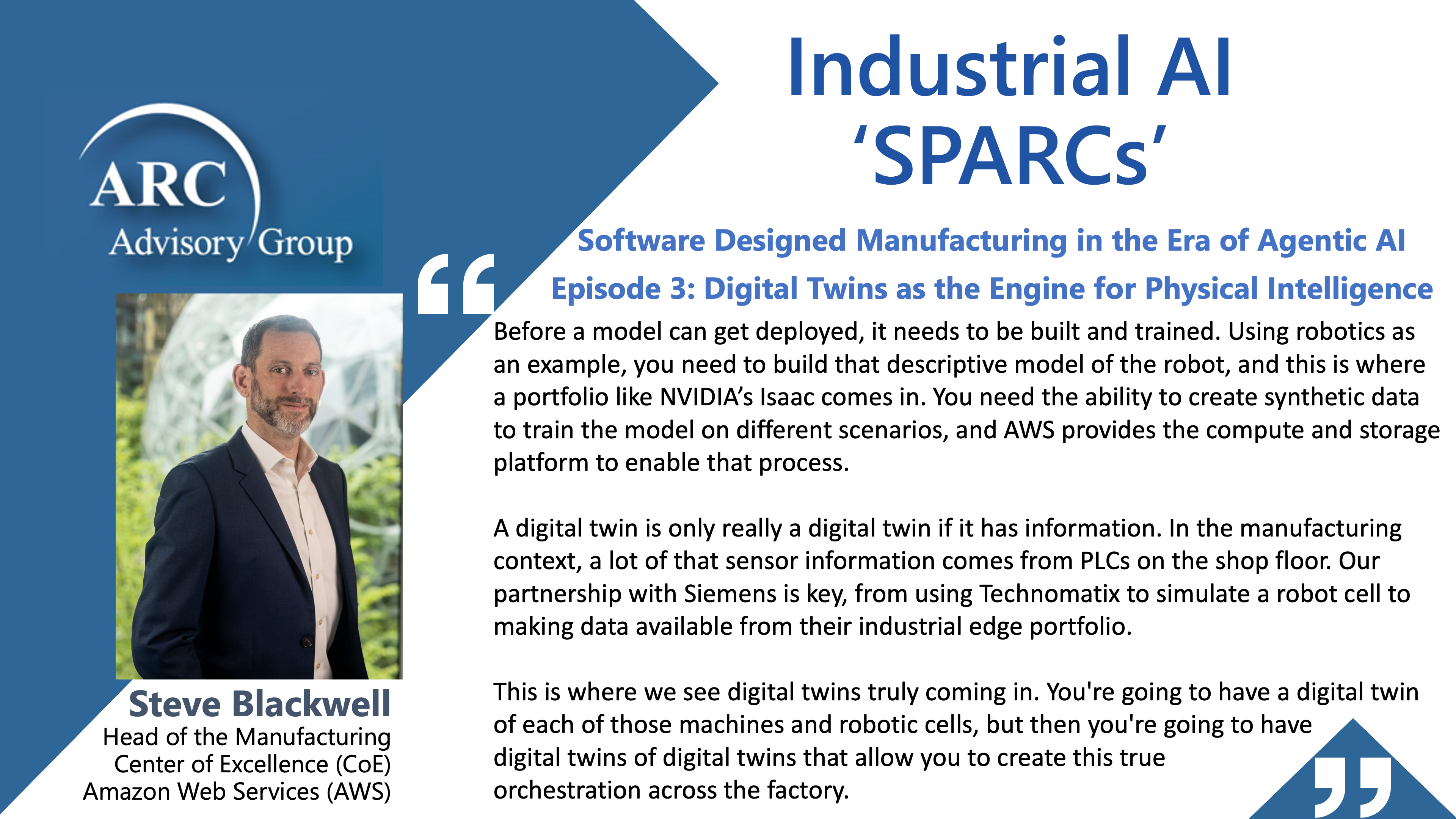
In our first ARC Advisory Group SPARC podcast, Steve Blackwell of AWS and I explored the vision for Software-Defined Manufacturing, where Agentic AI acts as the "brain and central nervous system." Our second conversation brought that vision to the factory floor, examining the "muscles" of the operation with the rise of Physical and Embodied AI.
In this third installment of our ongoing dialogue, we connect the brain and the muscles. A central theme in my new ARC research series on the Voyage to Physical Intelligence is that for any system to perceive, reason, and act in the physical world, it needs a deep, contextual understanding of that world. This brings us to the critical role of the digital twin—not as a static model, but as a live, learning environment that serves as the foundation for the next wave of industrial autonomy.
You can listen to or watch our full conversation here:
For those who prefer to read, I’ve distilled our conversation into the key insights and recommendations below.
The term "digital twin" is often misunderstood as just a 3D CAD model. AWS presents a more sophisticated, four-level maturity model: Level 1 is the Descriptive twin (the visualization). Level 2 is Informative, enriched with real-time IoT and enterprise data. Level 3 becomes Predictive, using machine learning to forecast behavior.
The final stage, according to Steve, is Level 4, the Living Digital Twin—a closed-loop system that is constantly updated by the physical world it represents. This "living" model is the essential foundation for Physical Intelligence, providing the world model an AI needs to operate.
Steve Blackwell (AWS): "We look at a digital twin at four levels. The final one is Level 4, what we call the living digital twin, where models are constantly being updated by the behaviors of the physical system. This is very much where Physical Intelligence and Physical AI come together."
Colin Masson (ARC Advisory Group): "The brain of the autonomous factory requires an evolution in our thinking of the digital twin—not as a static model rooted in CAD and PLM, but as a live learning environment that serves as the foundation for the next wave of industrial autonomy."
High-fidelity, physics-based simulation is changing the game for developing and deploying Physical AI. This "simulation-first" approach, powered by partnerships with companies like NVIDIA, allows manufacturers to train, test, and validate complex robotic operations and AI models in a virtual environment before a single piece of physical hardware is installed. By using synthetic data to train models on rare or dangerous edge cases, companies can de-risk innovation, dramatically reduce commissioning times, and accelerate the deployment of autonomous systems.
Steve Blackwell (AWS): "Before a model can get deployed, it needs to be built and trained. Using robotics as an example, you need to build that descriptive model of the robot, and this is where a portfolio like NVIDIA’s Isaac comes in. You need the ability to create synthetic data to train the model on different scenarios, and AWS provides the compute and storage platform to enable that process."
Colin Masson (ARC Advisory Group): "This simulation-first approach fundamentally changes the game for developing and deploying the Physical AI systems we've been talking about. It allows agents to test scenarios, learn, and then command physical systems with true intelligence."
A digital twin is only as intelligent as the data that feeds it. It requires a complete "digital thread" that stretches from initial design in a PLM system to real-time operational data from PLCs on the factory floor. This is where the broader ecosystem is critical. Partnerships with industrial automation leaders like Siemens are essential for breaking down data silos and ensuring that critical engineering and enterprise context—the "as-designed" and "as-planned" truth—continuously fuels the operational digital twin.
Steve Blackwell (AWS): "A digital twin is only really a digital twin if it has information. In the manufacturing context, a lot of that sensor information comes from PLCs on the shop floor. Our partnership with Siemens is key, from using Technomatix to simulate a robot cell to making data available from their industrial edge portfolio."
Colin Masson (ARC Advisory Group): "It's a complex ecosystem. Most of what's out there is brownfield and heterogeneous. You need partners from the AVEVAs of the world to Rockwell Automation, and you need to connect the entire digital thread from design to operation and maintenance."
The ultimate vision is a closed-loop system where the digital twin acts as the "world model" for Agentic AI. In this paradigm, an agent analyzes a digital twin of a machine or process, simulates outcomes, and formulates a plan. That plan is then executed in the physical world. Crucially, the real-world results are fed back to the twin, updating its state and enabling a continuous cycle of learning and optimization. This extends to creating "digital twins of digital twins" to orchestrate entire factory lines, enabling a level of system-wide intelligence that was previously unattainable.
Steve Blackwell (AWS): "This is where we see digital twins truly coming in. You're going to have a digital twin of each of those machines and robotic cells, but then you're going to have digital twins of digital twins that allow you to create this true orchestration across the factory."
Colin Masson (ARC Advisory Group): "At some point, we're orchestrating agents, people, and robots. It feels like we need a whole new paradigm to do that, because it's going to be a very different mix of people, agents, and physical intelligence."
As Steve and I concluded, we are in the early stages of a profound transformation—an industrial AI (R)Evolution that is accelerating daily. This conversation is just one part of our ongoing dialogue. I will continue to check in with Steve Blackwell and other thought leaders at AWS and across the wider ecosystem to chart the course of software-defined manufacturing and Physical Intelligence.
To follow this fast-moving and complex topic, subscribe to the ARC Advisory Group Digital Transformation Podcast and follow me on LinkedIn for real-time insights. We've already teed up several future conversations, and you won't want to miss them.
For more insights on the topics discussed, explore these ARC Advisory Group resources:
The dialogue on industrial AI and digital transformation is constantly evolving. To stay informed and hear more insights from industry leaders, we invite you to subscribe to the ARC Advisory Group's Digital Transformation podcast series.
We believe the best conversations include diverse perspectives. If you are an innovator in this space and would like to contribute to a future discussion, please reach out to Colin Masson at ARC Advisory Group.
For ARC Advisory Group recommendations for Navigating the AI Wars - including the Industrial Robot Wars–Closing the Digital Divide by Embracing Industrial AI, assembling your Industrial-Grade Data Fabric, and governing and guiding major decisions about enterprise, cloud, industrial edge, and AI software, please contact Colin Masson at [email protected].
Or set up a meeting with my fellow Analysts and I, at ARC Advisory Group to find out more about our Executive Insights Service for Industrial organizations, and Industrial AI Insights Service for Vendors.