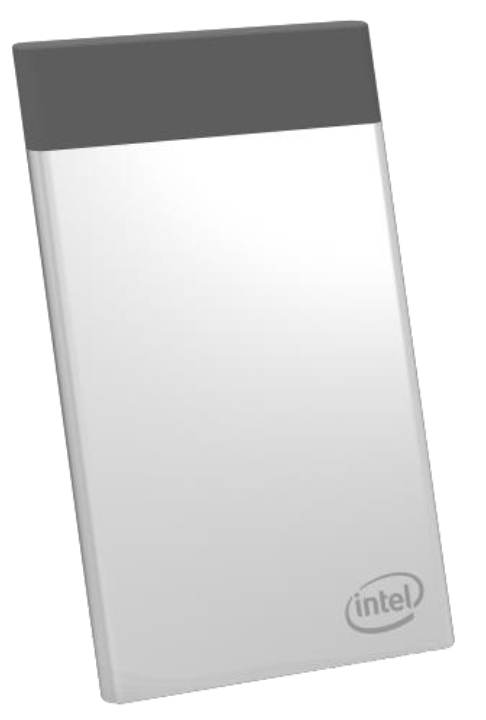
Intel announced a credit card-sized « Compute Card » that provides a modular approach to designing edge computing power and connectivity into consumer or industrial products. The Intel Compute Card is a full computer with memory, storage, IO options, and wireless WiFi and Bluetooth connectivity. The product is announced for mid 2017 and potential applications will be both consumer products such as appliances for connected homes but also for commercial equipment.
Synching Life Cycles
Intel’s approach provides an answer to the differences in life cycle duration of a compute module and the physical hardware. To illustrate this point, let us consider a car. An average quality car will have a life cycle of at least ten years, but after a few years, the navigation and entertainment systems have an outdated look and performance. If not only the software but also the hardware of these systems could be refreshed every few years, and brought synch with computer life cycles, cars could be maintained current, and customers and society would benefit from latest connectivity. Intel mentions the interface would be a standard "USB-C plus extension". It would be an additional advantage for the consumer or OEM if this would become global standard.
Implications for Industrial Products
Similar scenarios are thinkable for consumer electronics, but also machine tools, manufacturing equipment and possibly control systems in the future. We expect this innovation to ripple through into industrial equipment and automation equipment over the coming years. We expect major benefits from it in terms of reduced development time and effort for creating new products and reduced cost by fit-for-purpose upgrading, as also the
Open Group pursues in the domain of process automation.
IoT Modules for Education and Product Development
Intel also provides a range for products for educational purposes as well as for developing and piloting IoT applications to create connected devices, consumer or light industrial IoT, intelligent wearables. Other possibilities are mobile robotics and unmanned aerial vehicles (UAV) and more. The products come with software packages supporting development of products. This
page gives an overview of available products. Among those products are the Arduino 101 (or Genuino 101 outside the US).
Differentiation
The Intel Compute Card is more suited for industrialization of productions because of the standard module interface, one of key differentiators compared to the Arduino/Genuino and the
Raspberry pi. Intel announced a range of processors for the card, for different computational loads, which also seems more adapted to industrial applications.




















