Representative End User Clients







Representative Automation Clients







Representative Software Clients








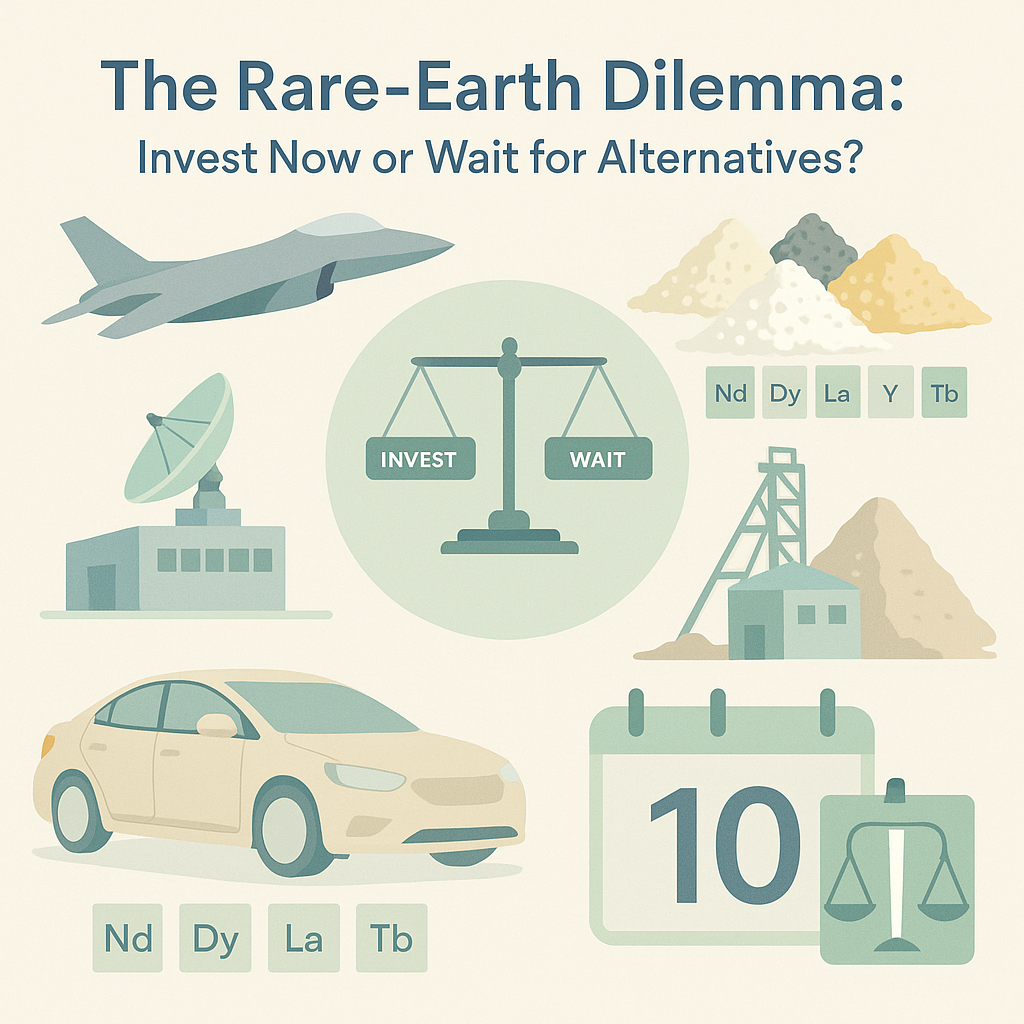
Headlines from around the world reflect growing anxiety in the rare-earth element (REE) supply chain. China, the dominant global producer and supplier of rare-earth elements, has imposed new restrictions on their supply and trade. This is not an isolated incident, but one that will be difficult to resolve quickly. In a world marked by trade wars and active military conflicts, manufacturing faces crises on multiple fronts. Every economic and industrial power is racing to secure rare-earth supplies—often by forming new alliances to explore deposits from Greenland to Central Asia.
But here lies the dilemma: Is it truly worth investing hundreds of millions of dollars to source, extract, refine, and build an independent rare-earth supply chain? Or is this just another passing challenge that could fade over time, if market forces are allowed to take their course over the next few years to a decade?
A single stealth fighter aircraft may require as much as 400 to 500 kilograms of rare-earth elements. With active wars raging across Europe and Asia, stealth technology has become indispensable. Without it, air defense is nearly obsolete.
Cutting-edge technologies such as radar, lasers, drones, hypersonic missiles, and other defense systems rely on a wide range of rare-earth elements to power high-performance magnets, motors, and luminescent components. While exact quantities are hard to verify, estimates suggest a single unit of defense equipment may require anywhere from a few kilograms to several hundred kilograms of REEs. Multiply that across a fleet or defense program, and the demand easily reaches tons.
Although multiple industries—from electronics to renewable energy—are affected by the rare-earth shortage, the most acute concern lies in national security and defense.
The term “rare-earth” can be misleading. Not all of the 17 elements in this group are truly rare, and not all are equally critical. Of these, approximately eight are of particular importance to defense and national security:
Neodymium (Nd)
Dysprosium (Dy)
Samarium (Sm)
Yttrium (Y)
Europium (Eu)
Terbium (Tb)
Lanthanum (La)
Praseodymium (Pr)
These elements are essential for their magnetic, luminescent, and catalytic properties, and they are considered irreplaceable in many defense applications. While small or moderate deposits of these elements exist outside China, they are not always economically or technologically viable to access and process.
Rare-earth elements can potentially be sourced from countries like Australia, India, and Brazil, among others. However, establishing a full rare-earth extraction and refining operation typically requires several hundred million dollars and at least three to five years to become operational. This includes not just extraction, but also licensing, environmental compliance, and infrastructure setup. It may take another few years to break even—assuming prices remain favorable.
These projects therefore demand long-term commitment from both investors and buyers. With supply chain disruptions often fluctuating based on geopolitical events, many investors may hesitate to commit without strong guarantees of long-term demand.
Rare-earth materials have long been a core component in electric motor engines. However, change is already underway. The latest fifth-generation EV motors—like those developed by BMW—have moved away from rare-earth reliance entirely. Within two to five years, most global automotive manufacturers are expected to roll out EV motors that no longer depend on rare-earth materials. This marks a significant innovation and a critical shift in the sustainability of supply chains.
But why hasn't the defense industry made a similar transition?
Some alternatives—such as iron nitride magnets and ferrite-based motors—are being explored. However, none have yet met the performance, accuracy, and reliability standards required for military deployment. Defense applications have far higher thresholds for precision and durability, making it harder to approve experimental materials.
Still, just as the automotive sector has developed viable alternatives under the pressure of sustainability and geopolitical risk, it’s plausible that the defense industry will begin rolling out its own rare-earth-free technologies within the next five years.
Every nation must weigh the cost of investing hundreds of millions of dollars in new rare-earth refining operations against the possibility that emerging alternatives will make those investments obsolete in a few years. Forming cross-national alliances to fund joint supply chains may provide short-term stability, but innovation could soon upend the equation.
For both national security planners and business leaders, this is a difficult balancing act. And that is the rare-earth dilemma.