Representative End User Clients







Representative Automation Clients







Representative Software Clients








In my last post, we unpacked the "Schism of Speed" and explored how Industrial AI Pacesetters are rewriting the rules of scale, leaving the old "Fast Follower" strategy dead in the water. But as we dig deeper into the data from the ARC Industry Leadership Forum 2026, we have to address a critical friction point where AI ambition meets physical reality.
One of the most fascinating aspects of the ARC Forum last week was witnessing the hallway conversations between IT-focused Data Scientists and Operational Technology (OT) Plant Managers. A Data Scientist or vendor marketing executive might pitch a brilliant, generalized Large Language Model (LLM) or Copilot, only to have an OT leader from a chemical plant point out that "AI hallucinations" in a high-pressure refining environment do not result in a funny chatbot error—they result in catastrophic physical failure.
This disconnect highlights a persistent confusion we are continually—and perhaps irritatingly, but necessarily—trying to dispel: the assumption that all AI is Generative AI. Since we published The Industrial AI (R)Evolution back in 2023, I have been evangelizing "Industrial AI" not as a monolithic technology, but as a diverse toolbox of analytical and machine learning techniques—a theme I've explored extensively in my three-part Industrial AI Toolbox series for Industry Week, and across my ongoing Industrial AI research and blogs on the ARC Advisory Group website. As was repeated many times on stage at the ARC Industry Leadership Forum, success requires "using the right AI tool for the job." While Gen AI has a vital role—like Copilots parsing maintenance manuals or simplifying code generation—it is just one instrument. Our surveys deliberately dug deep into the specific applications of different AI and ML models because tuning a PID loop requires a vastly different algorithm than drafting a shift report.
The recurring question I heard from IT leaders and Data Scientists alike was: "How does this apply to my specific industry?" Why them specifically? Because Operational Technology (OT) veterans, alongside the Engineering Technology (ET) teams who designed the products and plants, are already intimately familiar with the physics and constraints of their vertical industry. It is the IT architects and Data Scientists—tasked with scaling horizontal, enterprise-wide AI platforms—who are suddenly realizing that a generic, monolithic AI strategy rarely survives contact with the plant floor. They are recognizing that to achieve true IT/OT/ET convergence, they must adapt their digital tools to the physical, regulatory, and legacy realities of the industrial world.
Generic "Industrial AI" trends make for good headlines, but they do not help you tune a PID loop in a refinery or optimize a multi-million-dollar picking fleet in a warehouse. This is exactly why, in our ARC Advisory Group Q4 2025 Industrial AI, Energy, and Robotics Survey of 570 global decision-makers, we did not just look at the aggregate data; we sliced it by vertical.
Before we look at the differences, let's look at what the entire industry agrees on.
Across every vertical we surveyed, a few universal truths emerged. The entire industrial sector is moving toward the same horizon; they are just taking different paths to get there.
The AI Mandate: 55 percent of all respondents ranked AI & ML as their #1 impact technology over the next five years, more than double that of Cloud Infrastructure (23 percent) or Clean Energy (22 percent).
The End of the Silo: A massive 63 percent consider "decoupling data from software" critically important. The market universally recognizes that you cannot scale intelligence on a fragmented, proprietary infrastructure.
The Goal is Autonomy, Not Just Assistance: 56 percent of the aggregate market prioritizes "Level 3 Autonomous Operations Models" (where AI closes the loop) over simpler "Level 2 Copilots" (46 percent).
Augmentation over Replacement: The fear narrative is officially wrong. Only 16 percent cite "eventually replacing workers" as a primary driver. The goal is super-charging human productivity to solve the skills gap.
While the endpoint is shared, the physics, regulatory environments, and legacy constraints of different industries force radically different technology strategies. If you are a technology vendor pitching a generic AI message, or an IT leader pushing a monolithic corporate standard onto your plants, this data is your reality check.
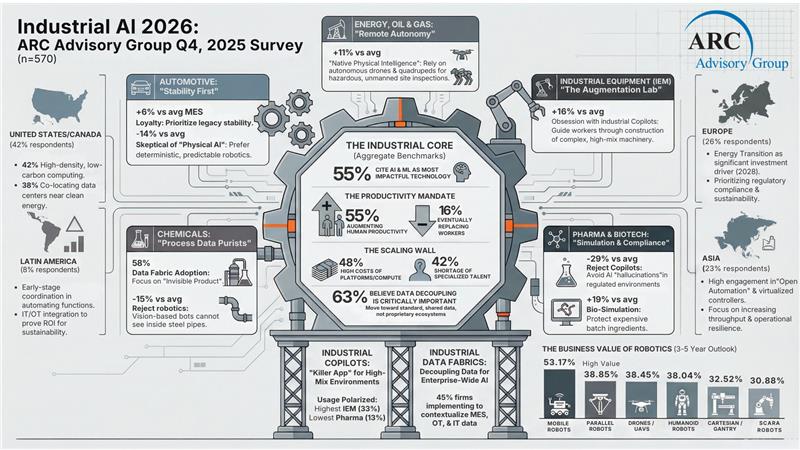
Here are the distinct "personalities" revealed in our Q4 2025 data:
You might expect the creators of autonomous vehicles to be the most aggressive adopters of autonomous factory tech, but auto plants carry immense legacy debt. They prioritize stability above all else.
The Data: 31 percent of automotive respondents plan to keep their traditional MES as the central system of record (the highest of any vertical, +8 percent over the average). Furthermore, they are skeptical of "Native Physical Intelligence" in robots (only 22 percent priority vs. the 36 percent average).
The "Why": In a brownfield auto plant, the cost of downtime is calculated in thousands of dollars per minute. Ripping out a legacy MES or introducing probabilistic, "learning" robots onto a high-speed, tightly coupled assembly line creates unacceptable risk. Instead, they want deterministic reliability. They are focusing their AI efforts on Agentic Scheduling (31 percent) to manage complex Just-in-Time logistics and sequencing, rather than direct machine control.
The IEM sector is dealing with incredibly complex, high-mix/low-volume environments. They do not have standard assembly lines; they build custom, one-off machines.
The Data: IEM shows a massive 58 percent focus on Industrial Copilots (the highest of any sector, +16 percent over the average). Additionally, 68 percent prioritize Level 3 Autonomous Operations.
The "Why": Because every build is different, workers need real-time, context-aware guidance (Augmentation) to assemble unique systems correctly the first time. Furthermore, IEM builders are transitioning to "Machine-as-a-Service" business models. Their high focus on autonomy is about building AI into their products to offer remote monitoring and optimization services to their end customers.
For Energy and Utilities, it is not about factory throughput; it is about remote resilience, safety, and the massive shift toward clean energy (cited by 44 percent of this sector as a top priority).
The Data: This sector showed a massive 61 percent prioritization of Level 3 Autonomous Operations and heavily indexes on Physical AI/Robotics (47 percent vs. 36 percent avg), specifically Drones and UAVs (54 percent).
The "Why": Energy companies are trying to solve the "lonely worker" problem and manage distributed, highly hazardous assets (offshore rigs, pipelines, solar farms). They are utilizing autonomous physical intelligence to conduct unmanned site inspections and keep humans out of harm's way.
In an industry where the product flows invisibly through steel pipes and chemical reactors, articulated robot arms take a back seat.
The Data: 58 percent are intensely focused on Data Fabric adoption. They also show a high demand for Generative AI for ease of programming (55 percent).
The "Why": You cannot optimize continuous, highly regulated batches if your data is locked in proprietary DCS historians. They are heavily investing in Data Fabrics to liberate this data. Their focus on GenAI for programming suggests a need to democratize control of complex batch processes for a newer generation of engineers.
Pharma operates under the strictest regulatory scrutiny in the world (e.g., FDA 21 CFR Part 11).
The Data: While they aggressively pursue Autonomous Operations (61 percent), they largely reject standard Industrial Copilots (only 31 percent priority, -11 percent vs avg). Conversely, they are heavy investors in Digital Twins (42 percent) and the Industrial Metaverse (39 percent).
The "Why": In a GxP-regulated environment, an AI "hallucination" from a Copilot is not just a mistake; it is a compliance violation that can shut down a facility. They bypass generic Copilots in favor of highly deterministic, agentic intelligence for automated compliance and "Golden Batch" replication. They rely on Digital Twins for "Sim-to-Real" training to protect expensive batch ingredients before executing in the physical world.
Your industry's specific physics, legacy assets, and regulatory environment entirely dictate your AI architecture. Applying a discrete manufacturing AI strategy to a continuous process problem is a guaranteed recipe for stalled pilots.
For technology vendors and service providers, this data highlights why generic "AI washes" in marketing and product development are failing to resonate with plant managers. You must speak the specific language of their vertical constraints.
Are you aligning your AI and data investments with the proven realities of your specific industry, or are you chasing generic hype? The deep, vertical-specific cuts of our data provide the strategic roadmap you need.
(To dive deeper into the data driving these trends, members of the ARC Executive Insight Service can access our full "Industrial AI Pacesetters 2026 Report" and selected insights from our "Q4 2025 Industrial AI, Energy, and Robotics Survey" via the ARC client portal. For customized benchmarking, vendor analysis, and specialized market intelligence, explore ARC Advisory Group's Voice of Market Service.)
Geography often acts as destiny in digital transformation. In the third post of this series, Global Divergence: How Regions are Betting on AI & Robotics in 2026, we’ll look at how borders dictate technology strategy. We'll explore why North America is playing a "Data First" software game, why Europe is building a "Sustainable Fortress," and how Asia and Latin America are aggressively leapfrogging legacy systems with physical robotics and cloud-native AI.
For ARC Advisory Group recommendations for Navigating the AI Wars—including the Industrial Robot Wars—Closing the Digital Divide by Embracing Industrial AI, assembling your Industrial-Grade Data Fabric, and governing and guiding major people, processes, and technology decisions about enterprise, cloud, industrial edge, and AI, please contact Colin Masson at [email protected].
Or set up a meeting with my fellow Analysts and I, at ARC Advisory Group to find out more about our Executive Insights Service for Industrial organizations, and Industrial AI Insights Service for Vendors.