Representative End User Clients







Representative Automation Clients







Representative Software Clients








Following up on my recent blogs recapping the incredible operational blueprints laid out in the PepsiCo and Jabil keynotes at the ARC Industry Leadership Forum 2026, I know many of you are eagerly awaiting a recap of the engaging Executive Panel Discussion that followed. I promise I will be sharing that as soon as we can release the video recordings.
In the meantime, I want to dive much deeper into the data we presented in Orlando. To kick off this four-part blog series, I’ll be expanding on the insights my colleague Greg Gorbach shared last week following the keynotes, drawn directly from our newly released Industrial AI Pacesetters 2026 Report. Then, over the next three posts, I'll provide a deeper dive into the regional, role, and vertical industry insights I explored during my Thursday morning breakout session with Craig Resnick and Inderpreet Shoker.
If you joined us in Orlando last week, you undoubtedly felt the shift in the room. Looking out into the audience during my breakout session on the Industrial AI (R)Evolution, the cross-pollination of disciplines was striking. We had Operational Technology (OT) veterans, IT architects, Engineering Technology (ET) leaders, and Data Scientists all actively debating not if Industrial AI works, but why some companies are compounding their gains exponentially while others remain stuck in "Pilot Purgatory."
For decades, the "Fast Follower" strategy was the safe, pragmatic bet in manufacturing. The prevailing wisdom was to let the pioneers take the arrows, and simply buy the technology once the hype settled and the solution matured.
Our latest research, however, suggests that in 2026, the Fast Follower strategy is effectively dead.
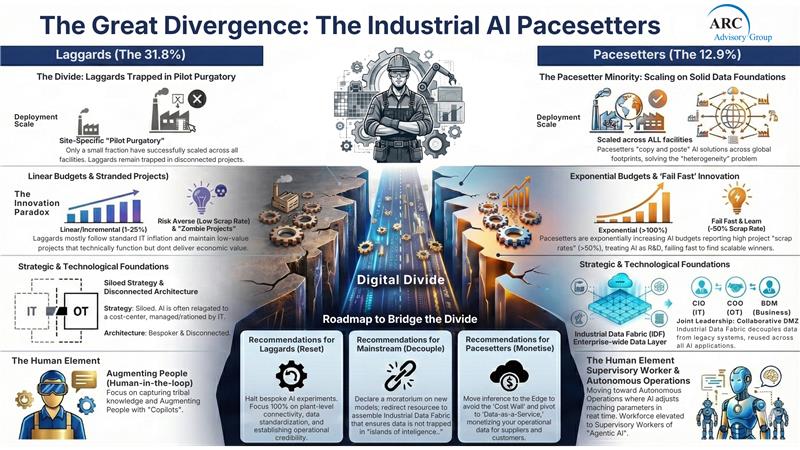
Reinforced by our Q4 2025 Industrial AI, Robotics and Energy survey of 570 global decision-makers, the ARC Advisory Group Industrial AI Pacesetter Report (which surveyed 510 global decision-makers earlier in Q4 2025) reveals a market that has fractured, leading to what we call the "Schism of Speed." The industrial sector has essentially split into three distinct cohorts:
Pacesetters (12.9 percent): They aren't just experimenting; they are operationalizing AI as a structural competitive moat. They are doubling down, with AI budgets growing >100 percent, and have moved decisively beyond simple "Augmentation" to Level 3 Autonomous Operations and Level 4 Embodied Intelligence.
Mainstream (55.3 percent): Stuck on the "Use Case Treadmill," they are buying isolated, point-solution applications that do not scale across the enterprise.
Laggards (31.8 percent): Trapped in the "Innovation Paradox." They report high project success rates internally, but often because they are cherry-picking safe, low-impact projects that do little to move the needle on EBITDA.
The gap between the Pacesetters and the rest of the pack is no longer linear; it is increasingly exponential. Pacesetters are benefiting from the "Compound Interest of Innovation." Because they have prioritized building an Industrial Data Fabric (which 63 percent of our total respondents now deem critically important), the data curated for one AI project immediately fuels the next. Furthermore, they are deploying "Physical Intelligence"—robots and Agentic AI—faster and more cost-effectively than the Mainstream can even draft an RFP.
If you missed us in Orlando, or if you are not yet an ARC Advisory Group client, the Industrial AI Pacesetters 2026 Report provides a structured blueprint for understanding and closing this widening intelligence divide. The tools for the "Autonomous Factory" are here; the key variable left is the speed of organizational execution.
Here are the immediate, data-backed mandates for each cohort drawn directly from the report:
You must shift your strategy from "Experimentation" to "Operational Credibility." Halt the bespoke, "science fair" AI pilots that deliver no tangible business value. Concentrate your investments on the prerequisites of scale: connectivity, standardizing data tags, and data ownership. For business decision makers (BDMs), you must immediately stop justifying AI via headcount reduction. Reframe your business case around "Workforce Capacity"—using AI to lower the barrier to entry for new hires and capture the tribal knowledge of retiring experts. Win trust with simple, high-value robotic deployments that solve immediate pain points.
Stop buying isolated AI tools. You cannot scale intelligence on a fragmented infrastructure. We recommend declaring a moratorium on new, "black box" point solutions until your data foundation is secure. Redirect your investments to an Industrial Data Fabric to decouple your operational data from legacy applications.
You have scaled successfully, but you are now facing the "Cost Wall" of cloud inference and the risk of uncoordinated Agentic AI. Cloud inference costs for GenAI can become unsustainable at massive industrial scale. You must aggressively move inference workloads to the Edge to reduce variable cloud compute costs, treating latency as a revenue metric.
Unsure where your organization currently falls on the Schism of Speed? Take the ARC Advisory Group Industrial AI Readiness Assessment to evaluate your maturity and get tailored recommendations for your next phase of growth.
(To dive deeper into the data driving these trends, members of the ARC Executive Insight Service can access our full "Industrial AI Pacesetters 2026 Report" and selected insights from our "Q4 2025 Industrial AI, Energy, and Robotics Survey" via the ARC client portal. For customized benchmarking, vendor analysis, and specialized market intelligence, explore ARC Advisory Group's Voice of Market Service.)
Stay tuned for the second post in this series: One Size Fits None: Vertical Realities from the Q4 2025 Industrial AI Survey. We'll explore why a generic AI strategy fails when it reaches the plant floor, unpacking the unique technology priorities of five distinct industrial sectors—from Automotive's need for legacy stability to the Chemical sector's continued push for data fabrics.
For ARC Advisory Group recommendations for Navigating the AI Wars—including the Industrial Robot Wars—Closing the Digital Divide by Embracing Industrial AI, assembling your Industrial-Grade Data Fabric, and governing and guiding major people, processes, and technology decisions about enterprise, cloud, industrial edge, and AI, please contact Colin Masson at [email protected].
Or set up a meeting with my fellow Analysts and I, at ARC Advisory Group to find out more about our Executive Insights Service for Industrial organizations, and Industrial AI Insights Service for Vendors.