Representative End User Clients







Representative Automation Clients







Representative Software Clients








A wave of interest in industrial robots with humanoid features is sweeping through manufacturing and logistics sites, but can the vendors deliver on the promise of mobile, general-purpose robots that operate in spaces designed for people?
The past year has seen high-profile investments and proofs of concept that would have been unthinkable just a few years ago. Major players in manufacturing and tech are making big bets on human-like robots to work alongside people on the shop floor. These developments reflect the notion that “AI now has a body,” and the race to deploy intelligent robots in real operations has begun.
Many of the humanoid robots slated for industrial use over the past decade have either remained science projects or fizzled out after not meeting expectations. So why humanoid robots, and why now? The answer lies in a confluence of forces.
Robot mechanics, sensors, connectivity, and artificial intelligence have developed considerably, bringing humanoid robots into the realm of the practical. At the same time, business needs have reached a tipping point. Manufacturers are being pushed by labor shortages, demand for flexibility, and the exploration of automation in areas previously considered off-limits to machines. Let’s examine the latest emergence of industrial humanoid robots, whether this automation wave is different from past cycles, and why a human-shaped robot promises unique solutions to today’s industrial challenges.
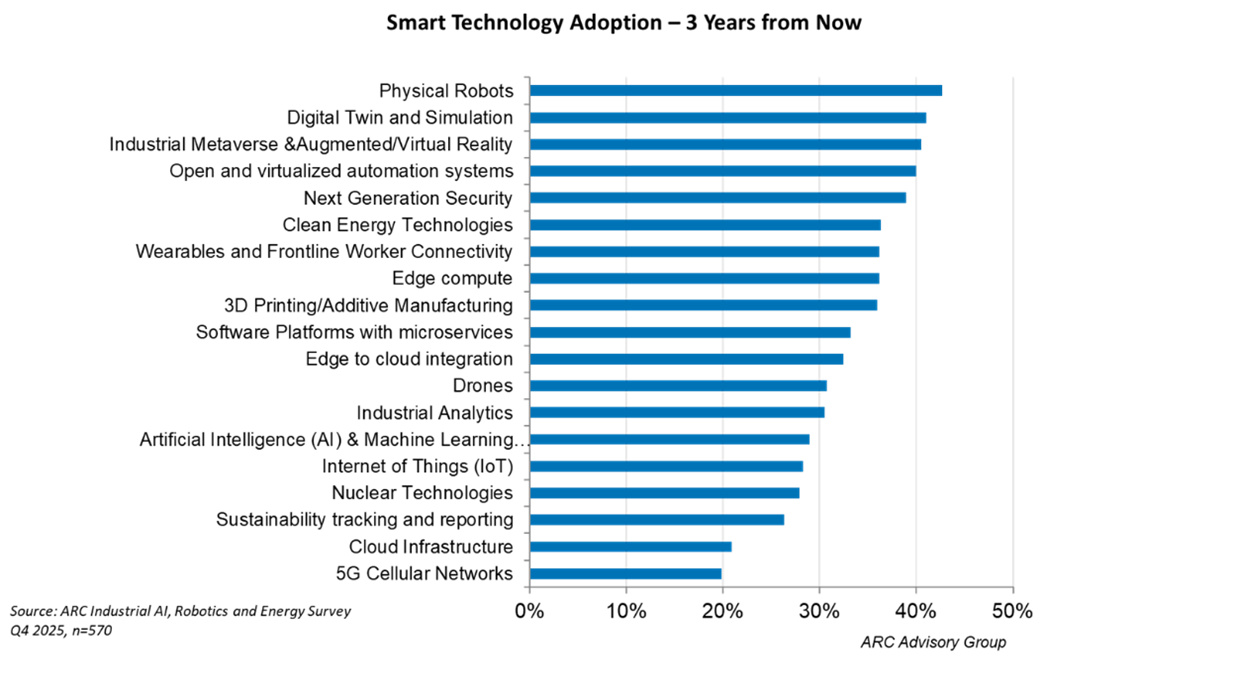
For decades, industrial automation has centered on special-purpose machines like fixed robotic arms and conveyors meticulously engineered to perform one task in one place with extreme efficiency. These systems excel at repetitive, predefined processes like welding a car door or packaging identical goods, but they lack utility when the script changes. Traditional robots lack flexibility. They can’t easily adapt to new product shapes, unexpected part positions, or tasks that lie beyond their narrow program. As a result, many factories still rely on human labor for all the “last-mile” tasks: the variable, unstructured jobs that fixed automation can’t do, such as picking mixed items, kitting parts for assembly, or responding to anomalies.
This lack of adaptability has become a glaring limitation. Competitive advantage today requires fast reconfiguration of production lines and warehousing workflows. Product lifecycles are shorter, demand is more volatile, and mass customization means factories handle a wider variety of processes. The time and cost to reengineer traditional automation for each change is untenable. Even in heavy manufacturing, brownfield sites, or existing plants, cannot be endlessly rebuilt to accommodate every new robot cell. The pressing need is for systems that are able to work in human-designed environments and pivot between tasks without months of programming or facility modifications. This is exactly the gap that humanoid robot manufacturers aim to fill.
Industrial plants and warehouses have been built around human workers for generations. Stairs, doorways, tools, and workstations have all been sized for people. Instead of reconfiguring these environments for machines, why not create robots that can use the same tools and spaces as humans? That’s the promise of humanoid machines: anthropomorphic designs, typically with a torso, two arms, and either legs or a mobile base, that can literally step into tasks a person would do.
The value of such an approach, if done successfully, is obvious. A humanoid robot can potentially open a door, climb a ladder, operate machinery, or use a power tool, leveraging the exact infrastructure and interfaces already present. No extensive reconfiguring is needed. A humanoid robot’s shape should not just be cosmetic; it’s a functional choice to make the robot more universally applicable to the problems that need solving.
Human-like mobility means these robots aren’t confined to a single workstation. They can move about a facility, traveling wherever needed. This mobility is crucial in settings like logistics and warehousing, where tasks are dispersed and change location frequently. Until now, automating such dynamic, unstructured tasks was nearly impossible. But a robot that can navigate a warehouse floor and manipulate objects of varying sizes, much like a person would, opens the door to automating a whole new class of activities.
However, just because it is possible to automate a legacy task exactly as humans did it doesn’t mean that task is still worth doing that way. Industry leaders should resist using advanced robots to preserve outdated workflows. Instead, they should treat every humanoid deployment as a chance to rethink and redesign how work gets done. The goal is to leverage these new capabilities to improve processes or eliminate wasted effort, not simply to mechanize existing inefficiencies.
If the need for flexible automation explains the “why” of humanoid robots, the advances that make them possible help to explain the “why now.” The past few years have seen simultaneous breakthroughs in the three fundamental domains of robotics: what ARC calls the Body, Nervous System, and Brain of an intelligent robot. These correspond to the physical machinery, or mechanical body; the sensing and control networks, or nervous system; and the AI-driven software, or brain, that together give a robot “physical intelligence.”
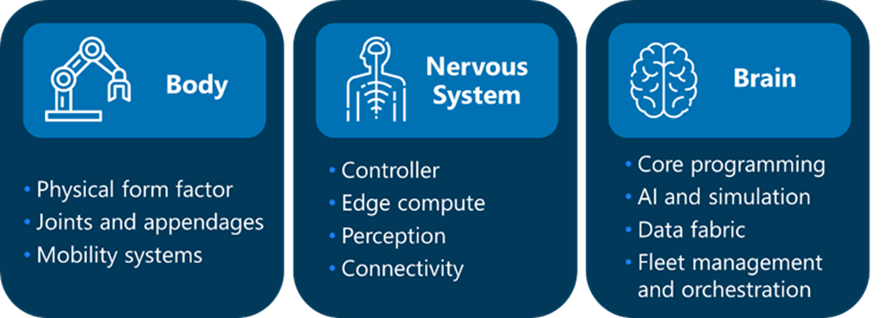
Better Bodies: The robotic hardware itself, including motors, materials, and batteries, has improved significantly. New actuators and joints offer improved dexterity and strength combined with greater energy efficiency compared to past robots. For instance, modern humanoid prototypes employ torque-controlled joints and lightweight composites, enabling fluid motion without excessive power draw. Importantly, battery technology now supports hours of untethered operation, and hot-swappable or rapid-charging systems promise high uptime. Ruggedized designs with industrial-grade frames and components ensure these robots can handle the wear and tear of factory duty.
A More Efficient Nervous System: Today’s humanoids are built on a backbone of high-speed connectivity and local compute that simply wasn’t feasible 10 years ago. Industrial wireless networks, including private 5G on factory floors, allow robots to remain in constant, low-latency contact with control systems while roaming freely. Edge computing advances mean a robot can carry a supercomputer onboard. Specialized AI chips, like NVIDIA’s Jetson and others, enable real-time perception and control, processing sensor data on the robot itself instead of waiting on an outside connection. This “nervous system” of sensors, networks, and controllers allows a humanoid robot to sense its environment in detail and coordinate complex motions with reliability and safety, even in dynamic environments. As a result, a modern robot can detect an obstacle and stop or reroute within milliseconds, or adjust its grip if a part isn’t where expected—capabilities far beyond the blind, caged robots of the past.
An Intelligent Brain: The AI and software controlling robots have leaped forward, granting these machines a form of cognitive ability. Machine vision algorithms powered by deep learning allow humanoid robots to identify objects, read human visual cues like gestures and signals, and navigate complex scenes. Reinforcement learning and digital simulation, or “sim-to-real” training, let robots practice tasks virtually and learn optimal strategies before they even touch a real object. Natural language interfaces are emerging, so a technician might one day verbally instruct a robot to “go retrieve part X from that shelf,” and the robot’s cognitive “brain” will interpret, plan, and execute the multistep task. Increasingly, robotic assets connect with data fabrics and enterprise intelligence platforms to gain context and update tasks.
Crucially, these three domains have advanced in concert. Robots have become physically durable, flexible, perceptive, and smart all at once. This phenomenon is why a functional industrial humanoid is possible now, while the trials of a decade ago came up short.
Even with the advancements in the technology stack, market pull is required to trigger a significant uptick in humanoid robot deployment. Several strategic forces are pushing companies to explore humanoid robots:
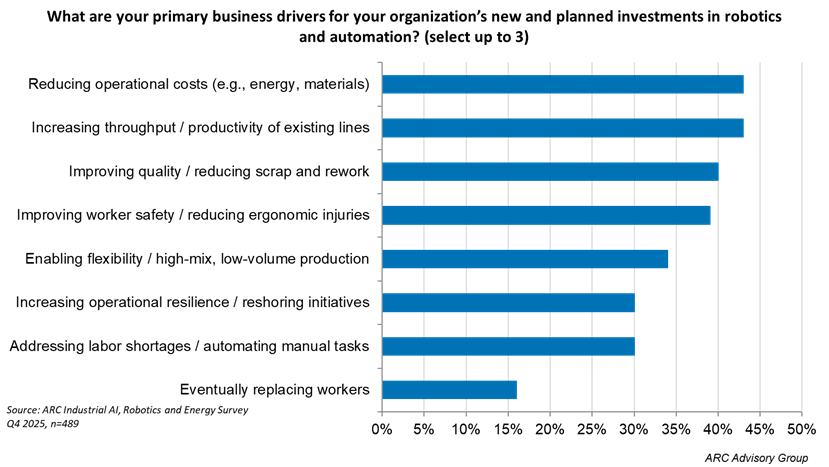
Flexibility and ROI Pressure: In an era of intense global competition, manufacturers seek efficient automation that doesn’t sacrifice flexibility. Capital expenditure decisions increasingly weigh the total cost of ownership and adaptability of solutions. Humanoid robots are compelling because they are generalists. A humanoid robot could potentially handle multiple different assignments in a facility. If achieved, this physical version of the old software adage “code once, use everywhere” could offer attractive value to owners by continuing to work while fixed machinery becomes idle or obsolete when tasks change.
Safety and Resilience: Humanoid robots promise to improve workplace safety by handling hazardous or ergonomically taxing tasks. A robot can inspect machinery in a hazardous area or lift heavy objects all day without fatigue, removing humans from harm’s way.
Labor Shortages and Skills Gaps: Across manufacturing and logistics, a workforce crunch is accelerating automation plans. Baby Boomer retirements, a scarcity of skilled trades workers, and declining interest in repetitive manual jobs have created a critical manpower gap. In ARC’s view, the goal is augmentation, not wholesale replacement: AI won’t replace people, but people augmented with AI will replace people without AI. In practical terms, humanoid robots offer a compelling way to complete “dull, dirty, and dangerous” tasks, extending the reach of current employees and helping industrial firms decouple their productivity from labor availability.
All these drivers are reinforcing each other to create the moment we are seeing today. The result is that humanoid robots are becoming a tangible new tool for industry. ARC views this moment as a strategic inflection point. The question is no longer “can it be done?” but rather “how will this change our operations?” Manufacturing and supply chain leaders would be wise to start planning for the role of intelligent robots, including humanoids, in their strategic roadmaps.
It’s important to maintain perspective: industrial humanoid robots are still in the early stages. Many challenges remain, including improving reliability, safety, and governance; scaling up the manufacturing output of humanoid robots to meet demand; and pairing new advancements with the right business cases. However, the confluence of matured technologies and urgent business needs suggests that humanoid robots are here to stay and will only grow more capable.
This post is Part 1 of a 3-part series on industrial humanoid robotics. Stay tuned for Part 2, which will explore the ecosystem of early movers, partnerships, and the emerging value chain making humanoid robots a reality in industry.