Representative End User Clients







Representative Automation Clients







Representative Software Clients









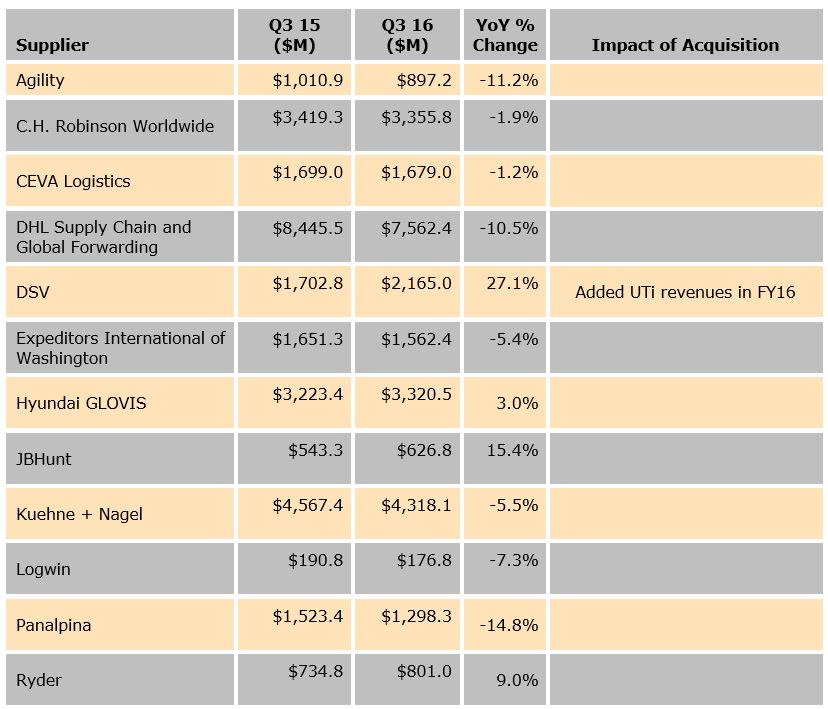
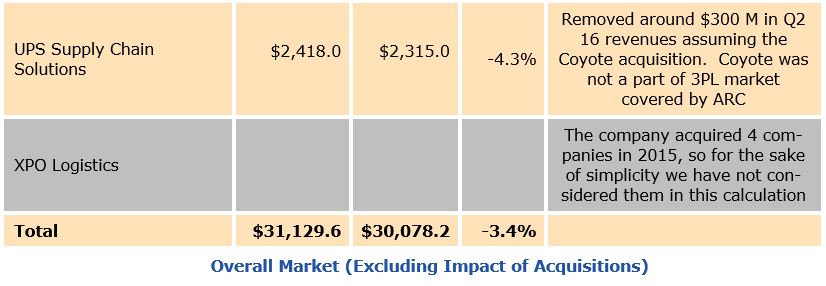
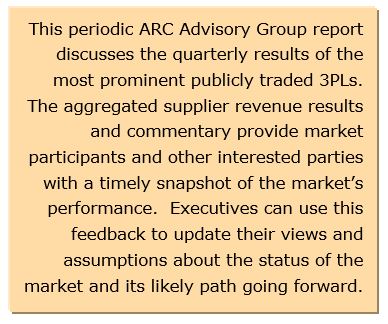 The third-party logistics (3PL) market − encompassing non-asset-based transportation, warehousing, and integrated supply chain services − experienced a year-over-year growth of 1.8 percent in revenues in the third quarter of 2016; we have the 3PL market shrinking. The growth was mainly driven by acquisitions. Organic growth (without the effect of acquisitions) declined in all three quarters of FY2016 - by 8.9 percent in Q1, 6.9 percent in Q2, and 3.4 percent in Q3. This decline is mainly due to uncertain global economic environment especially in Europe, lower cost of transportation, and the continuous pressure on fuel rates.
The scope of coverage includes non-asset based transportation, and warehousing services (called contract logistics in Europe) as follows:
Out of this report’s scope are revenues from asset-based transportation moves (truckload, less than truckload, parcel/express, rail, ocean, air, etc.). The analysis is based on revenues reported by public companies on a quarterly basis that break out their revenues in the segments mentioned above. If asset-based moves and non-asset based moves are reported in the same category, but more than half of revenues come from asset-based moves, they are excluded. If asset-based moves and non-asset based moves are reported in the same category but more than half of revenues come from non-asset based moves, they are included.
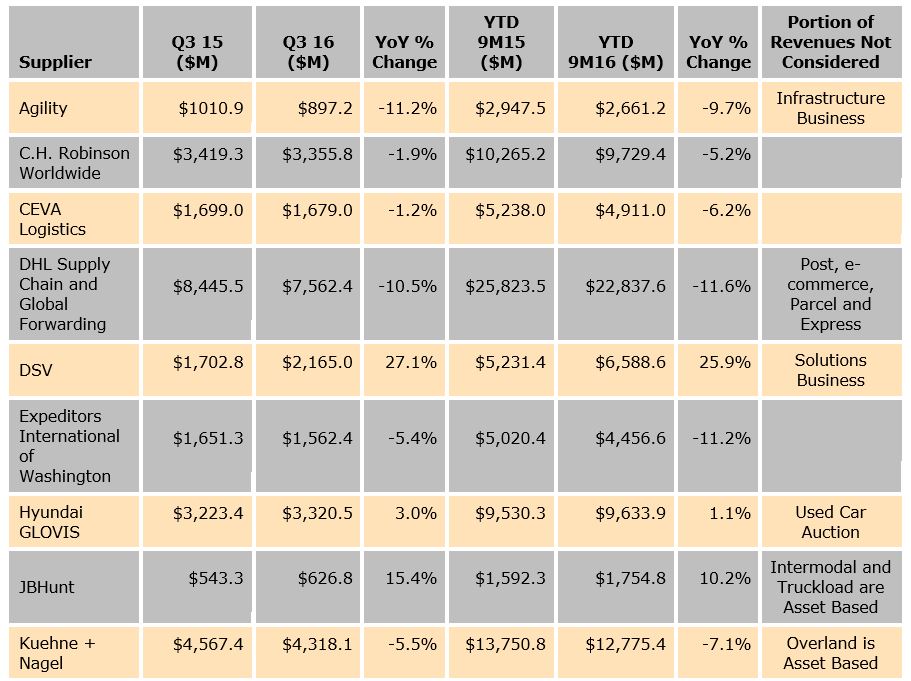
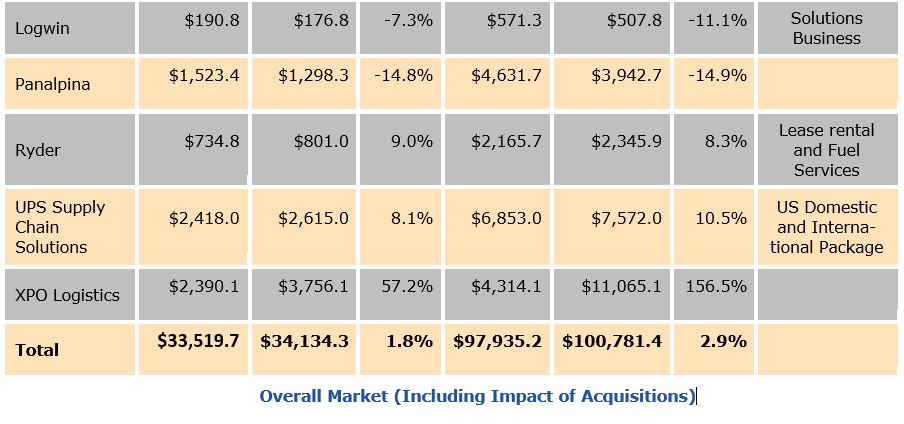
The tables on the next pages compare Q3 2015 with Q3 2016 and YTD 2015 with YTD 2016 in terms both of non-organic, and organic growth, respectively. Additionally, the tables highlight the growth rates during the quarter and the year and share the details of the portion of revenues not covered in the report. Some other noteworthy modifications from Q3 2015 include:
When analyzing organic growth, it’s necessary to make certain assumptions (explained in the column titled “Impact of Acquisition”) with which all parties might not fully agree. Unfortunately, this cannot be avoided and it’s important to keep in mind that the goal of this analysis is not to report on how individual companies are doing, but to show whether the 3PL market is continuing to grow organically. Based on the available data and the aforementioned assumptions, ARC estimates that, in terms of organic growth, the market has shrunk by 3.4 percent. While some parties might argue with this specific percentage, it’s absolutely clear that the market is doing very poorly.
This ARC Advisory Group report discusses the most recent quarterly revenue results of the most prominent publicly traded 3PLs. We translate financial results reported in foreign currencies to US dollars using an average exchange rate for the given reporting period. Owing to this translation, some companies may show negative growth. The suppliers’ reporting period for this analysis is the quarter ending in September, unless stated otherwise. We have considered the consolidated revenues for all vendors, which includes revenues of its subsidiaries.
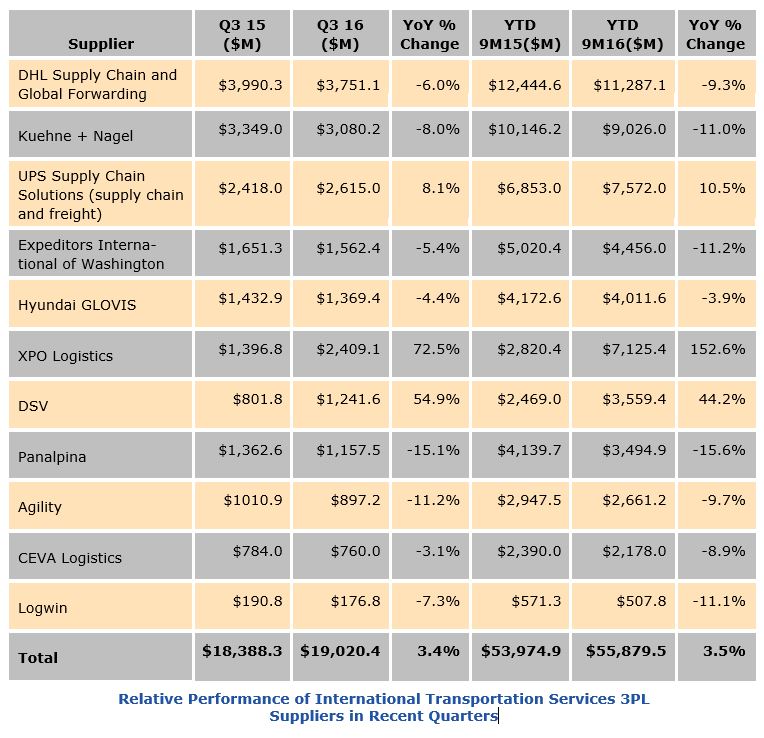
This segment includes revenues from international freight forwarding, and custom services. This segment witnessed year-over-year increase of 3.4 percent in reported revenues. By not considering XPO and adding impact of acquisition on UPS and DSV, this segment declined by 3.5 percent in q-o-q revenues. Non- asset based International segment accounts for 55.7 percent of the total considered revenues for 3PLs. Major 3PLs in this category are:
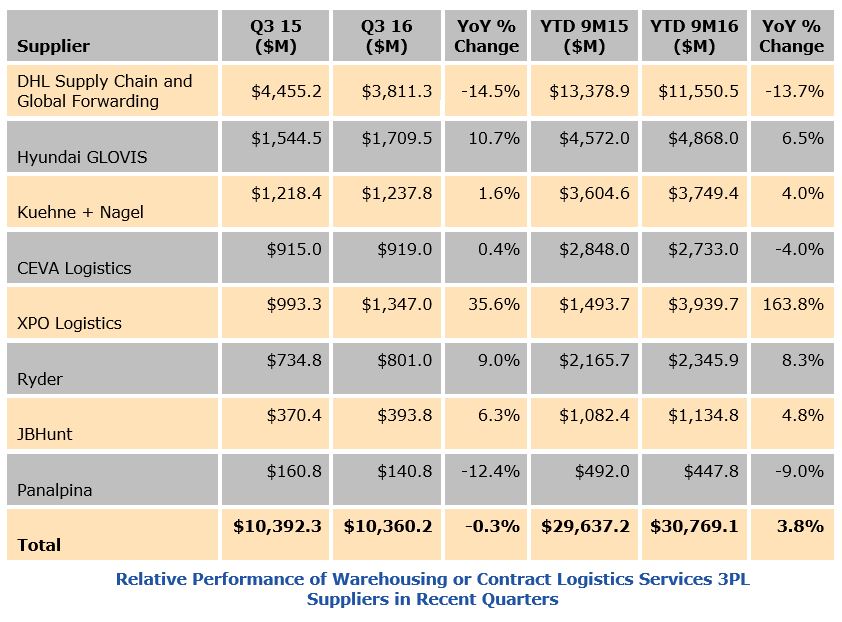
This segment consists of revenues from warehousing and other value-added services like packaging, light assembly, sequencing goods for a factory line. This segment witnessed year-over-year decline of 0.3 percent as reported. Excluding XPO from the list, the segment witnessed a decline of 4.1 percent. Contract Logistics or warehousing services is the second largest market segment and accounts for 30.4 percent of the total considered revenues for 3PLs. The following table includes the major 3PLs in this category.
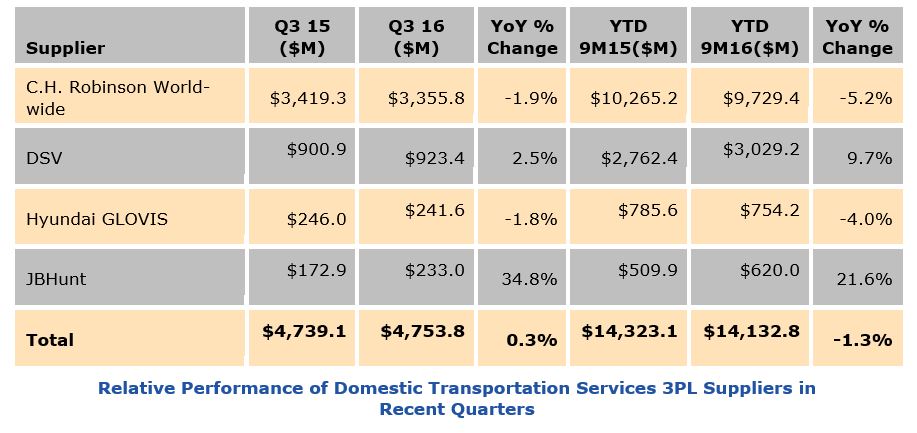
This segment includes revenues from brokerage /domestic freight forwarding, and managed transportation services. This segment witnessed year-over-year increase of 0.3 percent as reported. The domestic transportation services segment accounts for 13.9 percent of the total considered revenues for 3PLs. The following table includes the major 3PLs in this category.
Agility reported revenue of approximately $897.2 million for the quarter ending September 30, 2016 from its Global Integrated Logistics (GIL) business. This represents a decrease of 11.2 percent compared to the same period in the prior year. Company management said that the main impact to revenue shortfall remains in the general slowdown in Project Logistics business as a result of the slowdown in the oil and gas market.
C.H. Robinson reported total revenue of $3.3 billion, representing a decline of 1.9 percent year-over-year. C.H. Robinson reports its revenues as sourcing and transportation. Transportation services are further a combination of truckload, LTL, Intermodal, air, Ocean 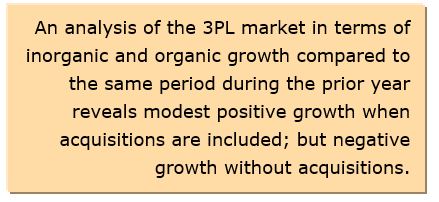 Customs and other logistics services. Transportation revenues declined by 1.5 percent for Q3 16. The decrease was due to lower cost of transportation, including fuel, partially offset by higher volumes. Also, Sourcing revenues also declined by 4.7 percent in the third quarter of 2016.
CEVA reported revenue of over $1.6 billion for the three months ended September 30, 2016, down 1.2 percent year-over-year. Revenue in the freight management segment for the three months ended 30 September 2016 declined by 3.1 percent compared to the same period last year. The decline was mainly due to low rate environment, which was in turn due to the continuous pressure on fuel rates as well as the increase in carrier capacity relative to market demand and depressing market prices. Revenue in contract logistics increased by 0.4 percent.
DHL reported revenue of $7.5 billion from its global freight forwarding and supply chain segments. This represents a decline of 10.5 percent from the same period the previous year. The company reported a decline of 6.0 percent in the freight forwarding (non-asset international) segment and 14.5 percent in supply chain (contract logistics). In the freight forwarding segment, the decline in revenues was due to lower fuel surcharges and generally low level of air and ocean freight rates. In the supply chain area, the decline was due to change in revenue recognition with the UK National Health Service (NHS) as a result of revised contract. The company did not get major advantage from the strengthening euro.
DSV reported $2.1 billion revenues for Q3 16. This represents an increase of 27.1 percent in revenues compared to the same period last year. Air and sea freight saw an increase of 54.9 percent and road freight also saw an increase of 2.5 percent compared to the same period previous year. The increase in revenues was mainly driven by the UTi acquisition.
Expeditor reported revenue of $1.5 billion. This represents a decline of 5.4 percent over Q3 15. The revenues consist of airfreight, ocean freight, ocean services, custom brokerage, and other services. The decline was due to uncertain global economic environment especially in Europe and continuing slow trade. Low ocean container volume also added to the decline.
Hyundai Glovis reported $3.3 billion which is an increase of 3.0 percent compared to the same period prior year. Domestic logistics declined by 1.8 percent, while international logistics declined by 4.4 percent. The contract logistics portion consists of CKD (complete knock down) and other distribution revenues saw an increase of 10.7 percent with over $1.5 billion revenue.
JBHunt reported $626.8 million, an increase of 15.4 percent from the same period the previous year. Dedicated Contract Services (DCS) revenues reported were $393.7 million; up 6.3 percent because of better integration of assets between customer accounts, fewer unseated trucks, increased customer supply chain fluidity and customer rate increases. Integrated Capacity Solutions (ICS) reported revenue of $233.0 million; an increase of 34.8 percent.
Kuehne Nagel reported revenue of $4.3 billion revenues. This is a 5.5 percent decline from the same period last year. The revenues consist of sea freight, air freight, and contract logistics. Sea freight revenues of Kuehne + Nagel declined by 13.6 percent and airfreight declined by 9.8 percent. This decline was due to lack of growth in global trade. In the global airfreight market, shrinking demand and excess capacity resulted in margin pressure. The contract logistics segment witnessed an increase of 1.6 percent due to successful implementation of new business and expansion in pharma and e-commerce fulfilment.
The Logwin Group reported revenue of $176.8 million, a decline of 7.3 percent from the same period the previous year in the air-ocean segment of the business. Though there was favorable volume growth in both air and ocean freight against an overall slow market environment, the decline in revenues was mainly due to low freight rates and negative foreign exchange effects.
Panalpina reported revenues of $1.2 billion revenues, which is a decline of 14.8 percent compared to the same period previous year mainly due to prolonged downturn in oil and gas sector. Panalpina’s air freight revenues declined by 4.1 percent in the third quarter. According to management, the slowdown of growth was mainly due to lower per-ton cost. Ocean freight revenues declined by 25.9 percent year-over-year mainly due to lower volumes in oil and gas and managed solutions. Logistics product revenues also declined by 12.4 percent.
Ryder recorded revenue of $801.0 million, an increase of 9.0 percent compared to the same quarter the previous year. Services revenue increased due to new business, increased volumes, and higher pricing in the Supply Chain Solutions (SCS) and Dedicated Transportation Solutions (DTS) segments. The contract-related maintenance and contract maintenance product lines benefited from growth in fleet size, and contract-related maintenance revenue also increased from higher volumes. These increases were partially offset by lower fuel prices passed through to the DTS and SCS customers.
UPS Supply Chain and Freight recorded revenue of $2.6 billion, an increase of 8.1 percent compared to same period previous year. Revenue growth was primarily due to the acquisition of Coyote Logistics. Weak market conditions in the Air Freight Forwarding and LTL (less than truckload) markets weighed on top-line growth.
According to the management market, conditions in International Air Freight and the U.S. truckload brokerage industries remain soft. Despite these conditions, company saw increased loads in Coyote Logistics. The Forwarding business experienced tonnage growth in the Ocean and North American Air Freight products, partially offsetting the decline in International Air Freight tonnage.
XPO recorded revenue of $3.7 billion, an increase of 57.2 percent compared to same period the previous year. Transportation revenues were at $2.4 billion for the quarter, a 72.5 percent increase from the same period in 2015. Logistics revenues totaled $1.3 billion, compared to $993.3 million in Q3 15. The year-over-year increase in revenue was primarily due to the acquisitions of Norbert Dentressangle, Con-way, Bridge Terminal Transport, and UX Specialized Logistics, and also due to organic revenue growth led by the last mile and freight brokerage businesses.
The 3PL market continued to decline in Q3 in terms of organic growth. Almost all the 3PLs witnessed significant decline in Q3 2016 compared to the same period last year. The ones witnessing growth made significant acquisitions during FY 2015. Though some currencies show signs of revival against the US dollar, other reasons for decline are slow global trade, soft market environment in air and ocean freight, oil prices, and volatile rates. ARC Advisory Group expects the situation to continue unless the global trade market picks up which seems less likely in near future as per the predictions of the WTO.
If you would like to buy this report or obtain information on how to be-come a client, please contact us
Keywords: Third-Party Logistics (3PL), Contract Logistics, Non-Asset Based Domestic, Non-Asset based International, Freight Forwarding, ARC Advisory Group.