Representative End User Clients







Representative Automation Clients







Representative Software Clients









Keywords: Circular Economy, Sustainability, Decarbonization, Technology, Green Supply Chain, Automation, Plastic Recycling
As governments enforce stricter regulations and push industries to adopt a more circular approach, companies are forced to redesign their products in order to minimize waste, maximize reutilization, and increase the percentage of recycled materials. According to OECD, the use of secondary plastics are expected to have a high growth in the upcoming years. On the other hand, the industry is facing technological challenges related to product design, advanced recycling plants automation and optimization, and reliable value chains.
To address this complex challenge, ARC has explored the requirements of the market and mapped it with the solutions that leading automation companies are providing. The aim of this research is to understand how well these companies are fulfilling the need to enable the scalability of a circular economy.
After analyzing more than 15 companies, we focused on the 10 companies showing more capabilities to support the circular economy. As a result of the study, Siemens was identified as one of the leaders in the market. The company provides solutions to reduce waste by design, automation solutions for advanced recycling facilities, and digital tools for green supply chains. This document includes a description of the Champions Radar and a deep dive into Siemens solutions.
The objective of Champions Radar is to map the solutions offered by providers to address specific market demands. Its goal is to evaluate how effectively these solutions meet market needs. This research provides valuable insights for both end users and solution providers.

For end users, it identifies market leaders capable of addressing their specific requirements. By leveraging the research findings, end users can pinpoint potential providers that align closely with their unique needs.
For solution providers, the Champions Radar offers a different kind of value. It provides a comparative analysis, highlighting their strengths and weaknesses in relation to competitors. Additionally, it identifies opportunities for growth and market expansion.
The research began with engaging end users to discuss their specific challenges. We explored their perspectives, the obstacles they are facing, and the solutions they currently use or are seeking.
The next step involved mapping market needs to the value propositions offered by solution providers. This included researching the hardware, software, and services they offer, as aligned with the insights gathered from end users. We reached out to solution providers to discuss the information we gathered.
Finally, we created the Champions Radar by evaluating each solution against indicators defined in collaboration with end users. These indicators consider solution capabilities, provider experience, and revenue, resulting in a comprehensive and actionable analysis.
The research on plastic circularity covered technological topics that are relevant according to the interviews we held with end users. It includes solutions related to product design, process and energy optimization, automation and supply chain as key aspects to support the industry in plastic circularity.
Major automation companies were considered in the analysis by exploring their value proposition in terms of what hardware, software, and services they provide to the industry.
As part of the study result, Siemens was identified as one of the leaders in the industry. The company provides solutions across the different use cases discussed with end users. Siemens Product Lifecycle Management software solutions is already recognized as one of the leaders in the industry, and it is the reason behind the largest revenue size in the chart. Siemens also provides advanced solutions for plant automation and supply chain software. Further, Siemens partners with leading technology providers specialized in advanced (i.e., chemical) recycling, including Pyrum Innovations, Eurex Energy, Enviro Systems, Plastic Energy and Arcus Greencycling.

Siemens offers an integrated portfolio of solutions to support companies across the plastic circularity value chain—from sustainable product design to efficient manufacturing, electrification, and supply chain management. These solutions not only help the industry to adopt more circular and sustainable practices, but also enable chemical recycling businesses to validate, equip, and scale their processes effectively.
Siemens Product Lifecycle Management (PLM) software, including Teamcenter, enables companies to design innovative, sustainable products with a lower carbon footprint. Teamcenter, recognized as a leading PLM solution, facilitates collaboration across teams and suppliers, ensuring accurate product data and efficient workflows. With digital twins and simulation capabilities, Siemens PLM helps companies evaluate environmental impacts throughout the product lifecycle.
Siemens provides advanced process modeling tools, including Digital Process Twins based on gPROMS simulation software, to support innovation and efficiency across the product lifecycle. This high-fidelity simulation technology enables companies to accelerate digital R&D, particularly in designing more sustainable products with a higher share of recycled materials. Engineers can predict how these materials will behave under varying conditions—such as changes in temperature or pressure—and fine-tune product formulations early in development.
In process design and optimization, gPROMS helps manufacturers adapt existing processes to accommodate recycled content. For example, when switching to materials with different properties, users can simulate and optimize parameters like mixing speeds, impeller types, and temperature profiles to maintain high product quality. This reduces trial-and-error in the lab or plant, cutting waste and energy use.
Siemens offers comprehensive Advanced Process Control (APC) services, including process analysis, controller optimization, and turnkey engineering solutions. The SIMATIC PCS 7 DCS features embedded APC applications, providing closed-loop control for more efficient processes.
Siemens offers the SIMATIC Energy Management Suite to support energy optimization at both the company and machine level. By capturing real-time energy data, it helps identify inefficiencies, lower consumption, and drive sustainability.
Complementing this, Siemens provides advanced switchgear solutions like the SIVACON S8, a modular low-voltage system known for its safety and flexibility. Together, these tools enable efficient and reliable energy management across operations.
Siemens provides two DCS systems: The well-established SIMATIC PCS 7 DCS, and its successor, the entirely web-based SIMATIC PCS neo DCS which relies on new forms of digital collaboration. Both DCS systems share a common hardware platform and offer embedded solutions for integrated engineering and operations, including seamless integration with Siemens’ COMOS, SIMIT, and gPROMS tools for virtual commissioning, process simulation and operator training. APC, remote operation and energy management are embedded functionalities.
Reliable measurements are key to seamlessly controlling processes. A comprehensive portfolio of process instrumentation and analytics, enriched with soft-sensing solutions, ensure smooth operations and compliance with regulations.
Siemens Digital Logistics solutions help companies transform their supply chains. Through the Digital Logistics platform, companies can efficiently plan, execute, and optimize their logistics networks. This solution addresses challenges such as raw material bottlenecks and procurement risks by enabling real-time tracking, predictive analytics, and efficient inventory management.
With these solutions, Siemens empowers companies in the plastic circularity industry to reduce their carbon footprint, increase process efficiency, and build sustainable, resilient operations.
Siemens collaborates with a range of technology partners to help companies in the advanced recycling sector validate, implement, and scale their processes efficiently. These partnerships bring together digitalization, automation, and process expertise to accelerate the transition toward a more circular and sustainable industry.
One example is Siemens’ partnership with Plastic Energy, a company that specializes in chemical recycling of end-of-life plastic waste. By integrating Siemens’ automation and digital solutions, Plastic Energy can monitor and optimize plant performance, improve safety, and ensure consistent product quality as they expand their operations globally.
Siemens also supports Eurex Oil, which focuses on converting plastic waste into high-quality oil products. With Siemens’ advanced control systems and data analytics tools, Eurex Oil benefits from increased process reliability and transparency—critical factors for scaling up innovative recycling technologies.
In the field of tire recycling, Siemens works with Scandinavian Enviro Systems, a pioneer in recovering valuable materials such as carbon black and oil from used tires. Siemens provides tailored digital and automation solutions that help streamline operations and ensure precise control over complex pyrolysis processes.
Another notable collaboration is with Pyrum Innovations, which also specializes in end-of-life tire recycling. Siemens’ technologies enable Pyrum to standardize and replicate its plants with a high degree of automation and digitalization, supporting its international growth strategy.
These collaborations demonstrate how Siemens empowers advanced recycling innovators to turn complex ideas into scalable, efficient industrial solutions—bridging the gap between technology and sustainability.
Companies are increasingly investing in and developing recycling technologies, signaling a growing interest in the circular economy. According to the OECD, utilization of secondary plastic has been steadily rising over the past two decades. However, recycled resins still account for just 9 percent of global plastic production as of 2021. Mechanical recycling dominates, representing around 90 percent of global processing capacity, while bio-based recycling accounts for 7 percent and chemical recycling is a small but growing segment, making up only 0.8 percent of the total.
The volume of utilization of recycled plastic is expected to increase significantly in the coming years, with forecasts suggesting a growth of between 4.5 percent and 7.4 percent over the next 10 years.
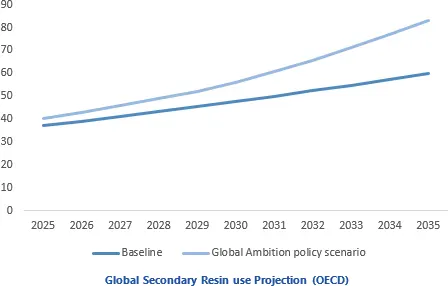
There is a clear business opportunity related to plastic circularity in the coming years. Governments are driving the industry toward a more circular approach, encouraging companies to rethink product designs, improve transparency, and increase the use of recycled materials. This creates new opportunities for solution providers with the right tools to enable the industry to scale at the required pace.
Siemens has shown that it can play a key role in helping companies tackle the technological challenges they are facing to reduce waste, test new designs, optimize processes in advanced recycling and create green value chains.
ARC Advisory Group clients can view the complete report at the ARC Client Portal.
Contact Us if you would like to speak with the author.
Obtain more ARC In-depth Research Market Analysis.