Representative End User Clients







Representative Automation Clients







Representative Software Clients









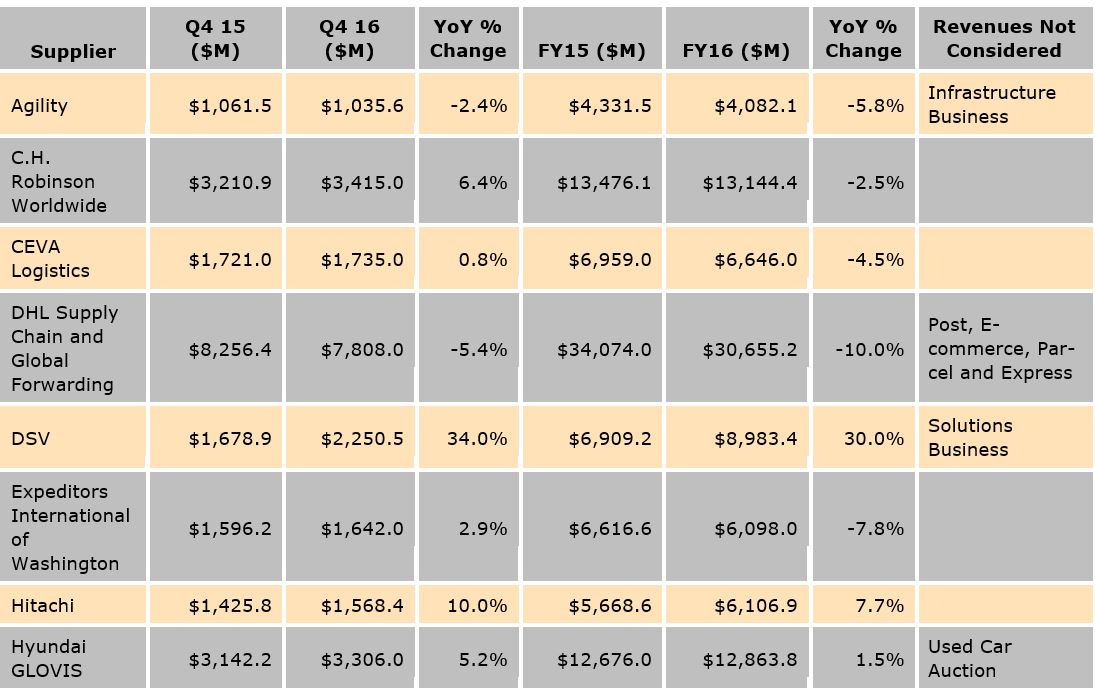
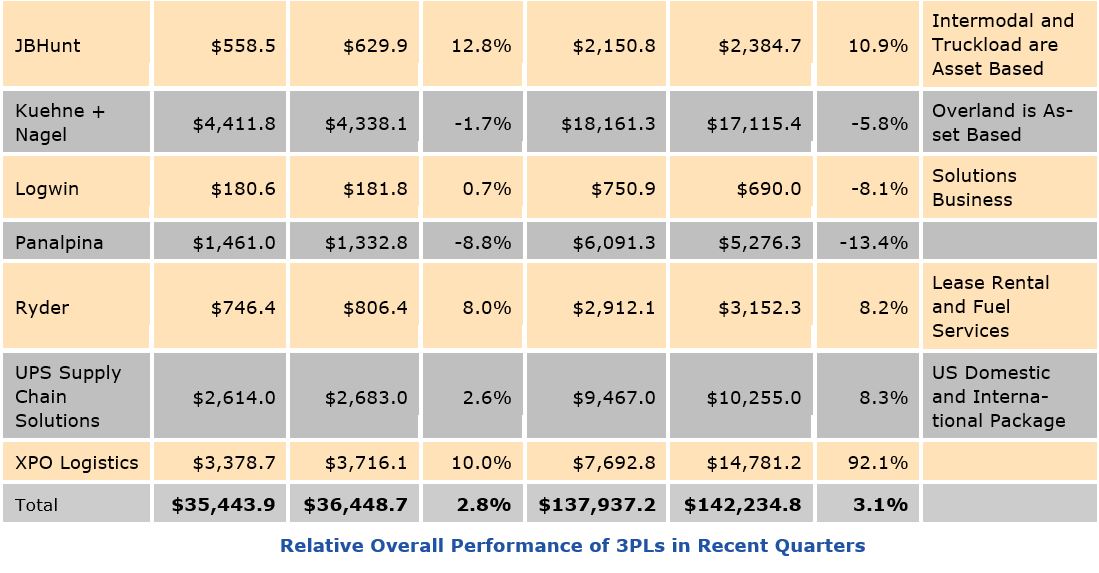
The third-party logistics (3PL) market experienced a year-over-year growth of 2.8 percent in revenues in the fourth quarter of 2016. This 3PL market growth was primarily driven by acquisitions. Organically, the 3PL market grew by 0.7 percent in Q4 2016 but 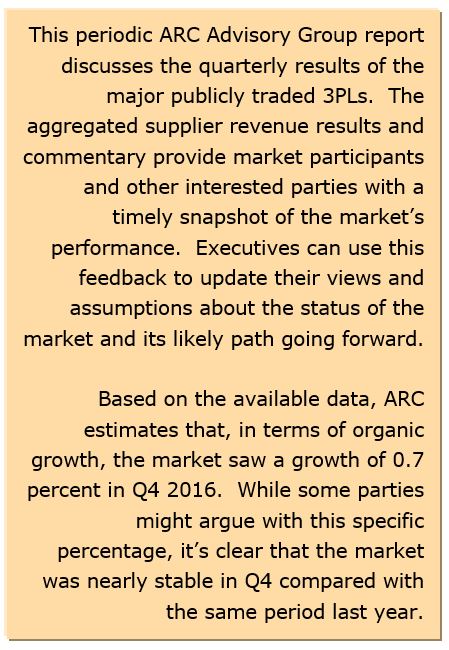 declined by 5.3 percent for the entire fiscal year.
ARC’s scope of coverage for the 3PL market includes the following non-asset-based transportation and warehousing services (called “contract logistics” in Europe):
Note that in cases in which asset-based transportation moves (truckload, less than truckload, parcel/express, rail, ocean, air, etc.) and non-asset-based moves are reported in the same category - but more than half of revenues come from non-asset-based moves - we have included those revenues.
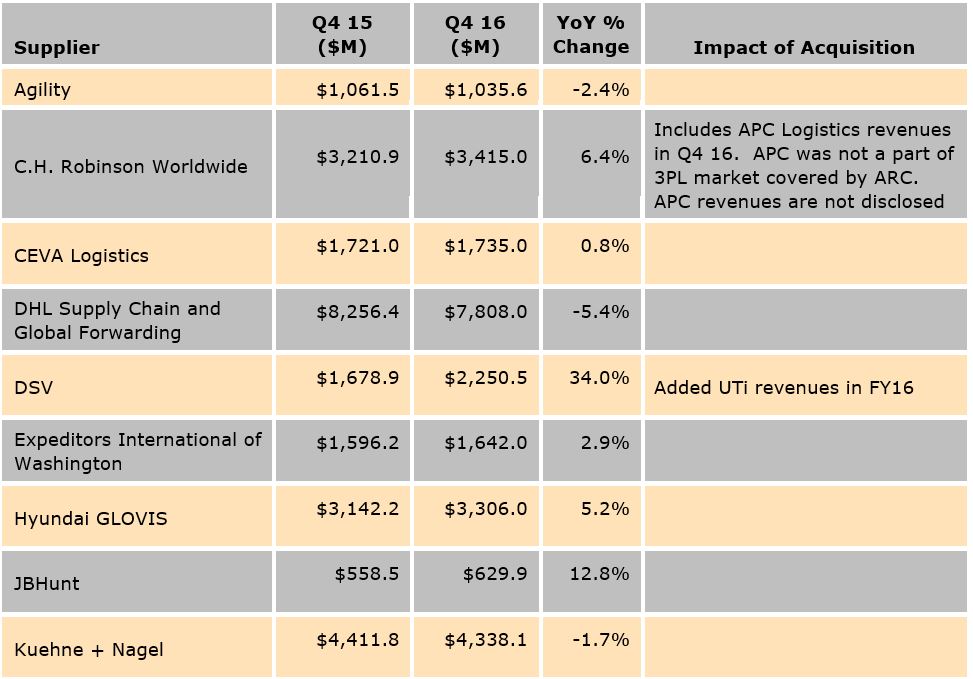
Some noteworthy adjustments from Q4 2015 include:
Unfortunately, when analyzing organic growth, it’s necessary to make certain assumptions with which all parties might not fully agree. While this cannot be avoided, it’s important to keep in mind that the goal of this analysis is not to report on how individual companies are doing, but to show whether the 3PL market is growing organically.
Based on the available data, ARC estimates that, in terms of organic growth, the market saw a growth of 0.7 percent in Q4 2016. While some parties might argue with this specific percentage, it’s clear that the market was nearly stable in Q4 compared with the same period last year.
This ARC Advisory Group report discusses the most recent quarterly revenue results of the major publicly traded 3PLs. ARC translates financial results reported in foreign currencies to US dollars using an average exchange rate for the given reporting period. Owing to this translation, some companies may show negative growth. The suppliers’ reporting period for this analysis is the quarter ending in December, unless stated otherwise. ARC considered the consolidated revenues for all vendors, which includes revenues of its subsidiaries.

This segment includes revenues from brokerage/domestic freight forwarding and managed transportation services. The segment experienced a year-over-year increase of 8.7 percent during the fourth quarter and a 3.1 percent increase during the year. The domestic transportation services segment accounts for 18 percent of the total considered revenues for 3PLs during the quarter and 17.8 percent during the year. The following table looks at the major 3PLs in this category.

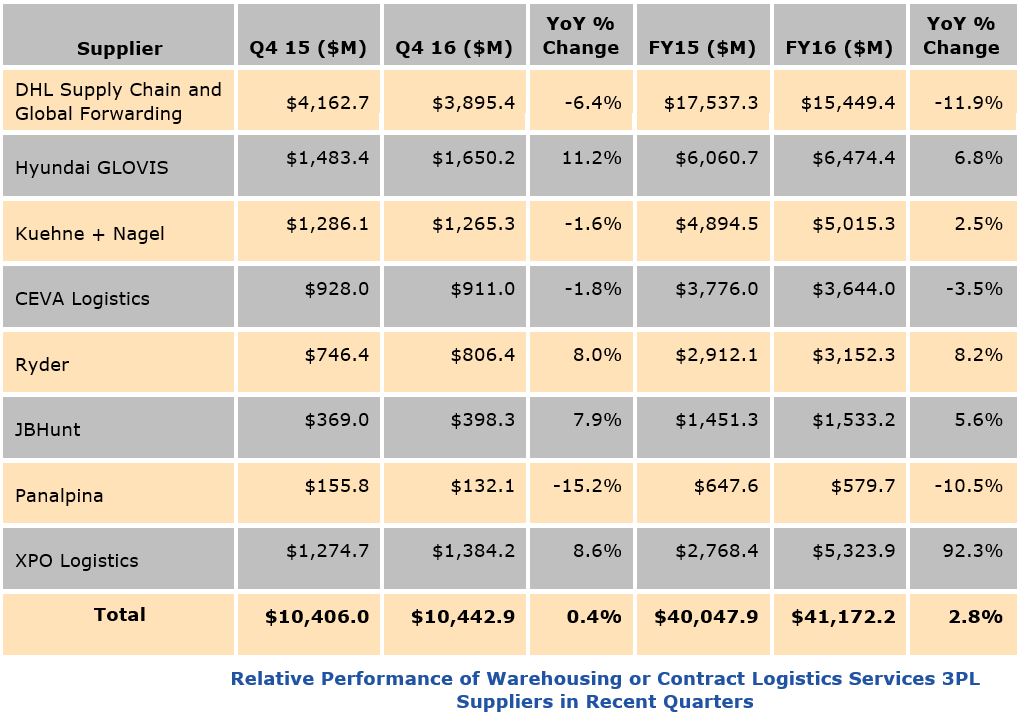
This segment covers revenues from international freight forwarding and custom services. The segment witnessed a year-over-year increase of 2.3 percent during the fourth quarter and 3.3 percent increase during the year. Non-asset-based international segment accounted for 53.4 percent of the total considered revenues for 3PLs during the quarter and 53.2 percent during the year. The following table looks at the major 3PLs in this category.

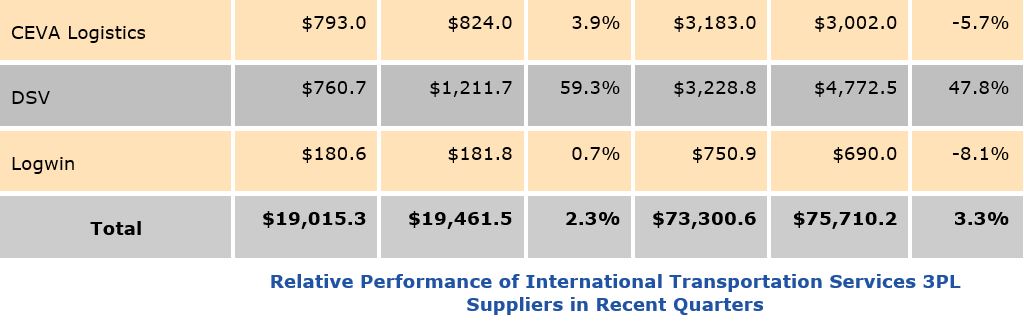
This segment consists of revenues from warehousing and other value-added services, such as packaging, light assembly, and sequencing goods for a factory line. The segment witnessed a year-over-year growth of 0.4 percent for the quarter and an increase of 2.8 percent for the year. Contract logistics or warehousing services is the second largest market segment and accounts for 28.7 percent of the total considered revenues for 3PLs during the quarter and 28.9 percent during the year. The following table looks at the major 3PLs in this category.
Agility reported revenue of slightly over $1 billion from its Global Integrated Logistics (GIL) business for the fourth quarter. This represents a decline of 2.4 percent compared with the same period the previous year. The company reported a decline of 2.2 percent in its reporting currency, Kuwaiti dollars. The Kuwaiti dollar declined by 0.2 percent during Q4 2016 compared with the same period the previous year. Management indicated that this decline was due to the slower growth in emerging markets, ongoing pressure on rates, low oil prices, and subsequent delays in capital spending.
C.H. Robinson reported a total revenue of over $3.4 billion, indicating an increase of 6.4 percent year over year. The increase in total revenues was driven by volume growth across all the company’s services. However, the net revenue declined by 1.6 percent year over year due to the result of lower truckload margins. The company acquired APC Logistics (APC) on September 30, 2016, which represents approximately 2 percent of the company’s net revenues in the fourth quarter of 2016. Commencing from Q4, the company is reporting operating results based on three reportable segments, including North American Surface Transportation (NAST), Global Forwarding, and Robinson Fresh.
CEVA reported revenue of over $1.7 billion in Q4 2016, an increase of 0.8 percent year over year. Also, the company reported a growth of 4.3 percent in Q4 on a constant currency base. This growth was mainly driven by growth in volumes. Freight management 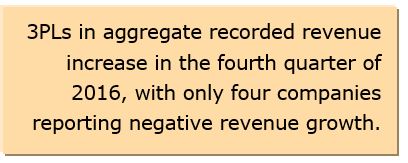 segment experienced an increase of 3.9 percent and contract logistics was down by 1.8 percent in revenue.
DHL reported revenue of $7.8 billion from its global freight forwarding and supply chain segments, representing a decline of 5.4 percent from the same period the previous year. The company reported a decline of 4.4 percent in the freight forwarding (non-asset international) segment and 6.4 percent in the supply chain (contract logistics) segment. In the freight forwarding segment, the decline in revenues was due to lower fuel surcharges and low level of air and ocean freight rates. In the supply chain area, the decline was due to change in revenue recognition with the UK National Health Service (NHS) as a result of revised contract.
DSV reported revenue of $2.2 billion for Q4 2016, representing an increase of 34 percent compared with the same period last year. Air and sea freight saw an increase of 59.3 percent and road freight saw an increase of 13.1 percent compared with the same period the previous year. The increase in revenues was mainly driven by the UTi acquisition.
Expeditors reported revenues (consist of airfreight, ocean freight and ocean services, custom brokerage, and other services) of about $1.6 billion, indicating an increase of 2.9 percent compared with Q4 2015. This growth was primarily driven by airfreight tonnage and ocean container record level volumes growth of 12 percent in Q4 2016.
Hitachi reported revenues of over $1.5 billion, representing an increase of 10 percent compared with the same period last year. For the 12 months ending in December 2016, the company increased revenues by 7.7 percent. This growth was mainly due to the strengthening of the Japanese yen of around 11 percent against the US dollar. The company saw a decline of nearly 4 percent in revenue year over year in Japanese yen. The majority of the revenues derived from non-asset-based domestic transportation. Around 60 percent of Hitachi’s revenues came from domestic logistics while the rest from a combination of international logistics and other services.
Hyundai GLOVIS reported $3.3 billion in revenues, representing a growth of 5.2 percent compared with the same period in FY15. The domestic logistics business grew by 4.4 percent, while the international logistics business declined by 1.1 percent. The contract logistics business, consisting of complete knock down (CKD) and other distribution revenues, grew by 11.2 percent.
JBHunt reported revenues of around $629 million, which is an increase of 12.8 percent from the same period the previous year. Dedicated Contract Services (DCS) revenues were $398 million, up by 7.9 percent due to the addition of new customer accounts, higher truck productivity excluding fuel surcharge revenue, rate increases implemented in the current and earlier periods, and improved asset utilization. Integrated Capacity Solutions (ICS) reported revenue of $231 million, an increase of 22.2 percent due to an increase of 38 percent in load growth.
Kuehne + Nagel reported revenue of $4.3 billion. This is a 1.7 percent decline from the same period last year, mainly due to currency conversion. The revenues consisted of sea freight, airfreight, and contract logistics. The company reported around 6 percent increase in sea freight volumes and 4.3 percent increase in airfreight volumes.
Logwin reported revenue of about $181 million, an increase of 0.7 percent from the same period the previous year. The prime reason for this growth was increase in air and ocean freight volumes. Negative currency translation effects had a negative impact on revenues and led to a very low growth rate of 0.7 percent in Q4 2016.
Panalpina reported revenues of around $1.3 billion, a decline of 8.8 percent compared with the same period the previous year. Panalpina’s airfreight revenues grew by 3 percent in the fourth quarter. The company saw an increase of 10 percent in airfreight volumes in FY16. According to management, the slowdown in revenue growth was mainly due to lower per-ton cost. Ocean freight revenues declined by 20.8 percent, mainly due to lower volumes in oil and gas and managed solutions. Logistics product revenues also declined by 15.4 percent.
Ryder reported revenue of about $806.4 million, up by 8 percent compared with the same quarter the previous year. Services revenue increased due to new business, increased volumes, and higher contractual pricing in all business segments, including Supply Chain Solutions (SCS) and Dedicated Transportation Solutions (DTS) segments.
UPS recorded revenue of $2.6 billion, an increase of 2.6 percent compared with the same period the previous year. Revenue growth was primarily due to the acquisition of Coyote Logistics. Also, the company saw increased revenue from the distribution unit led by growth in the health care, retail, and aerospace sectors.
XPO Logistics reported revenue of about $3.7 billion, an increase of 10 percent compared with the same period the previous year. Transportation revenues were $2.3 billion for the quarter, 10.8 percent increase from the same period in 2015. Logistics revenues totaled $1.3 billion, 8.6 percent increase from Q4 2015. The year-over-year increase in revenue was mainly due to the acquisition of Con-way and the growth in organic revenue led by the last mile and contract logistics businesses. The company divested North American full truckload unit on October 27, 2016.
Q4 2016 showed nearly stable growth compared to the first three quarters of the year. Of the 15 suppliers covered in the report, 11 reported positive year-over-year growth. As a whole, the 3PL market was impacted by the negative currency conversions, ongoing pressure on rates (low freight rates), and falling oil prices. Declining revenues may not exactly give a true picture of the overall business performance of the 3PLs.
ARC believes that the decline is seasonal and has occurred against the backdrop of declining oil prices and negative currency conversions. ARC anticipates a turnaround in revenues during the FY 2017, with the recent (modest) increase in oil prices and strengthening of other currencies against the US dollar.
If you would like to buy this report or obtain information about how to become a client, please Contact Us
Keywords: Third-party Logistics (3PL), Contract Logistics, Non-asset-based Domestic, Non-asset-based International, Freight Forwarding, ARC Advisory Group.