Representative End User Clients







Representative Automation Clients







Representative Software Clients








My colleague Valentijn DeLeeuw has written about two of the IIoT/I4.0 workshop sessions that took place at the recent ARC Forum in Orlando. Here we discuss the third, which featured the Industrial Internet Consortium. IIC executive director Dr. Richard Soley, together with three other speakers, offered a lot of information about the progress and goals of the young organization. Dr. Soley frequently speaks about the need and opportunity to apply "Internet Thinking" to the industrial space. The advent of the Internet transformed the way we consume music, read books, learn the news, do banking, file taxes, and more - but there are major transformations and disruptions to be had in the industrial space as well.
The first European IIC testbed is a collaborative effort between Bosch, Tech Mahindra, Cisco, and National Instruments - all members of the Industrial Internet Consortium. They are working to ensure that industrial tools automatically do what needs to be done at the right location. For example, they are collaborating on the “Track and Trace” project. By determining the position of a cordless nutrunner on the shop floor with extreme precision, it is possible to automatically select the correct torque for each task, making it possible to tighten safety-relevant screws with exactly the required force, for example. 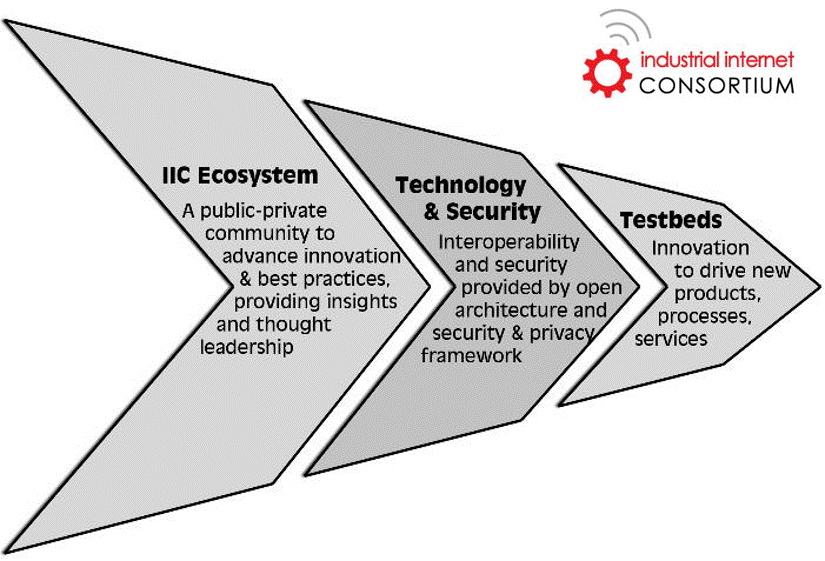
Katya Golovchenko of TE Connectivity talked about how the Internet of Things will impact companies where you might not expect to see a change. TE Connectivity is known as a supplier of all kinds of electrical connectors, but they recognize that their business will change as well. They
started experimenting with the Internet of Things and their first effort is a smart object that sits in an industrial cabinet. Is connected wirelessly and provides information about temperature, current, wattage, etc. to an iPhone app.
Jean-Philippe Provencher of PTC ThingWorx talked about using the Internet of Things for competitive advantage in two ways: operational excellence and product differentiation. We all have business processes across the enterprise - in product design, quality, sales and marketing, service, manufacturing, supply chain, scheduling logistics, and so on. With IoT now the opportunity we have is to make these real-time by bringing real-time data feed directly from the machines from the equipment.
Just imagine if, instead of having to imagine or to come up with assumptions about what good bundles of key features and capabilities would make sense, your marketing group or an engineering group could see exactly how the customers are using your product in the field. Why not just look directly at how customers really use the products, not just today but also with all the data you collect over the years.
Jaime Smith of National Instruments talked about intelligent edge devices for the industrial Internet of Things. These devices fall broadly into two categories: cyber-physical systems where distributed control nodes are synchronized and coordinated and adapt and learn about each other and their environment, and big analog data solutions. In these systems a wide range of sensors acquire a great deal data that is then analyzed to improve a process or to improve uptime.
Jaime cited an experience with Airbus, where he learned that when a plane is assembled, 400,000 holes are drilled and then over a thousand tools are used to connect the parts together with fasteners. Doing that correctly, with the right tools in the right place, can be a real quality problem. Airbus is working to make the tools themselves smarter, to have wearables on the workers so they get information of what they should be doing as well as coordinating with robotic systems and backend systems to really assist the worker.
As the production systems get smarter, advanced planning becomes less important. Consider the parallel to navigation: we all used to have occasion to plan out our driving routes in advance - but now we just turn to our GPS to take us the quickest way.
In the end, all presenters agreed: we don't need to wait. The Industrial Internet of Things is not only for the future - it can provide real benefits today.
Posted in IIoT and I4.0 Viewpoints