Representative End User Clients







Representative Automation Clients







Representative Software Clients








 Summary
The doors on rail cars can result in significant unplanned downtime. This became the focus of a pilot project for preventive maintenance using an Industrial Internet of Things (IIoT)-enabled solution built on IFS asset management software and Microsoft Azure cloud platform at a large municipal-owned transit company in Europe. The solution automatically diagnoses a variety of issues to trigger appropriate preventive maintenance to avoid train downtime and related penalties. The integrated solution includes business process automation that initiates a maintenance work order in IFS to prevent alerts being forgotten.
Industrial IoT enables On Schedule Trains
During the recent IFS World conference and other discussions, ARC talked with IFS customer Christian Thindberg, CIO, Sporveien, about its Industrial IoT application for improved on-schedule movement of its trains. Sporveien is the municipally owned public transport operator in Oslo (the capital of Norway) that operates and maintains the Oslo Metro and Oslo Tramway – the only rail transportation for the city. Established in around 1,000 AD, Oslo is now a modern city with a population of 634,000 and 1.5 million people in the wider metropolitan area.
Many of these people depend on the trains to run on schedule for their jobs and other activities. Sporveien has a demanding service level agreement (SLA) for on-time schedules with the city. Also, local laws require Sporveien to reimburse ticket holders for the cost of a taxi when late.
Unplanned Downtime Cascades into Missed Schedules
 Attempting to operate the train with a door stuck open represents an obvious safety hazard. An open door prevents the train from moving. When a train cannot leave a station due to a stuck door, the next train is also delayed. As a result, a single stuck open door cascades into a delay for many trains, creating a serious issue for thousands of riders. Loss of confidence in trains being on time reduces ridership and revenues and engages penalties based on Sporveien's SLA.
Sporveien's division for the Oslo Metro operates with 92 cars and, with six doors per car, the total number of doors comes to 552. Each door must open and close for hundreds of stops during a day. This presents many thousands of opportunities for door-related failures, any one which could result in a cascade of missed schedules. As the train cars age, maintenance needs increase, and uptime and asset utilization have become key priorities to keep trains running on time.
Diagnostics for Complex Modern Trains
 Each car has an onboard computer that, among other things, keeps track of approximately 3,000 parameters – 25 for each door alone. When the system senses a problem, the computer takes a snapshot of those parameters. In the past, a mechanic would bring a portable computer and connect it to the on-board computer with a cable to read the data for diagnosis. Manual communications between the mechanic, supervisors, and maintenance involved multiple steps, often resulting in miscommunication, delays, and errors. Since 3,000 parameters are far too many to interpret manually, the true source of the problem was often not repaired. Repeated occurrences of the same problem were not uncommon, resulting in more unplanned downtime until the real problem was finally identified and resolved.
IIoT-Enabled Predictive Maintenance
Each door housing uses a rail with bearings on which the door slides. The bearings need lubrication and can wear. Research into the problem determined that the speed in which a door closes slows down gradually prior to the point at which it becomes stuck open. This discovery lead to the creation of an application to monitor this door parameter.
 Now, each car has Wi-Fi and a unique ID. The data snapshot gets downloaded into an internal database. Selected data get sent to Microsoft Azure, which has several methods to query the data using its Event Hub and Stream Analytics. Event Hub can log millions of events per second in near-real time. Stream Analytics performs real-time analytics on these data. IFS specialists helped create logic on Azure to assess the incoming stream of car parameters. For example, more than three "slow closing" errors for a particular door in a day sets a flag that goes to the onsite instance of IFS. Then, business objects in IFS Applications provide the automated business process that creates a maintenance work order for the planner to schedule.
Currently, this application of IIoT for preventive maintenance is a pilot program at Sporveien. Planned enhancements include looking at more data to determine the level of urgency. Scheduling maintenance involves a complex set of constraints – skills, repair parts, back-up car availability, and more. To further improve maintenance productivity, it's often best to include the new work into an existing, planned work order, rather than creating a new one.
Benefits with Industrial IoT
Based on the success of the pilot, Sporveien expects that a full roll-out will reduce unplanned downtime, enable it to exceed its SLA for on-time train scheduling, avoid related penalties, and may even earn a bonus reward. And, of course, the people of Oslo will have more confidence in using the city's Metro.
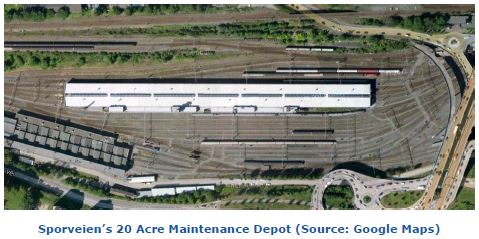 High asset availability will become more critical to success when the Metro changes to scheduling 106 of its 115 cars as planned in 2016. Many of the remaining cars are involved in upgrades (new seats, a subsystem, software, etc.). It can take three weeks to perform full maintenance on a car. Even moving the car into the 20 acre maintenance depot for service has to be well planned (Wi-Fi helps schedule the trains to arrive in the correct order). According to Mr. Thindberg, with IIoT and IFS Applications, the Metro expects to operate more smoothly with much lower risk of unplanned downtime.
In the maintenance function, the benefits will include improved quality and efficiency. The quality improvement occurs with a higher first-time fix rate. Higher efficiency is expected with removing the manual diagnostics and steps for communications. Uptime – the key metric for any maintenance department – will improve.
Lessons Learned
The IIoT-enabled preventive maintenance pilot project was a collaborative effort among corporate IT, maintenance, and IFS. Now, the mechanics use the data and understand its meaning. Involving the mechanics with respect for their competence and skills was key to understanding the equipment and business process issues.
Organization change management is important. Just installing a new screen would not be enough. The involvement and buy-in changed the way they work and avoided falling back to the old way of doing things when IT left. Their involvement in creating the solution helped gain acceptance and pilot project success.
IFS Applications
IFS (XSTO: IFS) develops and delivers software for enterprise resource planning (ERP), enterprise asset management (EAM) and enterprise service management. Founded in 1983, it currently has over 2,700 employees and more than 2,400 customers with one million users worldwide. IFS Applications, a component-architected product, allows customers to select the required modules and purchase only what they need. IFS Applications includes financials, human resources, quality management, document management, customer relationship management (CRM), business intelligence, enterprise asset management (EAM), field service management (FSM) and other core functionality to facilitate full life cycle management of products, assets, customers, and projects.
Conclusion
Rail cars have complex mechanical and electrical systems with hundreds of thousands of moving parts. For reliable service, these systems need regular maintenance. As costly as regular maintenance can be, early failure of neglected equipment is typically far more expensive. Also, a stalled train immediately blocks the railway, which causes timetable delays and unhappy customers for the remainder of the day. A successful railway operation requires reliability.
Industrial IoT offers the opportunity to help control these maintenance costs while improving the key metrics for the SLA. Sporveien's pilot IIoT application for doors provides a shining example.
Keywords: Industrial IoT, Uptime, Predictive Maintenance, Sporveien, IFS, Microsoft, ARC Advisory Group.