Representative End User Clients







Representative Automation Clients







Representative Software Clients








Summary
 As a global sponsor for the recent ARC India Forum in Bangalore, Siemens had ample opportunity to showcase its technology expertise via presentations by company representatives and customers alike. This helped stimulate a vibrant dialog between suppliers, end users, ARC Advisory Group analysts, and other forum participants.
Siemens' presentations highlighted the challenges of the manufacturing industry and the road ahead, which – according to the company – will focus on digital manufacturing to facilitate collaborative product and process development; and integrated engineering, the basis of Industrie 4.0.
The main challenges in today's industrial environment include shortening time-to-market, increasing flexibility, and boosting efficiency. New technologies can help industrial organizations overcome these challenges. These include Big Data, analytics, mobility, cloud computing, 3D modeling and simulation, and the overall Internet of Things (IoT). All are helping transform industry through collaboration, knowledge transfer, and competence building – internally and across the entire value chain.
Some key takeaways include:

Ashish Bhat, Head Digital Factory Division, Siemens India
Lights the Lamp
From left to right: G. Ganapathiraman, Country Manager, ARC Advisory Group India; Dr. Valentijn de Leeuw, Vice President, ARC Advisory Group Europe; Girish Naik, Country Head India, EIS, TCS; Arundhati Bhattacharya, General Manager, NTPC; KS Viswanathan, Vice President, NASSCOM; and Dilip Sawhney, President AIA and Managing Director Rockwell Automation India
Digitalization in Manufacturing
In his keynote address, Gautam Dutta, Senior Director-Marketing, Siemens Industry Software India, spoke about digitalization in manufacturing through every phase of the value chain. He said, "You have to digitalize — make the digital thread a proactive agent in driving your business. With a fully optimized Digital Enterprise, manufacturers are better equipped to initiate or respond to disruptive innovation."
According to Mr. Dutta, Industrie 4.0 represents a new level of organization and control of the entire value chain, across the lifecycle of products; is increasingly geared to individualized customer wishes; and encompasses all phases from the idea and the order to development and production, delivery of a product to the end customer, even recycling and related services. Key research areas of Industrie 4.0 include horizontal integration via value-added networks, end-to-end engineering across the entire value chain, and vertical integration and networked production systems.
Mr. Dutta spoke about digitalization and the processes involved in the discrete and process industries and how the entire value chain is integrated. Cornerstones of the digital enterprise are: transparent factories – internally and externally connected via adaptive IT systems; integrated value chain with seamless engineering; modular, networked, secure automation; and use of intelligent models.
Taking a step-wise approach to implementing Industrie 4.0 principles, which would make a lot of sense for small and medium sized companies, would require:
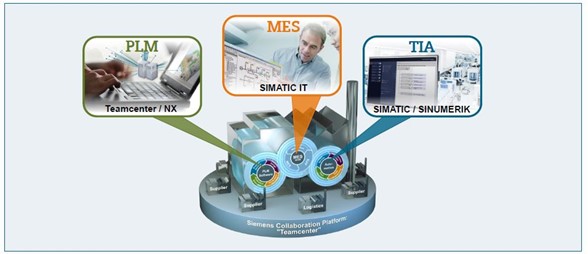
Digital Enterprise: The Siemens Portfolio of Solutions for the Stepwise Implementation of Industrie 4.0
Mr. Dutta cited a case study in which Teamcenter was implemented in a structured manner and customer-ready (including the necessary training) within ten days; demonstrating that Teamcenter/software can be scaled and customized for SMEs. In the automotive industry, vehicles are being designed, developed and manufactured with Siemens PLM software including MES – and the production is automated with SIMATIC automation components. He also discussed: NX – integrated, flexible and efficient PLM solution for product design, engineering and manufacturing; SIMATIC S7 -1500 and TIA Portal for efficient manufacturing; SINUMERIK – from virtual design to the real workpiece; and the SIRIUS modular system for industrial controls.
With the government incentives and the right business climate he said that there's never been a better time for companies to Make in India.
Integrated Engineering from Plant Design to Predictive Maintenance
Samson Samuel, Head Engineering and Consulting Group, Process Industries & Drives, Siemens India, gave a presentation on how integrated engineering can help ensure competitiveness. Showing actual plant pictures, he explained "then" and "now" scenarios and the advantages of integrated engineering across the plant lifecycle. In process plant design, the advantages of integrated engineering include both parallelization of the planning stages (to compress project schedules) and increased quality – from the idea to the plant.
Mr. Samuel said that, in the past, commissioning and installing a new system was a laborious and time consuming process. Now, with integrated engineering, the entire process is simplified as it allows continuous testing and optimization of automation using a simulated plant; and fast system start-up due to shorter commissioning, thereby increasing ROI.
Although there was often less data to manage in the past, it was not up-to-date. For example, in chemical plants, archived data was typically incomplete and/or inaccurate. When a migration was planned, it took several months to revise the documentation. During operation, new plant data is created, but not always consistently documented. The longer the system is in operation, the more the system configuration evolves, widening the gap between "as-built" and "as-is."
According to Mr. Samuel, integrated engineering provides consistent and easily retrievable data storage to manage the workload efficiently and boost productivity. The data pool continuously compares data with the process control system, bridging the gap between plant engineering and operations. He said that the Siemens products COMOS as plant engineering software and SIMATIC PCS 7 as the process control system, already function according to this principle. In the optimization stage (which includes energy management) integrated engineering provides the basis for both quality improvement and innovation, and higher productivity due to agility in responding to market requirements. For maintenance activities, integrated engineering enables timely and predictive intervention.
Integrating Energy Management Practices
A joint presentation by Milind Kulkarni, Chief Manager, Siemens and M. Sreenivasulu, Founder & Executive Director, Hanuman Automation (a Siemens customer) spoke about effectively integrating energy management practices into plant and production operations for operational excellence. Energy management should be a built-in element at all operational levels and the data on energy consumption patterns should be transparent.
Factors that motivate end users to enhance energy efficiency:
Energy data management delivers answers to challenges of energy consumption in the industry. According to the presenters, this is an investment with payback!
 Showcasing a case study, the presenters highlighted best practices of energy data management from project kickoff to implementation. They made it clear that without transparency there can be no efficiency. Energy optimization enables quick "wins" without significant capital investment. The next steps are seamless integration from energy management from the machine level up to plant management system; and also between production and facility management. An overview of energy management with SIMATIC substantiated its efficacy. The benefits of energy data management include: transparency; energy efficiency, savings, and awareness; regulatory compliance; and sustainable investments.

Conclusion
Siemens' presentations at the recent ARC India Forum charted the roadmap for a digital world. Everything is connected and integrated via a digital thread – processes, technologies, and people. Monitoring and controlling energy costs across all layers has garnered attention across all industry verticals.
Siemens showcased its technologies via case studies, exhibiting the company's expertise in multiple domains. With its global footprint and technology breakthroughs, the company is boosting industrial growth. As we learned, high on the company's agenda are integration, innovation, and a commitment to Make in India. These themes resonated well with Forum attendees.
All signed-in ARC Advisory Group clients can view this report in pdf format at this Link
If you would like to buy this report or obtain information about how to become a client, please Request ARC Info
Keywords: Digital Manufacturing, Industrie 4.0, Innovation, Integrated Engineering, Siemens, ARC Advisory Group.