Representative End User Clients







Representative Automation Clients







Representative Software Clients








FERC Order 2023, issued in July 2023, aimed to address the significant backlog of renewable energy projects waiting to connect to the U.S. electric grid. Utilities routinely raise concerns about how adding renewables will impact the grid reliability and costs. Grid and transmission operators face resource constraints in terms of staffing and technical expertise to quickly integrate renewables and so far, the interconnection backlog has not been significantly reduced.
We take our reliable electric grids for granted. They usually maintain a precise frequency, a narrow range for voltage, a nearly pure sine wave without harmonic distortion and power factor that makes distribution efficient. Let’s see how it is done.
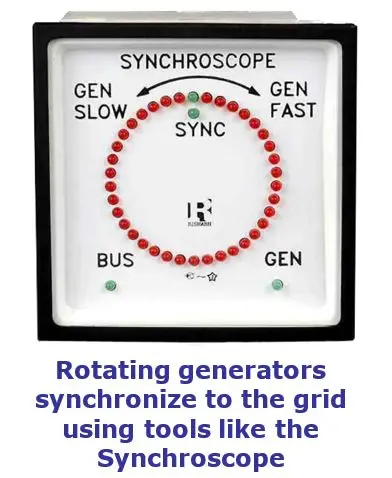
The classic synchronization process for gas and steam turbines involves matching the frequency, voltage, and phase angle of the generator's output with the grid's parameters. This is typically done using a synchronizer device (a synchroscope or synch check relay) that monitors the grid and generator parameters and adjusts the generator's speed and excitation until it matches the grid. In most cases this is an automated process, but manual synchronization is still practiced. Once synchronized, the generator's speed control transitions to droop control mode. In this mode, the governor's setpoint is no longer a fixed speed but rather a power output level. The turbine's speed is allowed to vary slightly within a certain range. A 4% droop would mean that a 4% change in speed would drive the power output by 100%. Not every turbine on the grid has the same droop setting but in general the actual settings allow all the turbines on the grid to share the load roughly in proportion to their generating size.
Grids must maintain a stable frequency, otherwise, cascading blackouts can occur. To achieve this, grid operators use a multi-layered system. The first layer, called "Droop Control," is a rapid response system that automatically adjusts the power output of all connected generators when the frequency changes. The second layer, known as "Automatic Generation Control" (AGC), fine-tunes the frequency further by instructing generators to make sustained adjustments over a longer period. The large rotating masses of generators help to stabilize the frequency, much like a flywheel. However, if the frequency deviates too much, safety systems will shut down generators and loads to prevent widespread damage and blackouts.
If the primary and secondary responses are not sufficient to restore frequency, grid operators shift to a tertiary control level. This is manual intervention by activating additional generation reserves or adjusting the dispatch of generators or demand response. This response varies by region and NERC (North American Electric Reliability Corporation) has a comprehensive set of reliability standards that must be followed by all entities involved in the operation of the Bulk Electric System (BES), including Independent System Operators (ISOs) and Regional Transmission Organizations (RTOs).
Complex and evolving markets are designed to improve reliability, reduce power costs, and meet environmental regulations. In New England we have
Day-Ahead Energy Market. This results in a day-ahead schedule for each generator.
Real-Time Energy Market. You can see the dynamic “Local Marginal Price” (LMP) at this site. https://www.gridstatus.io/live.
Ancillary Services Markets such as frequency regulation, voltage support, and spinning reserves
These markets are evolving to adapt to increased renewable power by incentivizing transmission upgrades, long duration energy storage, various demand response technologies, and servicing peak loads with clean power.
With such a complex control and market arrangement it is no wonder that new generating sources need to provide an interconnection study so that grid operators can figure out how and when they can be dispatched or curtailed. For example, ISO-New England has this procedure https://www.iso-ne.com/static-assets/documents/rules_proceds/isone_plan/pp05_6/pp5_6.pdf
The delays caused by engineering studies can be reduced with more precise models and simulations and the engineering expertise to use them. Developers of inverter-based generation are advised to understand the details of how their inverter and energy source can interact with the grid.
The interconnection queue includes a wide range of inverter-based energy generation systems including solar PV, grid-scale batteries, wind turbines, fuel cells, flywheels, supercapacitors, and some energy plants may utilize dc generators or intermediate dc stages for energy conversion, requiring inverters for grid connection. These include some hydroelectric power plants, some pumped hydro storage, ocean energy converters: some concentrated solar power (CSP) and some biomass and waste-to-energy plants too. Inverters can be grid forming or grid following and may have advanced control features that are useful for grid stability.
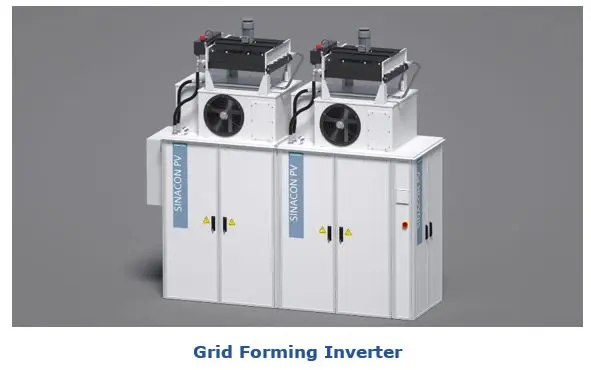
Invert based generation is an increasing percentage of grid power and many inverters do not take advantage of the full capabilities of the inverter and generating source. Lithium-ion batteries have a proven track record of providing power that can support frequency regulation and it is the inverter that controls the flow of power allowing the battery to provide synthetic inertia.
Inverter based generators can support frequency, voltage, and power factor control, but not all inverters have the same control system and communication capability. Inverters for lithium batteries act quickly to support grid frequency and are very useful for reducing peak loads. A battery system with grid-forming inverters offers several advantages over traditional synchronous generators. Firstly, they behave similarly to synchronous machines, acting as a voltage source behind an impedance without the physical constraints associated with rotating machinery.
They can autonomously control the voltage and frequency of the grid, providing stability and support during disturbances.
They can start up and energize a section of the grid without relying on an external power source.
They can remain connected to the grid and continue to provide support during voltage sags and other disturbances.
They can emulate the inertia of synchronous generators, helping to stabilize the grid frequency during sudden changes in generation or load.
One significant advantage lies in the control capabilities of grid-forming inverters. Advanced grid-forming controls enable these inverters to exhibit synchronous, inertial, and damping behavior of the voltage vector. This results in an instantaneous, delay-free power response to grid events.
While grid-following inverters are still dominant, the adoption of grid-forming inverters is increasing, especially in the following scenarios:
When a significant portion of the grid's power comes from renewable sources, grid-forming inverters can help maintain stability and reliability.
In areas with weak grids or remote locations, grid-forming inverters can provide voltage and frequency support, ensuring reliable power supply.
Grid-forming inverters are essential for the operation of microgrids, as they allow them to operate independently from the main grid.
As renewable energy penetration continues to grow and power systems become more decentralized, grid-forming inverters are expected to play an increasingly important role in ensuring grid stability and reliability. Ongoing research and development are focused on making grid-forming inverters more affordable, efficient, and widely adopted. Developers of inverter-based generation assets should consider the capabilities of their inverters. Your inverter may change roles over its life. Grid engineers prefer inverters that have the capability to improve reliability, cost of power, and environmental compliance