Representative End User Clients







Representative Automation Clients







Representative Software Clients








This is another in my recent series of blogs sharing insights from ARC Advisory Group's Q4 2024 survey of nearly 600 respondents from the industrial sector. With manufacturers around the world bracing themselves for global trade wars, I've been taking a deep dive into some of the regional differences in smart manufacturing, digital maturity, and readiness to capitalize on new opportunities presented by Industrial AI technologies, and likely disruptions in global supply chains, since I published my first take on Industrial AI's Growing Digital Divide before ARC Advisory Group's Leadership Forum 2025.
This post focuses on a critical finding revealed in our latest survey data, starkly illustrating the varying levels of digital maturity and AI adoption across North America, Europe, and Asia. The differences are significant, and they offer valuable insights into the evolving landscape of industrial competitiveness.
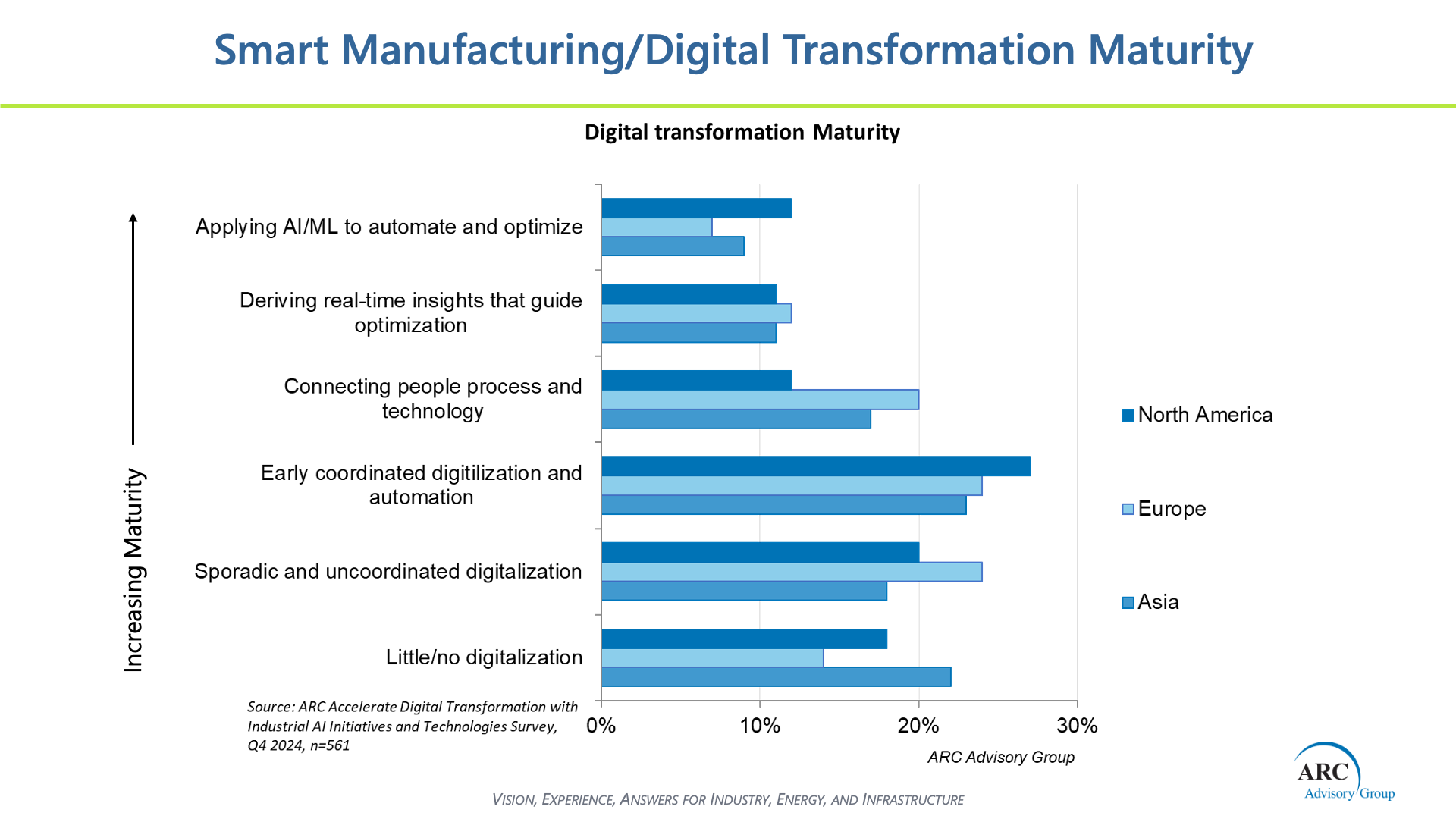

The most striking observation is North America's lead in applying AI/ML (12 percent). This is notably higher than both Europe (7 percent) and Asia (9 percent). While North America lags behind Europe in connecting people, processes, and technology (10 percent vs. Europe's 21 percent), its aggressive adoption of AI/ML suggests a strategic prioritization.
Several factors likely contribute to this:
Skills Gap: North America faces a well-documented shortage of skilled manufacturing labor. AI/ML offers a pathway to automate tasks, optimize processes, and reduce reliance on a shrinking workforce.
Higher Labor Costs: Compared with Asia, and to some extent Europe, labor costs in North America are significantly higher. AI-driven automation can provide a substantial return on investment by increasing efficiency and reducing operational expenses.
Competitive Pressure: North American manufacturers are acutely aware of the need to remain competitive in a global market. AI/ML is seen as a key enabler for achieving greater agility, responsiveness, and productivity.
Early Adoption Mindset: Although broad generalizations can be misleading, North American industry, especially in tech hubs like Silicon Valley, tends to foster a culture that encourages experimentation and early adoption of new technologies.
Europe's lower adoption rate of AI/ML (7 percent) is likely influenced by a combination of factors, including:
Ethical and Explainable AI Concerns: Europe has taken a leading role in the global conversation around ethical AI. The focus on explainability, transparency, and accountability in AI systems (as highlighted in various discussions within my NotebookLM sources) may be slowing down adoption. Companies are proceeding more cautiously to ensure compliance and avoid potential risks.
Stricter Regulations: The EU's AI Act and other regulatory initiatives create a more complex landscape for AI deployment. While these regulations aim to foster responsible AI development, they can also introduce hurdles and uncertainties for businesses.
Focus on Integration: Europe's higher percentage in connecting people, processes, and technology (21 percent) suggests a different strategic emphasis. European manufacturers may be prioritizing the foundational steps of digital transformation before fully embracing AI/ML. This is a more holistic, albeit slower, approach.
Asia shows a mixed trend: its AI/ML adoption rate (9 percent) is higher than Europe's, but it also has the highest proportion of manufacturers (22 percent) yet to begin digitalization, highlighting a substantial "long tail" of companies still falling behind.
Potential explanations include:
Lower Labor Costs: In many parts of Asia, labor costs remain relatively low. This reduces the immediate pressure to invest in automation technologies like AI/ML.
Manufacturing Verticals: Asia's manufacturing sector is highly diverse, spanning high-tech electronics to labor-intensive textiles, with digitalization approaches shaped by industry-specific needs and priorities. Sectors like textiles may find less immediate value in advanced AI/ML applications.
Varying Levels of Development: Asia includes highly industrialized nations like Japan and South Korea, as well as rapidly developing economies. This creates a wide spectrum of digital maturity levels across the region.
The regional disparities in digital maturity and AI adoption have significant implications for global supply chains. Most manufacturers operate complex, interconnected networks that span multiple regions. As global trade wars escalate, these supply chains will face increasing pressure to adapt and reconfigure.
Digital maturity will be a crucial factor in determining the resilience and agility of these supply chains. Companies that have embraced digitalization and AI/ML will be better positioned to:
Respond to Disruptions: Real-time data visibility and AI-powered analytics can help manufacturers quickly identify and mitigate disruptions caused by tariffs, sanctions, or other geopolitical events.
Optimize Inventory Management: AI can improve forecasting accuracy and optimize inventory levels, reducing waste and minimizing the impact of supply chain bottlenecks.
Reconfigure Sourcing and Production: AI-driven simulations and optimization tools can help manufacturers evaluate alternative sourcing options and production locations, enabling them to adapt to changing trade dynamics.
This survey was conducted before the Deepseek disruption in AI markets, and rapid advancements in AI technology are expected to accelerate adoption across all regions. However, factors such as skills gaps, labor costs, regulations, and cultural attitudes will continue to influence regional differences. Given the potential impact of trade tensions, future surveys may need to analyze the U.S. and Canada separately for a more detailed view of North American trends. See “Industrial AI in China vs the US” for an ARC Advisory Group take on their different approaches to governing and cultivating Industrial AI.
For ARC Advisory Group recommendations for navigating the AI Wars, closing the digital divide by embracing Industrial AI, assembling your Industrial-grade Data Fabric, and governing and guiding major decisions about enterprise, cloud, industrial edge, and AI software, please contact Colin Masson at [email protected] or set up a meeting with me, or my fellow Analysts at ARC Advisory Group.
Insights come from real people, something AI and chatbots just can’t replicate. ARC’s end user Voice of Customer (VoC) survey services go beyond algorithms and pre-programmed responses, capturing authentic, in-depth feedback straight from the source. We ask the right questions, dig into the “why” behind customer decisions, and uncover insights that no chatbot can predict. Whether you're fine-tuning a product, exploring a new market, or validating a strategy, our survey services provide the human perspective you need to make confident, data-driven decisions. Ready for insights that truly matter? Let’s talk. Contact Marianne D’Aquila [email protected] for more information on ARC Advisory Group end user survey capabilities.