Representative End User Clients







Representative Automation Clients







Representative Software Clients








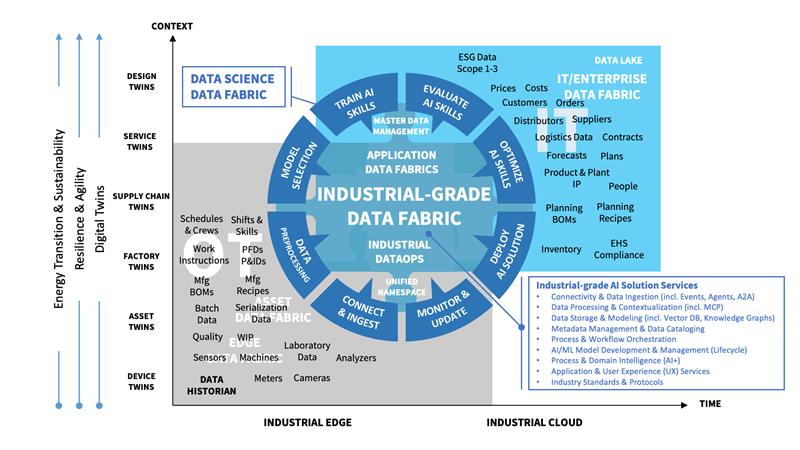
While understanding distinct Industrial Data Fabric (IDF) archetypes provides a valuable framework for prioritizing data fabric building blocks based on specific needs (as discussed in Blog Post 3 and 4), the reality for many industrial organizations is more complex. It's rare to find a single driver or a single user community whose needs can be met by strictly adhering to just one archetype pattern. Instead, building a comprehensive, Industrial-Grade Data Fabric often involves assembling a solution from a variety of components sourced from different vendors, effectively creating hybrid archetypes that serve the combined needs of IT, OT, and the teams building Industrial AI/AIOps solutions.
As our research at ARC Advisory Group shows, it is challenging for a single vendor to offer a platform that can meet the complex and diverse data needs spanning IT, OT, and the teams building Industrial AI/AIOps solutions sufficiently to support comprehensive Industrial DataOps across all domains and enable a full spectrum of AIOps solutions. Leading industrial organizations are proactively constructing their own IDFs by leveraging their existing core enterprise software platforms and augmenting them with specialized solutions – effectively combining building blocks prioritized by different archetypes.
This means an organization might start with an IT/Enterprise-Centric foundation for core governance and reporting, but then incorporate Edge-Centric building blocks for real-time local processing, add Data Science-Centric components for unified access to IT/OT data needed for AI model training, implement Industrial DataOps-Centric tools to streamline data pipelines from OT sources, and include Application-Centric building blocks focused on feeding data to specific OT applications (like predictive maintenance) or Enterprise applications (like Supply Chain or ERP). They might also integrate solutions providing Asset-Centric capabilities for digital twins.
This trend highlights a growing adoption of a best-of-breed strategy, where end customers carefully select individual components or building blocks (evaluated as discussed in Blog Post 2) to build a data fabric architecture that precisely meets their unique requirements, use case priorities, and the specific needs of their IT, OT, and the teams building Industrial AI/AIOps solutions. This hybrid assembly is the practical path toward enabling target Industrial DataOps pipelines and AIOps deployments across the enterprise. It necessitates strong collaboration across IT, OT, and the data and AI/ML teams to ensure the assembled components work together effectively, breaking down silos and fostering a truly data-driven culture.
Building an Industrial-Grade Data Fabric is not just a technical project; it's a strategic imperative for succeeding in the AI era and fundamentally enabling modern operational practices like Industrial DataOps and AIOps. The journey involves:
Recognizing the paramount importance of Data Quality (Blog Post 1).
Understanding and evaluating the essential Building Blocks that make up a data fabric (Blog Post 2).
Identifying key Archetypes as strategic patterns for assembling those blocks based on primary drivers and user needs (Blog Post 3).
Knowing how to Assemble Each Archetype by prioritizing specific building blocks, vendor types, and implementation recommendations (Blog Post 4).
Embracing the reality of Hybrid Approaches, combining elements from different archetypes to meet the full spectrum of diverse roles and use cases, and actively building your strategic fabric by wisely selecting components.
By carefully evaluating potential components across the key areas we've discussed, considering how they align with modern architectures, open-source technologies, and emerging standards, and understanding how different archetype patterns can be combined (including the Application-Centric approach supporting a range of OT and Enterprise systems), organizations can identify the right building blocks to assemble a data fabric tailored to their specific needs and the realities of their diverse user base. Remember that this fabric must ultimately empower IT, OT, and the data and AI/ML teams by providing them with the data they need, in the format they need it, with the necessary context and governance, thereby underpinning effective Industrial DataOps and making AIOps a reality across your operations.
The path to a comprehensive, Industrial-Grade Data Fabric is an evolutionary one, likely involving the strategic assembly of a hybrid solution over time. By focusing on collaboration, prioritizing needs, and wisely selecting building blocks, industrial organizations can successfully build their strategic Industrial Data Fabric through the complex data landscape and unlock the full potential of Industrial AI.
The Industrial Data Fabric Series:
Blog Post 1: The Foundation of Industrial AI: Addressing the Data Quality Imperative
Blog Post 2: Assembling Your Industrial-Grade Data Fabric: Identifying the Building Blocks
Blog Post 3: Industrial-Grade Data Fabric Archetypes: Understanding the Core Patterns
Blog Post 4: Industrial-Grade Data Fabric Archetypes: Selection and Vendors
Blog Post 5: Assembling Your Industrial-Grade Data Fabric to Enable Comprehensive DataOps and AIOps (this blog)
For ARC Advisory Group recommendations for Navigating the AI Wars, Closing the Digital Divide by Embracing Industrial AI, assembling your Industrial-Grade Data Fabric, and governing and guiding major decisions about enterprise, cloud, industrial edge, and AI software, please contact Colin Masson at [email protected] or set up a meeting with me, or my fellow Analysts at ARC Advisory Group.