Representative End User Clients







Representative Automation Clients







Representative Software Clients








Keywords: Process Automation Service, Yokogawa, OpreX Plant Stewardship, Open Process Automation Systems, IT/OT Convergence
This year marks the 50th anniversary of the introduction of DCS as the core of process automation systems. Over the past five decades, process automation systems have continuously evolved by incorporating new technologies. Services to maintain system health have also kept pace with these advancements. Currently, process automation systems are undergoing significant transformation driven by emerging technologies such as IT, IT/OT convergence, AI, and virtualization. Services must adapt to this new era.
ARC discussed Yokogawa Electric's new plant service framework. In an attempt to help its customers optimize their manufacturing operations, Yokogawa recently announced the release of its "OpreX™ Plant Stewardship — A Strategic Framework to Achieve Lifecycle Co-Experience," signaling a shift from a product-centric support to a performance-driven approach focused on improving safety, reliability, efficiency, compliance, and investment value across the plant lifecycle. Yokogawa felt this shift in focus was necessary to help its customers achieve operational excellence in an increasingly complex and competitive manufacturing environment.
With technological advancements, many process control applications are now managed by advanced software applications, which has increased the overall complexity of the automation systems. The increasing complexity of automation systems is making it harder than ever for end users to maintain these systems inhouse. As a result, more end users are turning to the automation vendors for help to ensure their manufacturing operations and maintenance practices are not holding them back from realizing their full potential.
Process automation systems are experiencing a transformation driven by evolving technologies such as IT, DX, AI, and virtualization. Advanced IT technologies, including wireless networks, highlight uncollected data beyond process data used for control within DCS. Enhanced networks enable the integration of data beyond DCS. AI technologies are now available for control, prediction, and diagnostics functions on applications. Virtualization technology allows control logic to operate on devices other than controllers. OPAF advocates for the openness of control systems, aiming to realize and popularize software-defined automation (SDA).
Greenfield plants are increasingly adopting open control systems. However, the legacy installed base of automation equipment in brownfield plants poses a challenge for end users to take full advantage of these new technologies in their existing plants. As a result, brownfield solutions are being implemented sequentially, prioritizing the most effective solutions while continuing production with their existing automation architecture.
The skills necessary to service the latest automation equipment are becoming increasingly complex. The level of complexity, coupled with the existing lack of skilled maintenance technicians and operators, is putting a strain on end users’ inhouse staff to ensure their operations are running at peak efficiency. As more end users choose to focus their resources on their core competencies, many of them are turning for help from their automation partners to ensure their manufacturing operations are in line with the ideal production state.
To address these challenges, it is necessary to focus not only on the maintenance of plant equipment and systems but also on the overall reliability, availability, and safety of plant facilities. Automation vendor partners have the skill set needed to support strategies for maintaining and developing plants to maximize operational efficiency and investment efficiency.
As plants grow more complex and interconnected—with rising IT/OT integration, cybersecurity threats, and a shortage of skilled personnel—traditional product-based maintenance approaches are no longer sufficient. In response, Yokogawa has expanded its lifecycle services portfolio through a strategic service framework: OpreX™ Plant Stewardship. This program ensures service performance across systems, field instruments, analyzers, software, and applications, and aims to evolve Yokogawa’s role into that of a trusted lifecycle partner—delivering value not just through products, but through co-created operational experience. The following are the key features of this new service framework.
OpreX Plant Stewardship adopts a service approach propelled by a strategic framework, designed to drive long-term operational excellence. By proactively identifying and addressing operational risks and challenges, organizations can align maintenance strategies with broader business goals. Yokogawa collaborates with stakeholders at all levels within the customer's organization, assisting them in navigating evolving demands and identifying the optimal balance between performance, cost, and sustainability.
Backed by decades of domain expertise, Yokogawa’s service offers five critical dimensions of plant performance:
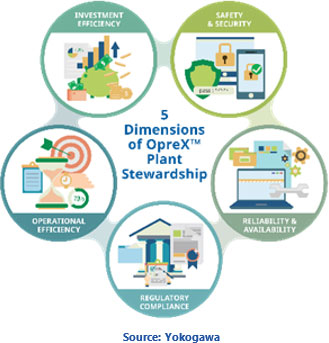
The structured engagement model ensures consistent collaboration and value delivery:
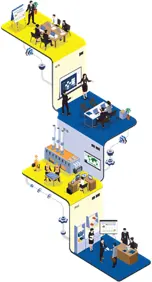
This framework enables customers to make comprehensive and forward-looking decisions about plant utilization. With access to Yokogawa experts and ecosystem partners, customers can unlock long-term value and efficiency across their operations. This is the core of the new service—a strategic framework to achieve lifecycle co-experience. Key enablers supporting lifecycle service delivery are as follows:
In plants where stopping is not allowed, the selection of process automation systems, vendor selection, overall design, and the selection of engineering implementation vendors are more critical than ever. Furthermore, the selection of a lifetime service partner to manage plant performance throughout its lifecycle is of utmost importance.
Yokogawa Electric recently announced "OpreX™ Plant Stewardship —A Strategic Framework to Achieve Lifecycle Co-Experience." Through this announcement, Yokogawa demonstrated its lifecycle service concept, methodology, and value to end users. Furthermore, it clearly indicated its intention to transform its programs, which were previously focused on individual products and hardware-centered maintenance services, into programs that provide value throughout the plant lifecycle.
In February 2025, Yokogawa Electric published "Future Scenario for 2040" under the Future Co-Creation Initiative, presenting future predictions including changes in the environment and the evolution of production activities visible to Yokogawa. Many new initiatives are expected to be announced soon.
ARC Advisory Group clients can view the complete report at the ARC Client Portal.
Contact Us if you would like to speak with the author.
Obtain more ARC In-depth Research Market Analysis.