Representative End User Clients







Representative Automation Clients







Representative Software Clients










The ARC Advisory Group Singapore Forum took place on 7 August 2025 under the theme “Winning in the Industrial AI Era.” Yokogawa participated as a Platinum Sponsor for this year’s edition, marking its second consecutive year of involvement. The event drew more than 180 attendees from across the industrial automation community and highlighted the increasing role of AI and emerging technologies in the sector.
Chai Kah Ming, Head of Smart Manufacturing, Executive Consultant & Sustainability Transformation, delivered a presentation titled “AI-First Strategy: Industrial Game-Changing Solutions to Deliver Key Value.” With experience leading over 30 Industry 4.0 projects and a strong focus on sustainability, Chai shared practical insights and a clear vision for how AI can transform industrial operations. The full presentation is available on YouTube: https://youtu.be/smX0I_7bjWA?si=ibgMVlODgvN6Xc8M
Manufacturing in the industrial AI era exhibits widely varying levels of autonomy. Most factories remain semi-automated, with humans handling most decision-making, while the first movers have started their journey toward fully autonomous operations. Yokogawa’s “IA2IA” (Industrial Automation to Industrial Autonomy) approach frames this transition as a series of ascending stages, reflecting the step-by-step progression toward higher levels of autonomy.

AI plays a central role in advancing industrial autonomy, but adoption can be challenging. As Chai notes, the difficulty lies not in technology availability but in identifying the right applications and use cases for AI in each organization. “AI-First” does not mean “AI-Only”; it means treating AI as a powerful tool to address complex industrial problems.
In today’s operations, many intelligent systems are already in place, so the focus should be on selecting the right AI tool for the right purpose, ensuring tangible value and meaningful outcomes. Chai envisions AI-First manufacturing as overlaying existing operations rather than replacing them: core systems like DCS, PLCs, MES, schedulers, and ERP continue to function, while AI acts as an end-to-end coordinator, linking operational technology (OT), information technology (IT), and engineering technology (ET) to enhance decision-making and optimize process flow.
Within this framework, humans remain in control. AI can operate in modes ranging from human-in-the-loop (advising humans), human-on-the-loop (executing under supervision), to selective human-out-of-the-loop (autonomous operation within safety guardrails). Safety, product quality, and equipment integrity remain paramount, enabling AI to deliver scale, speed, and insight while operating responsibly under human oversight.
Chai also introduced the idea of composable digital twins and embedded AI as a way to extend intelligent operations beyond isolated applications. He emphasized that AI is only one part of the overall decision-making process, and its capabilities can be amplified when combined with a digital twin. The composable digital twin approach with embedded AI suggests that organizations don’t need to have all systems fully digitalized or connected from the start. Instead, they can begin with a specific use case, progressively integrating components such as digital twins, AI models, and semantic layers. This modular strategy allows companies to start small, iterate, and scale their AI and digital twin capabilities over time, making adoption flexible and manageable even in complex industrial environments.
Chai shared two compelling use cases demonstrating how AI is delivering tangible results in manufacturing and enterprise operations, underscoring its potential for real value creation:
Autonomous Process Control:
The first case study examines how a Japanese chemical plant used autonomous AI to optimize a complex distillation process. The plant faced significant challenges because the components to be separated had very close boiling points, requiring exceptionally tight temperature and liquid-level control to maintain purity and separation. Recovered energy (recycled steam) from upstream processes, while energy-efficient, introduced large process dynamics and uncertainty, necessitating supplemental steam when recovered heat was insufficient. Seasonal changes in ambient temperature of around 40 °C further complicated control, affecting feed and column dynamics. Despite attempts using PID tuning and APC, the system could not be stabilized effectively.
To address this, the plant deployed Yokogawa’s FKDPP, a reinforcement learning-based AI model, for real-time autonomous control. The reported results included:
40 percent reduction in steam usage while maintaining consistent product quality through optimization of waste heat utilization
Automatic adaptation to new process dynamics without any model changes or tuning
Stable, year-round operation, with the system having run continuously for over three years
This case demonstrates the use of AI in a complex, dynamic process where conventional control methods could not maintain stability. FKDPP autonomously managed the distillation process, maintaining stable, year-round operation, optimizing energy use, and preserving product quality over more than three years.
AI-Powered Digital Twin for Enterprise-Level Asset Management:
The second case involved a large mining company with multiple sites and over 3,000 controllers across multiple vendors. Maintaining these assets with a small engineering team was challenging and inefficient, resulting in underperformance.
Yokogawa deployed a digital twin combined with AI to monitor and optimize the performance of all automation assets. The system provided:
Real-time monitoring of controllers and equipment.
Alerts and actionable recommendations for maintenance teams.
Benefits across operations, reliability, and engineering teams.
AI was essential here, as it streamlined oversight, monitored performance, and supported proactive decision-making, freeing staff to concentrate on more high-value work.
Chai concluded that the future of AI in industry is gradual but inevitable. Organizations move from human-driven decision-making to AI advisors to fully integrated AI partners, with humans maintaining oversight throughout.
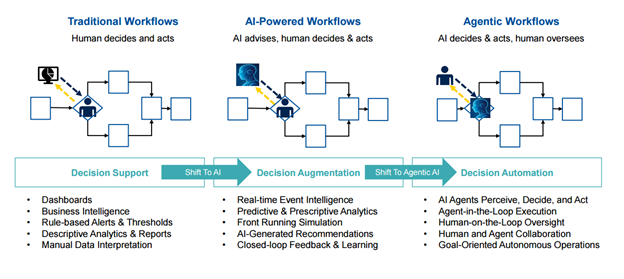
Building on this perspective, Chai mentioned some best practices for implementing industrial AI, which include:
Defining strategy: Align use cases with business and physics constraints.
Composable stacks: Build modular systems using digital twins, data integration, and orchestration platforms.
Prioritize Responsible AI: Ensure safety, explainability, and compliance at every stage.
Start Modular, Scale Toward Autonomy: Begin with high-value use cases and expand systematically.
As Chai reflected, the ultimate goal is to leverage AI’s scale, speed, and analytical power while humans focus on purpose, ethics, and value creation—a vision where AI is a trusted partner in industrial transformation.