Representative End User Clients







Representative Automation Clients







Representative Software Clients








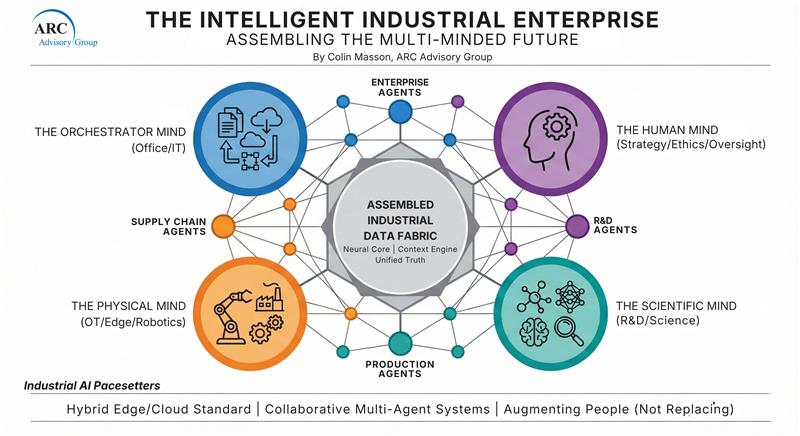
In my previous analysis, I outlined the "Great Bifurcation" of the industrial cloud—a strategic divergence where hyperscalers like Microsoft is solidifying its role as the Enterprise Orchestrator, while others like Amazon Web Services (AWS) are doubling down as the Builder’s Operating System.
For CIOs and CDOs, the immediate reaction is often anxiety: “Do I have to choose?”
The answer, according to our latest ARC Advisory Group Industrial AI Pacesetter Survey (Q4 2025), is a resounding no.
The most successful industrial companies—the top 12.9 percent we call "Pacesetters"—are not picking a single winner. They are doing what successful leaders always do: they are building a diverse team. They are architecting a "Multi-Minded" Enterprise that assembles the right AI model for the right job.
As I laid out in my research note From Co-Pilots to Humanoids, we are not looking at a single AI market, but a taxonomy of specialized "Minds." Here is how Pacesetters are assembling them—and the questions you should be asking to join them.
The "One Model to Rule Them All" fallacy is fading. Pacesetters realize that the AI required to draft a service contract is fundamentally different from the AI required to control a robotic arm or discover a new polymer.
They are assembling a "Multi-Minded" stack, leveraging capabilities from across the ecosystem:
The Orchestrator Mind: Best represented by the Microsoft/OpenAI stack, this is the tool for the knowledge worker—navigating the office, synthesizing documents, and managing workflow.
The Physical Mind: As we see in the rise of humanoids, the factory floor requires "Physical Intelligence" that understands gravity, friction, and collision—domains where builders including AWS, NVIDIA, and robotics leaders are focused.
The Scientific Mind: Often the unsung hero in R&D and engineering. Platforms like Altair RapidMiner are democratizing complex data science for engineers, while models such as Google’s Gemini models are providing the deep reasoning and multimodal capabilities required for material science and complex supply chain optimization.
The Question for IT & Data Science Leaders: Are you forcing a general-purpose LLM to solve physics problems? Or are you assembling a portfolio of models that matches the diversity of your operations?
If you have multiple minds, you need a shared memory.
Laggards often fail because they try to build this inside a single vendor's silo. Pacesetters succeed because they assemble their own Industrial Data Fabric.
This is not a passive "Federation." It is an active assembly of best-in-class components:
The Neutral Core: Pacesetters often utilize platforms such as Snowflake or Databricks to ensure data portability, preventing "gravity" from locking them into a single cloud.
The Context & Integrity Engine: Raw data is useless without context—and dangerous without integrity. Leaders are integrating dedicated DataOps and integrity solutions from vendors like HighByte, Litmus, Cognite, and Aperio to standardize and validate data. Advanced platforms like Sight Machine and TwinThread take this further, converting raw streams into business-ready "Digital Twins" that bridge the gap between factory physics and financial performance.
The Health Monitor (Industrial AIOps): To ensure the quality of this data pipeline, Pacesetters deploy specialized Industrial AIOps and analytics tools—such as Seeq, TrendMiner, and Falkonry—that detect anomalies in the data stream itself.
The Result: A fabric where a Scientific Mind (e.g., Google/Altair) can analyze R&D data, an Orchestrator (e.g., Microsoft) can update the ERP, and a Physical Mind (e.g., AWS) can adjust the production line—all accessing the same truth.
The Question for OT & Architecture Leaders: Does your data architecture allow an agent from one cloud to query a machine managed by another? Or have you built digital islands?
The "Multi-Minded" approach extends to the application layer. Pacesetters are moving beyond generic chatbots to deploy "Collaborative Multi-Agent Systems."
In this Composable Enterprise, you don't build every agent from scratch; you employ specialized agents from the vendors who know your business best:
Supply Chain Specialists: Innovative agents from vendors including Coupa, Descartes, Kinaxis, BlueYonder, and Aera Technology are moving beyond visibility to autonomous orchestration—negotiating everything from driver compliance to global inventory rebalancing.
The Industrial Enterprise Core: Major ERP and asset management players—such as Oracle, SAP, IFS, and Infor—are embedding agents directly into the transactional backbone of the enterprise.
Production Operations: The traditional "automation pyramid" is flattening. Market leaders like Siemens, Rockwell Automation, Honeywell, and AVEVA are evolving their MES and automation platforms into active "Shop Floor Agents." Innovators are leading this charge with agents that close the loop: Kelvin is empowering engineers to deploy "Collaborative Control" agents to the edge, while Imubit is deploying "Closed Loop AI" agents that use deep reinforcement learning to autonomously optimize complex refining and chemical processes. Meanwhile, Tulip Interfaces is empowering the workforce with "Frontline Copilots" that guide operators through complex tasks in real time.
The Question for Business Leaders: Are you treating AI as a "sidecar" application, or are you demanding that your core business, MES, and automation vendors provide agents that can negotiate with each other?
Finally, the most critical "Mind" in the loop remains the human one. The "Multi-Minded" enterprise does not replace people; it augments them.
Pacesetters report their primary AI interaction model is "Augmenting People," whereas Laggards are stuck at "Assisting" or "Replacing."
This augmentation requires the right interface. We know from our survey data that the "Industrial Metaverse" remains a long-term horizon (three-plus years) for many. However, its pragmatic foundation—Digital Twins—is already a core investment for Pacesetters today.
Leaders are investing now in the simulation capabilities—championed by partners such as NVIDIA, Siemens, Rockwell Automation, and Bentley Systems—that will eventually mature into a full Metaverse. Leaders recognize that as we layer multiple agents and models into our operations, humans need a visual interface to understand and supervise this complex machine.
The Question for Workforce Leaders: Are you waiting for the "Metaverse" to be perfect, or are you building the Digital Twin foundation today that allows your people to supervise the intelligent factory of tomorrow?
The "Great Bifurcation" is merely a fork in the road; the true destination is the Intelligent Industrial Enterprise.
This future represents the ultimate synthesis of People, Processes, and Technology. It is not a static stack, but a dynamic organism where multiple AI models provide the specialized reasoning, autonomous agents execute the complex workflows, and physical intelligence bridges the gap between the digital and physical worlds.
Underpinning this entire ecosystem is the assembled Industrial Data Fabric—the nervous system that allows these diverse minds to operate as one.
The Industrial AI Pacesetters of 2026 won't just be buying software; they are building their intelligent enterprise. The question is, are you?
Based on the data from over 500 decision-makers, we have built the ARC Industrial AI Readiness Assessment tool.
This isn't a generic quiz. It is a diagnostic tool that compares your organization’s maturity against the specific behaviors of the top 13% of the market.
Discover your "Pacesetter Score."
Identify your specific gaps in Data Fabric, Governance, and Workforce Strategy.
Get a personalized roadmap to close the gap.
Take the Industrial AI Readiness Assessment Here
For ARC Advisory Group recommendations for Navigating the AI Wars—including the Industrial Robot Wars—Closing the Digital Divide by Embracing Industrial AI, assembling your Industrial-Grade Data Fabric, and governing and guiding major decisions about enterprise, cloud, industrial edge, and AI software, please contact Colin Masson at [email protected].
Or set up a meeting with my fellow Analysts and I, at ARC Advisory Group to find out more about our Executive Insights Service for Industrial organizations, and Industrial AI Insights Service for vendors.