Representative End User Clients







Representative Automation Clients







Representative Software Clients








In my last post, we established that a generic, one-size-fits-all AI strategy will inevitably fail when it hits the physical realities of the plant floor. We explored how different vertical industries—from Automotive to Pharma—require vastly different applications of the Industrial AI toolbox.
But as we continued to unpack the Q4 2025 survey data during our Thursday morning breakout session at the ARC Industry Leadership Forum, another massive fault line emerged. Even if you get the vertical nuances right, a centralized, monolithic technology rollout will still falter (as I write this, I have a rather vivid image of a multi-million-dollar humanoid robot spectacularly faceplanting on a factory floor) if it ignores the reality of global borders.
The international flavor of the 2026 event carried an urgent undertone. Discussions spanning from European sustainability champions to Asian manufacturing executives made it glaringly obvious: "Digital Transformation" and "Industrial AI" mean very different things depending on your GPS coordinates. Geography often acts as destiny, dictating not just the pace of adoption, but the very nature of the technology being deployed.
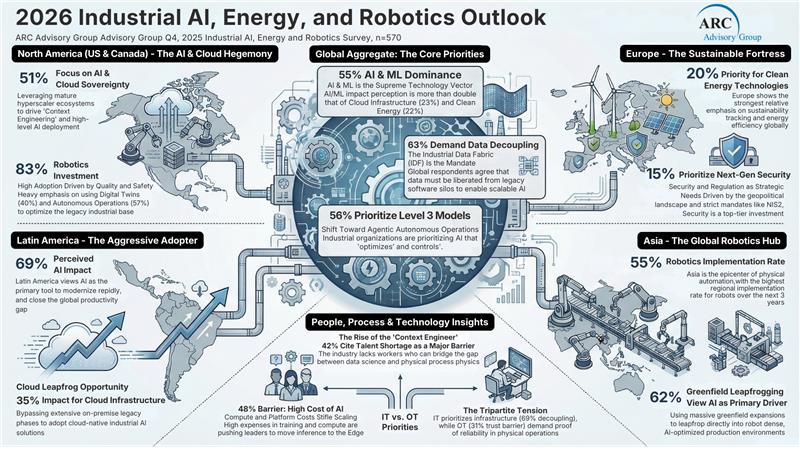
When we analyzed the regional cuts of our Q4 2025 Industrial AI, Energy, and Robotics Survey of 570 global decision-makers, we discovered four distinct regional "personalities" shaping the global AI footprint.
The US and Canada are playing a heavily software-centric, "Data First" game, buoyed by mature hyperscaler ecosystems, aggressive venture capital, and early adoption of Generative AI.
The Focus: A leading 51 percent of North American respondents cited AI & ML as their top impact technology. They are pouring investments into advanced digital twins, centralized cloud infrastructure, and Agentic AI designed to orchestrate complex, multi-tier supply chains.
The "Why": North America is battling an acute demographic cliff—the rapid retirement of its most experienced operators and engineers. As we noted in our analysis, the primary driver here is not simple cost-cutting; it is a pressing need for capacity. Manufacturers are using AI Copilots to digitize tribal knowledge and Agentic workflows to make a workforce of 50 produce the output of 100. However, their biggest hurdle is legacy technical debt: they are trying to wire state-of-the-art cloud AI models into a massive, aging "brownfield" industrial base, which is forcing them to confront the exorbitant costs and latency issues of cloud inference.
Europe is playing the role of the "Responsible Innovator." Their technology strategy is inextricably linked to geopolitical realities, energy security, and strict regulatory mandates.
The Focus: Europe shows the strongest global emphasis on clean energy technologies (20 percent priority). They view AI less as a pure throughput engine and more as an audit-grade tool for sustainability tracking, decarbonization, and next-generation security. Crucially, this is where the Sovereign Cloud becomes a non-negotiable mandate rather than an IT preference.
The "Why": You cannot manage what you cannot measure, and you cannot secure what you do not control. Driven by regulations like NIS2, the Corporate Sustainability Reporting Directive (CSRD), and stringent data residency laws, European industrials are aggressively pivoting toward Sovereign Clouds and specialized regional "Neoclouds." For those unfamiliar, a Neocloud is a localized, purpose-built infrastructure designed specifically to handle high-performance AI workloads while strictly adhering to regional data sovereignty and compliance laws. A prime example of this is the Germany Industrial AI Cloud, which I recently explored in depth in a dedicated ARC Advisory Group blog post. A monolithic global cloud strategy managed from North America simply will not pass European compliance audits in 2026. Data must remain resident, secure, and sovereign, forcing global enterprises to architect localized, federated Industrial Data Fabrics rather than dumping everything into a centralized global data lake.
While the West obsesses over Large Language Models and software layers, Asia is aggressively pursuing "Physical First" intelligence, cementing its position as the undisputed heavyweight in industrial robotics.
The Focus: Taking advantage of massive greenfield expansions, a staggering 55 percent of Asian organizations plan to implement physical robots at scale within the next 3 years. They are moving rapidly beyond simple, pre-programmed arms and are indexing heavily on autonomous mobile robots (AMRs) and embedded Vision-Language-Action (VLA) models.
The "Why": The narrative that Asia's manufacturing dominance relies solely on labor arbitrage is dead. With the rapid scaling of new, highly advanced manufacturing hubs across Southeast Asia, China, and India, these regions are leapfrogging the rigid, legacy IT/OT architectures that constrain Western plants. They are building highly flexible, "robot-dense" environments where AI directly controls the physical world to achieve unprecedented levels of precision and scale. Furthermore, in many emerging Asian markets (particularly in mining and energy extraction), the primary driver for robotics shifts drastically from "capacity" to "safety"—using embodied intelligence to keep human workers entirely out of hazardous, life-threatening environments.
Latin America emerged from our 2025 data as a surprise pacesetter in cloud enthusiasm and agile adoption.
The Focus: With an incredible 69 percent of respondents citing AI as their top impact technology, LATAM is moving with strong velocity, prioritizing cloud-based analytics, predictive maintenance, and connected worker technologies.
The "Why": Much like Asia’s approach to robotics, LATAM is utilizing software to bypass the extensive, painful on-premise legacy phases (like heavy, monolithic MES and DCS deployments) that bogged down North America and Europe for the last decade. They are moving straight to composable, cloud-native Industrial Data Fabrics and lightweight edge computing. This allows LATAM manufacturers to rapidly close the global productivity gap and compete on the world stage without requiring the massive, multi-year upfront capital expenditures historically associated with industrial digital transformation. They are proving that agility can outmaneuver deep pockets.
If you are a global manufacturer, pushing a centralized, headquarters-driven technology mandate down to your regional facilities is a recipe for internal friction. You cannot force a heavy software-first, public cloud initiative into a rural Asian plant hungry for physical robotics, nor can you ignore the Sovereign Cloud infrastructure required to legally operate your European facilities.
This is exactly where ARC Advisory Group’s Voice of Market Service becomes an indispensable asset for industrial stakeholders across the spectrum:
For Industrial Organizations: Global Centers of Excellence (CoEs) must coordinate strategies that respect regional realities. Our customized benchmarking allows enterprise IT and OT leaders to de-hype the market, align regional leadership, and tailor deployment roadmaps that empower local plants rather than constrain them.
For Technology Vendors and Service Providers: If your product roadmap or Go-To-Market strategy treats the globe as a monolith, you are leaving opportunities on the table. Vendors leverage ARC's deep regional data to inform their product roadmaps, tailor their marketing narratives, identify critical localized partnerships, and execute successful global expansion strategies that resonate with regional buying centers.
Do not guess what your global operations or prospective customers need. Use empirical data to align your stakeholders around a single source of truth.
(To dive deeper into the data driving these trends, members of the ARC Executive Insight Service can access our full "Industrial AI Pacesetters 2026 Report" and selected insights from our "Q4 2025 Industrial AI, Energy, and Robotics Survey" via the ARC client portal. For customized benchmarking, vendor analysis, and specialized market intelligence, explore ARC Advisory Group's Voice of Market Service.)
To wrap up this series, we will address the elephant in the room: the internal friction stalling these projects. In the final post, Bridging the Gap: The "Context Engineering" Crisis in IT and OT, we will unpack the "Tripartite Tension" between Data Scientists, Plant Managers, and Business Leaders, and introduce the crucial new role required to scale Industrial AI in 2026.
For ARC Advisory Group recommendations for Navigating the AI Wars—including the Industrial Robot Wars—Closing the Digital Divide by Embracing Industrial AI, assembling your Industrial-Grade Data Fabric, and governing and guiding major people, processes, and technology decisions about enterprise, cloud, industrial edge, and AI, please contact Colin Masson at [email protected].
Or set up a meeting with my fellow Analysts and I, at ARC Advisory Group to find out more about our Executive Insights Service for Industrial organizations, and Industrial AI Insights Service for Vendors.