Representative End User Clients







Representative Automation Clients







Representative Software Clients








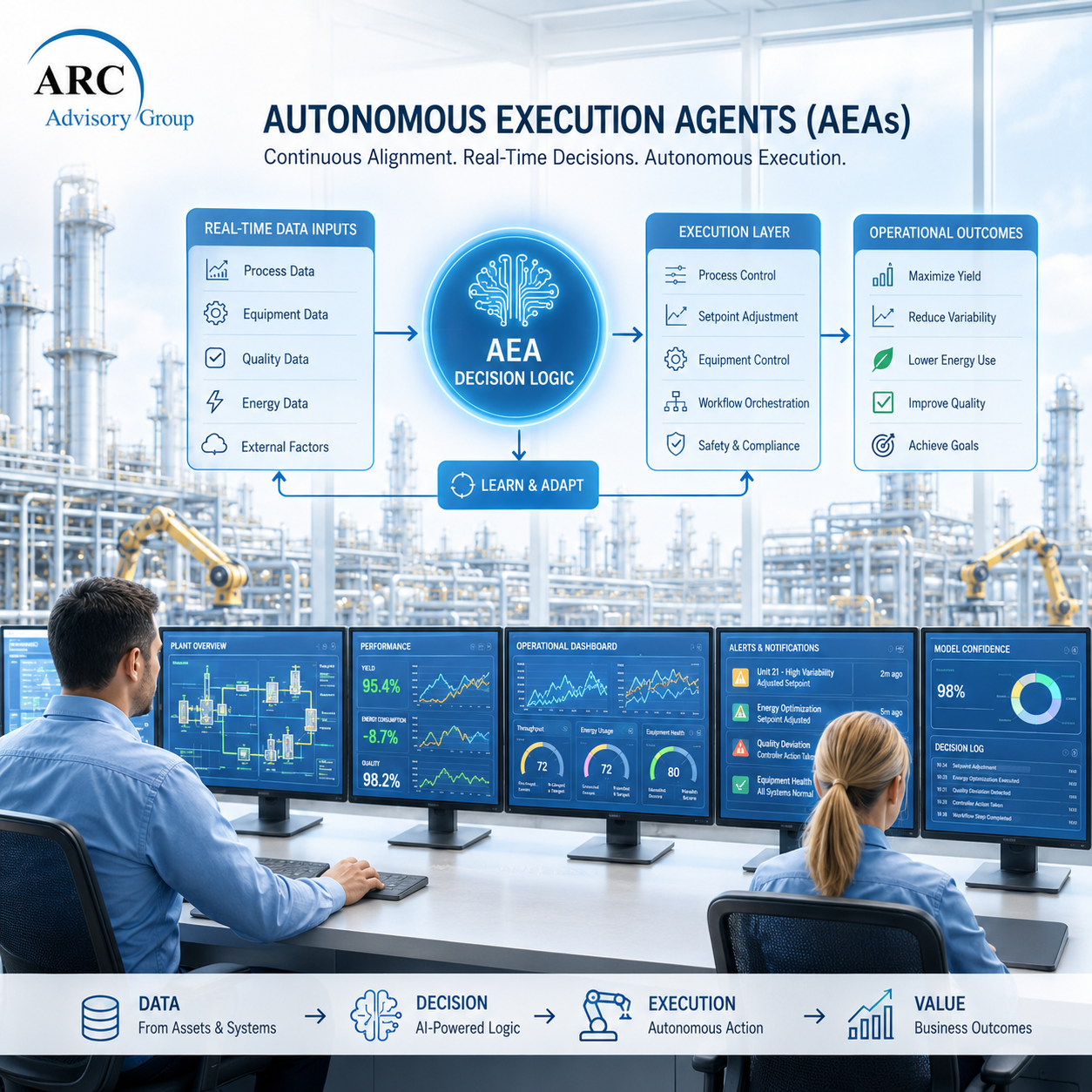
The operational value of Autonomous Execution Agents (AEAs) derives from their ability to adjust operating processes organization‑wide in alignment with explicit business objectives, such as minimizing process variability, maximizing yield, or reducing energy consumption. Unlike traditional analytics systems, AEAs can operate continuously across a spectrum ranging from advisory recommendations to closed‑loop autonomous execution. The value of AEAs is not limited to isolated performance improvements tied to individual models or dashboards but instead emerges from their role as persistent execution mechanisms embedded within industrial workflows. It is helpful to assess their impact at the level of operating models rather than discrete analytical features.
Many industrial organizations already utilize sophisticated analytics, including predictive and prescriptive models. However, these capabilities often remain decoupled from execution, relying on human interpretation, manual intervention, or episodic decision processes, all of which can introduce inefficiencies, errors, or delays.
AEAs explicitly address this gap by recommending adjustments or directly adjusting operating processes rather than merely informing decisions. In practice, this means that value is constrained not by model accuracy alone, but by whether insights are acted upon consistently, in a timely manner, and under real operational constraints. Traditional analytics tools, even when technically sound, often lack this execution linkage and therefore struggle to deliver sustained operational impact.
AEAs are explicitly designed to align operational decisions with strategic goals such as yield maximization, energy reduction, quality improvement, or takt‑time minimization. This alignment is not an abstract aspiration; it is encoded directly into the decision logic that governs how and when operational adjustments are made. It requires systems that operate continuously rather than through periodic optimization exercises. For example, platforms characterized as AEAs ingest real‑time operational data and adjust setpoints or execution parameters as conditions change, rather than relying on static operating envelopes. This structural capability enables ongoing pursuit of economic objectives, rather than intermittent improvement tied to manual tuning cycles.
From an operational perspective, variability arises not only from equipment behavior, but also from human decision‑making, shift changes, and inconsistent responses to similar conditions. By embedding decision logic within a persistent execution layer, AEAs provide a consistent response framework that operates independently of individual operator experience or organizational silos. AEAs recommend or execute parameter adjustments in response to recurring conditions, thereby standardizing operational responses within defined constraints. While outcomes vary by context, the mechanism itself—consistent application of decision logic—is a clear source of operational value.
Industrial environments are characterized by continuous change, including feedstock variability, equipment degradation, demand fluctuations, and energy price dynamics. AEAs can continually adapt to nonlinear process dynamics in real time in continuous industries and autonomously adjust execution parameters in discrete or hybrid environments.
This capability has direct operational implications. Rather than relying on delayed human intervention or periodic optimization reviews, AEAs are architected to respond as conditions evolve. These systems either recommend or automatically implement adjustments in real time, enabling faster alignment between current conditions and desired operating states. The value here is structural: reduced latency between detection and response.
The introduction of AEAs affects not only process performance, but also how work is organized. Many implementations emphasize human‑in‑the‑loop designs, in which operators and engineers retain oversight while being supported by continuous decision assistance or supervised execution.
From an operational standpoint, this shifts human effort away from routine monitoring and repetitive decision‑making toward supervision, exception handling, and improvement activities. Full autonomy is not necessarily the goal. From the perspective of the workforce, the value of an AEA often depends on how effectively the system supports existing roles rather than attempting to replace them.
It is essential to be explicit about what AEAs do not provide. AEAs do not eliminate the need for sound process design, reliable instrumentation, or skilled personnel. Their effectiveness is inherently bounded by data quality, model validity, integration with control and execution systems, and organizational readiness.
AEA examples encompass a range of deployment modes, many of which begin in advisory or supervised configurations. Ideally, AEAs should be positioned as long‑lived operational capabilities, not as short‑term optimization projects.
The operational value of Autonomous Execution Agents lies in their ability to continuously translate analytical insight into operational action within defined constraints and governance frameworks. By closing the loop between data, decision logic, and execution, AEAs address a structural limitation that has long constrained the impact of industrial analytics.
For industrial organizations, the most significant benefit may not be any single performance improvement, but the cumulative effect of sustained, consistent, and timely operational decisions aligned with business objectives. Understanding AEAs through this systemic lens is critical for setting realistic expectations and designing effective adoption strategies.
Be on the lookout for our upcoming MarketMap report about Autonomous Execution Agents. See how some of the leading solutions compare.
The Industrial AI (R)Evolution is moving faster than ever. To dive deeper into the frameworks and data shaping the future of the industrial sector, explore some of ARC’s latest research:
Execution-centric AI: connect data ingestion, contextual understanding, decision logic, and execution into a continuous loop that aligns real-time operations with business objectives For Powerful Autonomous Execution Agent Deployments, Start with a Capability-Based View | ARC Advisory Group
What Are Autonomous Execution Agents? What Are Autonomous Execution Agents? A New Category for Industrial AI | ARC Advisory Group
Mapping your maturity and strategy with ARC's 3-Axis Industrial AI Models Taxonomy
Where do you stand in the Industrial AI (R)Evolution? Take our Industrial AI Assessment to benchmark your organization's maturity, identify critical gaps in your IT/OT/ET convergence, and get actionable recommendations to accelerate your path to becoming an Industrial AI Pacesetter.
Don't guess what your global operations or prospective customers need. Use empirical data to align your stakeholders and de-hype the market with ARC Advisory Group's Voice of Market Service.