Representative End User Clients







Representative Automation Clients







Representative Software Clients








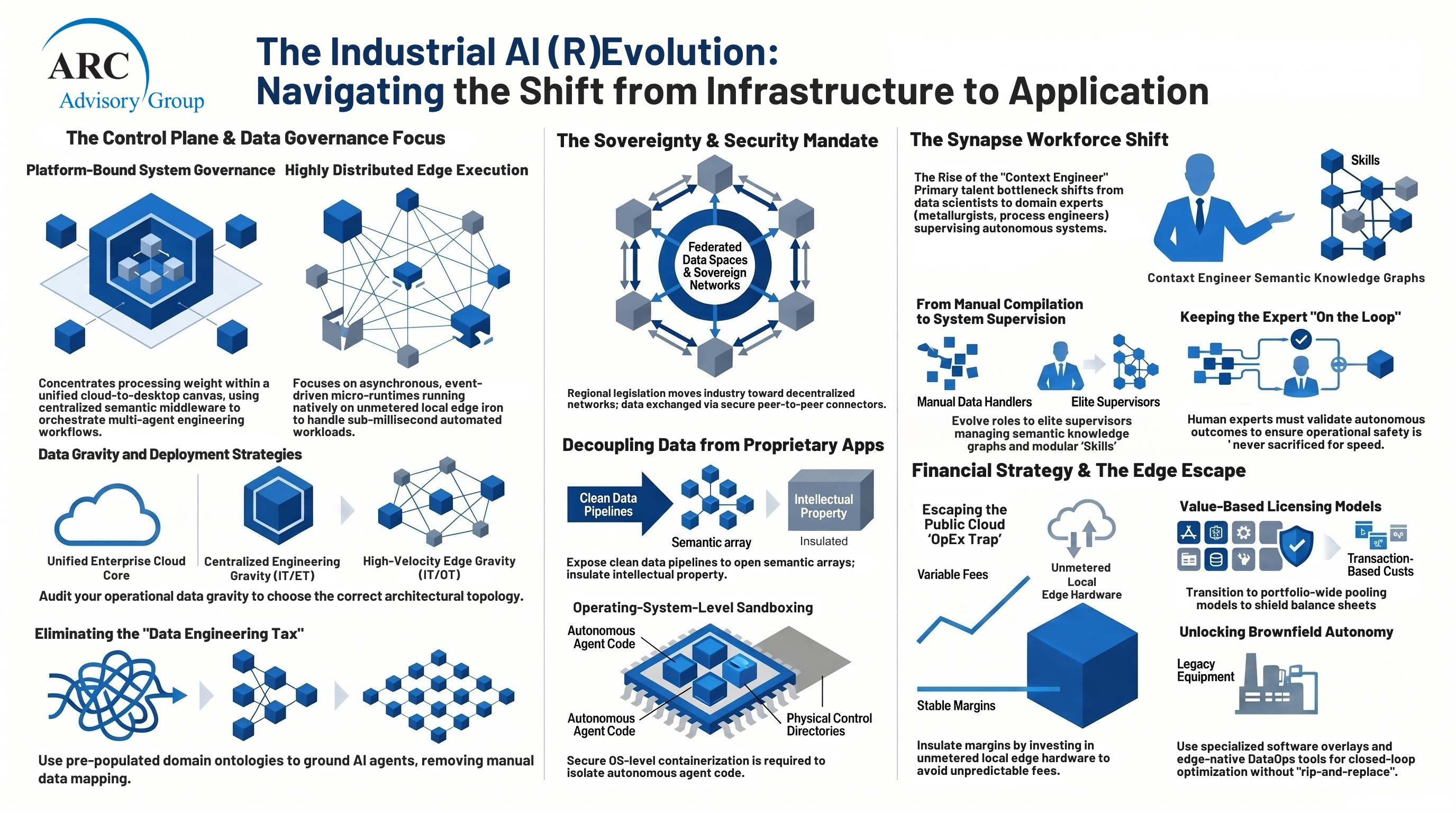
Welcome to the final installment of our deep-dive analysis series evaluating a remarkable week of global technological announcements—a milestone moment we may well look back upon as the definitive transition from the “Infrastructure Phase” of industrial artificial intelligence into the “Application Phase.” Over the past six entries, we have bypassed horizontal marketing hype to track how the convergence of custom edge silicon, unified enterprise data fabrics, and physics-grounded engineering models is fundamentally transforming the industrial sector.
Before we outline the broader competitive landscape, let us trace the logical arc established across this series:
Blog 1 (COMPUTEX, Taipei): We explored NVIDIA’s disclosures, examining how the transition to token-based computing metrics is forcing a total re-evaluation of hardware performance and thermodynamic design at the extreme edge.
Blog 2 (BUILD, Redmond): We analyzed corporate cloud and operating system architecture, mapping how new primitives like Windows Execution Containers are building a secure canvas for multi-agent automation.
Blog 3 (Realize LIVE, Detroit): We evaluated Siemens’ portfolio updates, showing how pre-populated domain ontologies within Intelligence Center X are eliminating the manual data engineering tax by grounding AI agents in physical reality and highlighting real-world virtual-first loops from pacesetters like PepsiCo.
Blog 4 (The Macro Synthesis): We unpacked the macro-level "Schism of Speed," presenting our global survey benchmarks to show how a trailing majority remains stuck in basic text pilots while an elite vanguard is disassembling the traditional Purdue Model.
Blog 5 (Financial Playbook): We delivered a playbook for the C-suite, demonstrating how industrial pacesetters are pairing unmetered local edge iron with value-based software pooling models to completely shield their balance sheets from the variable transaction fees of public cloud APIs.
Blog 6 (The Practical Edge): We explored the gritty operational trenches of brownfield facilities, proving how specialized software overlays, containerized virtual PLCs (vPLCs), and edge-native DataOps tools can unlock autonomy on legacy iron without requiring a cost-prohibitive equipment rip-and-replace.
Now, to bring this seven-part series to a definitive conclusion, we must zoom out to the global competitive map. Scaling industrial intelligence is no longer just a technical selection between software platforms; it has evolved into a geopolitical chess match defined by competing cloud rifts, sovereign federated data networks, and a fundamental reorientation of industrial labor.
As industrial organizations architect their long-term data fabrics, they face an escalating multi-billion-dollar infrastructure rift dividing the cloud landscape. This Hyperscaler Divide is characterized by two profoundly distinct philosophies of data gravity and computational scaling:
The Microsoft Strategy: Centered on building an edge-centric, operating-system-level canvas. By embedding execution sandboxes directly into the Windows and Azure enterprise core, Microsoft aims to act as the primary governance layer for multi-agent engineering workflows (ET) and corporate data fabrics (IT). This platform approach seeks to own the primary engineering interface, tightly linking low-code application tools and product lifecycle threads directly to automated enterprise intelligence layers.
The AWS Strategy: Focused heavily on top-down logistics, supply chain optimization, and highly distributed, containerized edge environments. Bounded by the strict deployment guidelines of the AWS Modern Industrial Data Technology Lens, AWS utilizes tools like AWS IoT Greengrass to localize inference loops for real-time computer vision and high-velocity machine telemetry. This edge architecture localizes automated decision-making to execute loops in milliseconds, funneling only compressed, metadata-rich decision packets back to a centralized cloud.
Partnerships with providers such as HighByte help AWS support industrial data flows across multi-vendor environments. More broadly, Microsoft is trying to influence the localized runtime environment of the plant, while AWS continues to emphasize cloud-scale services, data platforms, and distributed enterprise workflows.
This infrastructure divide means that enterprise leadership teams can no longer accept generic cloud migration paths. Selecting an infrastructure partner requires auditing where your operational data gravity lives—whether your primary operational bottleneck is localized desktop engineering silos or distributed supply chain logistics.
Concurrently, the rise of strict regional data legislation is shattering the concept of a single, borderless public cloud. Global manufacturing networks are running directly into regional data sovereignty walls, most visible in the construction of “Fortress Europe” through federated data spaces.
This hyperscaler rivalry is unfolding alongside stronger regional interest in data sovereignty and controlled data sharing, especially in Europe, where initiatives such as Catena-X have gained attention. For many manufacturers, the concern is how to exchange sensitive operational and product data without creating unnecessary dependency on a single centralized platform.
Catena-X represents a model for sovereign federated data spaces. Backed by European automotive stakeholders, it favors decentralized, standards-based data exchange in which participants retain control over what they share rather than relying on a single centralized data pool.
This model has gained urgency as European compliance requirements advance, including milestones tied to digital product passport initiatives and the Carbon Border Adjustment Mechanism (CBAM):
Digital Product Passport (DPP): Product-passport requirements are being phased in by product category. For batteries, the regulatory pathway is already under way, and broader DPP requirements are widely associated with 2027 and beyond rather than a single universal 2026 enforcement date.
Carbon Border Adjustment Mechanism (CBAM): CBAM enters its definitive period in 2026 for covered imports, with authorized declarants and annual declaration requirements applying from 2027. Manufacturers and importers therefore need auditable emissions and product-footprint data flows well before full reporting obligations mature.
Cross-industry standardization efforts, including the collaboration between Catena-X and the OPC Foundation, may help align OPC UA information models with data space architectures in support of Digital Product Passport and related use cases. In practice, this can help multi-tier enterprises share validated sustainability and quality information through controlled connectors without broadly exposing underlying machine parameters or intellectual property.
This architectural realignment brings us to the ultimate variable in the industrial autonomy equation: human capital. The primary talent bottleneck in modern industry is no longer about finding data scientists who can build models from scratch. It centers on arming your existing domain experts—your process engineers, metallurgists, and plant reliability veterans—with the precise semantic tools required to govern autonomous systems safely and predictably across the physical value chain.
We are witnessing the emergence of the Context Engineer within the broader Synapse Workforce Shift. Traditional knowledge workers spent their days manually compiling spreadsheets, writing custom integration scripts, and fighting protocol fragmentation. Context Engineers, by contrast, act as strategic supervisors of autonomous systems. They utilize low-code industrial workbenches, manage living semantic knowledge graphs, and calibrate token consumption using modular, prepackaged Skills. By keeping the expert human strictly on the loop to validate outcomes, industrial pacesetters are successfully scaling physical intelligence without sacrificing operational safety or tribal knowledge.
Rather than evaluating the final ledger through a narrow commercial selection between massive horizontal tech brands, industrial organizations should leverage the ARC Advisory Group 3-Axis Industrial AI Models Taxonomy and our corresponding Industrial AI Impact Assessment Tools to audit their technical execution across three vital vectors:
Axis 1: Application Domain (The Escalation Ladder of Physical Consequence): Maps where your intelligence engines are acting across the enterprise. This axis structures operations into a hierarchical framework, auditing execution from low-risk workforce enablers and basic industrial copilots up through high-consequence operational theaters—culminating in safety-critical, closed-loop machine optimization and autonomous kinetic control.
Axis 2: Model Class Sophistication (The Algorithmic Weaponry): Measures the specific engineering fitness of your deployed models. Pacesetting architectures reject the misapplication of generic, probabilistic large language models for continuous plant optimization. This axis grades your ability to execute a multi-model blueprint, pairing generative systems upfront as an exploration filter with domain-dense model classes—including Causal ML, Deep Reinforcement Learning, and Geometric Deep Learning Surrogates—for strict physical verification.
Axis 3: Domain Specificity, Governance, and Sovereignty (The Pacesetter Advantage): Audits the security boundaries and structural isolation of your data fabric. This axis evaluates how your system handles operational liability, data decoupling, and compliance with regional federated spaces. It measures your maturity in utilizing pre-populated graphs and operating-system-level sandboxes (like MXC) to ensure that incoming agents are structurally insulated from causing physical harm or triggering intellectual property exposure.
To translate this multi-part master series into an immediate operational roadmap, leadership teams must put their existing technology deployments through a rigorous, cross-functional audit:
Enterprise Canvas and Core Operating System Sandboxing: Have your corporate IT security architects established a verified operating-system-level containerization canvas—such as the Microsoft Execution Container (MXC)—to isolate autonomous multi-agent code execution and prevent unmanaged network traversals across your physical control directories?
The Industrial Context Layer and Pre-Populated Ontologies: Are your data science teams wasting capital attempting to manually map messy sensor tags to relational asset descriptions from scratch, or are you actively deploying pre-populated vertical ontologies that natively understand the complex lifecycle parameters linking design models (ET) straight to factory floor execution metrics (OT)?
The Digital Thread Recovery and The File System Crisis: What specific percentage of your critical product blueprints, geometry meshes, and machine schematics is still trapped on unversioned local desktop file systems, and have you formally elevated cloud-connected digital thread adoption from a basic IT project into a board-level corporate KPI to resolve the file system bottleneck exposed by Siemens?
Financial Tokenomics and The CapEx Edge Escape: Is your enterprise walking into an unpredictable public cloud OpEx trap by streaming high-velocity telemetry directly into cloud-metered APIs, or have you insulated your margins by investing up front in unmetered local edge iron running containerized agent sandboxes paired with portfolio-wide Value-Based Licensing pools?
Brownfield Realities and Domain-Specific Action Overlays: Is your digital transformation strategy stalled behind the capital cost wall of waiting for greenfield equipment upgrades, or are you capturing immediate throughput and reliability gains by deploying specialized software-first overlays and edge-native DataOps hubs to execute closed-loop reinforcement learning on your existing legacy iron?
Geopolitical Statecraft, Federated Sovereignty, and The Workforce Shift: How is your multi-site data sharing architecture being insulated to protect operational data sovereignty while actively preparing for upcoming 2027 Digital Product Passport cross-category mandates and 2027 CBAM annual declaration frameworks via peer-to-peer federated connectors, and are you systematically upskilling your veteran workforce from manual data handlers into elite Context Engineers?
The modern factory floor and process network have transitioned into a software-defined environment. Long-term survival across the digital divide requires an uncompromised commitment to cyber-physical architecture. By securing your core industrial context, investing in unmetered local edge processing, mandating value-based software pooling models, and transforming your frontline professionals into elite Context Engineers, your enterprise can successfully eliminate pilot purgatory, assert absolute data sovereignty, and lead the autonomous era.
The Industrial AI (R)Evolution is moving faster than ever. To dive deeper into the frameworks and data shaping the future of the industrial sector, explore my latest research:
Navigating the AI Wars and the escalating Industrial Robot Wars
Closing the Digital Divide by Embracing Industrial AI
Assembling your Industrial-Grade Data Fabric
Charting the new frontier of Physical Intelligence and transitioning to a Cyber-Physical Industrial Architecture (CPIA)
Mapping your maturity and strategy with ARC's 3-Axis Industrial AI Models Taxonomy
Take our Industrial AI Assessment to benchmark your organization's maturity, identify critical gaps in your IT/OT/ET convergence, and get actionable recommendations to accelerate your path to becoming an Industrial AI Pacesetter.
Don't guess what your global operations or prospective customers need. Use empirical data to align your stakeholders and de-hype the market with ARC Advisory Group's Voice of Market Service.
For tailored recommendations on governing and guiding major people, process, and technology decisions across the enterprise, cloud, industrial edge, and AI, please contact Colin Masson at [email protected].
Or, set up a meeting with my fellow Analysts and I at ARC Advisory Group to find out more about our Executive Insights Service for Industrial organizations and our Industrial AI Insights Service for Vendors.