Representative End User Clients







Representative Automation Clients







Representative Software Clients










Hitachi has launched HMAX Data Center, a portfolio of solutions designed to help support more sustainable and integrated data center operations. The offering brings together energy, IT, and cooling infrastructure capabilities to help enable AI-powered autonomous operations, maintenance, and optimization across data center environments.
The launch comes as rapid AI adoption is driving greater demand for data center capacity and increasing the energy required for server operation and cooling. At the same time, tighter interdependencies between IT workloads and facility operations are making infrastructure management more complex, while siloed operating models can limit efficiency and operational stability.
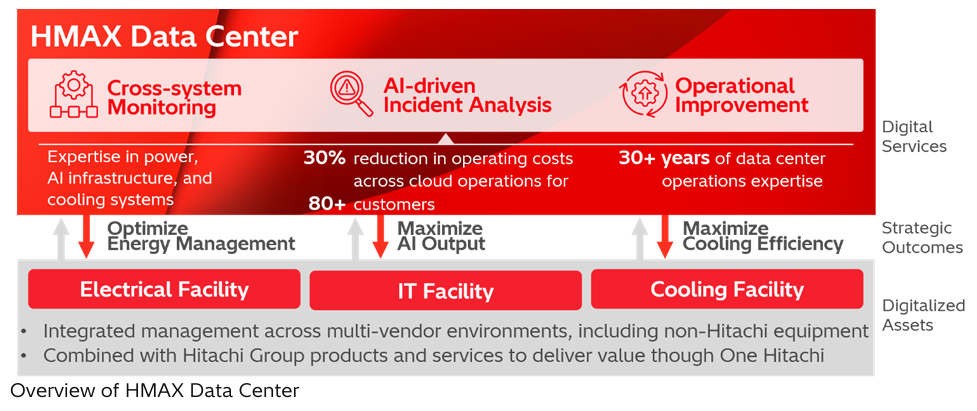
HMAX Data Center brings together Hitachi’s capabilities across IT, operational technology, and infrastructure products. The first offering in the portfolio is HARC for Data Center, an integrated data center management service initially available to customers in North America.
Built around Hitachi Application Reliability Centers (HARC), the service combines Hitachi’s operational expertise with Physical AI to provide integrated monitoring of multi-vendor power, IT, and cooling infrastructure. HARC has previously supported cloud operations for over 80 customers globally, and Hitachi reports that the platform has helped to reduce cloud operating costs by approximately 30 percent.
The service uses operational data from IT infrastructure, as well as power, cooling, energy management, safety, security, and environmental monitoring systems to help provide broader visibility across the data center. AI-powered anomaly detection and cross-domain analysis are used to help identify potential equipment issues, operational risks, and service impacts.
When incidents occur, HARC for Data Center correlates alerts, equipment conditions, and infrastructure dependencies to help support root cause identification, recommended countermeasures, escalation, and recovery. The service also supports post-incident reporting and continuous improvement activities intended to help improve operational resilience and service levels.
Hitachi plans to expand the HMAX Data Center portfolio through customer and partner co-creation. Future capabilities are expected to further address energy optimization across grid power, on-site generation, and battery storage; cooling efficiency; predictive anomaly detection; IT workload optimization; and facility capacity management.
The broader objective is to move away from optimizing individual infrastructure assets in isolation and toward integrated management across energy, cooling, and IT systems. This approach is becoming increasingly relevant as AI workloads are driving higher power densities and placing greater demands on data center infrastructure.
ARC has been tracking the growing convergence of AI infrastructure, power systems, cooling, and data center operations.
Hitachi and OpenAI Form Strategic Partnership to Advance Global AI Data Center Expansion
Siemens and Partners Develop Reference Architecture Purpose-Built for NVIDIA AI Data Centers
Power, Cooling, and AI: How Industrials are Enabling the Next Wave
As AI workloads continue to increase power density and operational complexity, integrated management of energy, IT, and cooling infrastructure will become increasingly important for improving data center efficiency, reliability, and resilience.