Representative End User Clients







Representative Automation Clients







Representative Software Clients








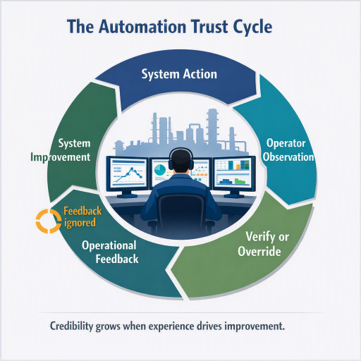
Operator distrust is often rational but not always caused by technical failure alone. It can develop through repeated exposure to nuisance alarms, opaque automated behavior, failed recommendations, awkward interfaces, weak training, unclear decision rights, and projects introduced without enough frontline involvement. It may also reflect limited experience with a new capability, inconsistent local practices, or concern about changing roles.
Technical managers should therefore treat distrust as diagnostic evidence rather than resistance to overcome. The task is to determine whether skepticism is warranted and what it reveals about signal quality, system performance, transparency, participation, competence, support, or operating discipline before greater authority is delegated to automation.
Operators rarely experience an automation architecture as a diagram. They experience it through alarms, trends, displays, automated sequences, setpoint changes, procedures, and the response they receive when something goes wrong. A system earns credibility when those interactions consistently reflect plant reality. It loses credibility when users must compensate for poor design or incomplete context.
Experienced operators often develop practical workarounds because maintaining safe, stable production requires judgment. Those workarounds can be misread as resistance, although they may show that the formal system does not adequately support work as performed. They should not be accepted uncritically, however: an informal practice may preserve performance, conceal a design defect, or introduce a new risk. Each case needs operational review.
Automation can perform reliably during routine operation yet become difficult to interpret when conditions move outside familiar patterns. Research on automated and remote oil & gas operations identifies poor interface design, alarm problems, loss of situational awareness, vigilance demands, and inadequate preparation for unexpected events as safety concerns. These findings support a sociotechnical diagnosis: performance depends on the technology, the interface, task allocation, training, procedures, staffing, and organizational response, not on operator attitude alone.
Distrust also grows when technology is framed as a replacement for expertise or when responsibility remains with operators while authority shifts to an opaque system. Operators are more likely to engage when automation reduces routine burden, improves context, and makes proven practices repeatable without obscuring accountability. Early participation gives operational knowledge a route into use-case selection, function allocation, interface design, validation, and recovery planning before weak assumptions become embedded.
Credibility grows through demonstrated performance, clear operating limits, understandable behavior, and visible evidence that feedback produces improvement. Plants should begin with bounded use cases in which operators can compare recommendations or actions with known process behavior. Validation should cover normal, abnormal, degraded, and recovery conditions, not only average accuracy. Teams should document overrides, rejected recommendations, unexpected actions, and successful interventions, then investigate what those events reveal.
Leaders should avoid demanding trust. Trust is an expectation; reliance is a behavior shaped by capability, consequence, context, and available alternatives. The objective is justified reliance: operators use automation when evidence supports it, verify or challenge it when uncertainty or consequence warrants caution, and can intervene through clearly defined authority and escalation paths.
Include operators in use-case selection, function allocation, design reviews, testing, and post-deployment learning.
Distrust alone does not explain behavior. The next article examines how people calibrate reliance, including the risks of both undertrust and overtrust.
ARC research on operator effectiveness, control-room design, human-machine interfaces, and alarm management reinforces the practical point that adoption is shaped by the quality of daily operating interactions. Operator workarounds, overrides, and rejected recommendations should therefore be treated as evidence for design and lifecycle improvement.
SINTEF review, Human Factors and Safety in Automated and Remote Operations
World Economic Forum, Human-Machine Collaboration in Industrial Operations
For further information or to provide feedback, contact [email protected].