Representative End User Clients







Representative Automation Clients







Representative Software Clients









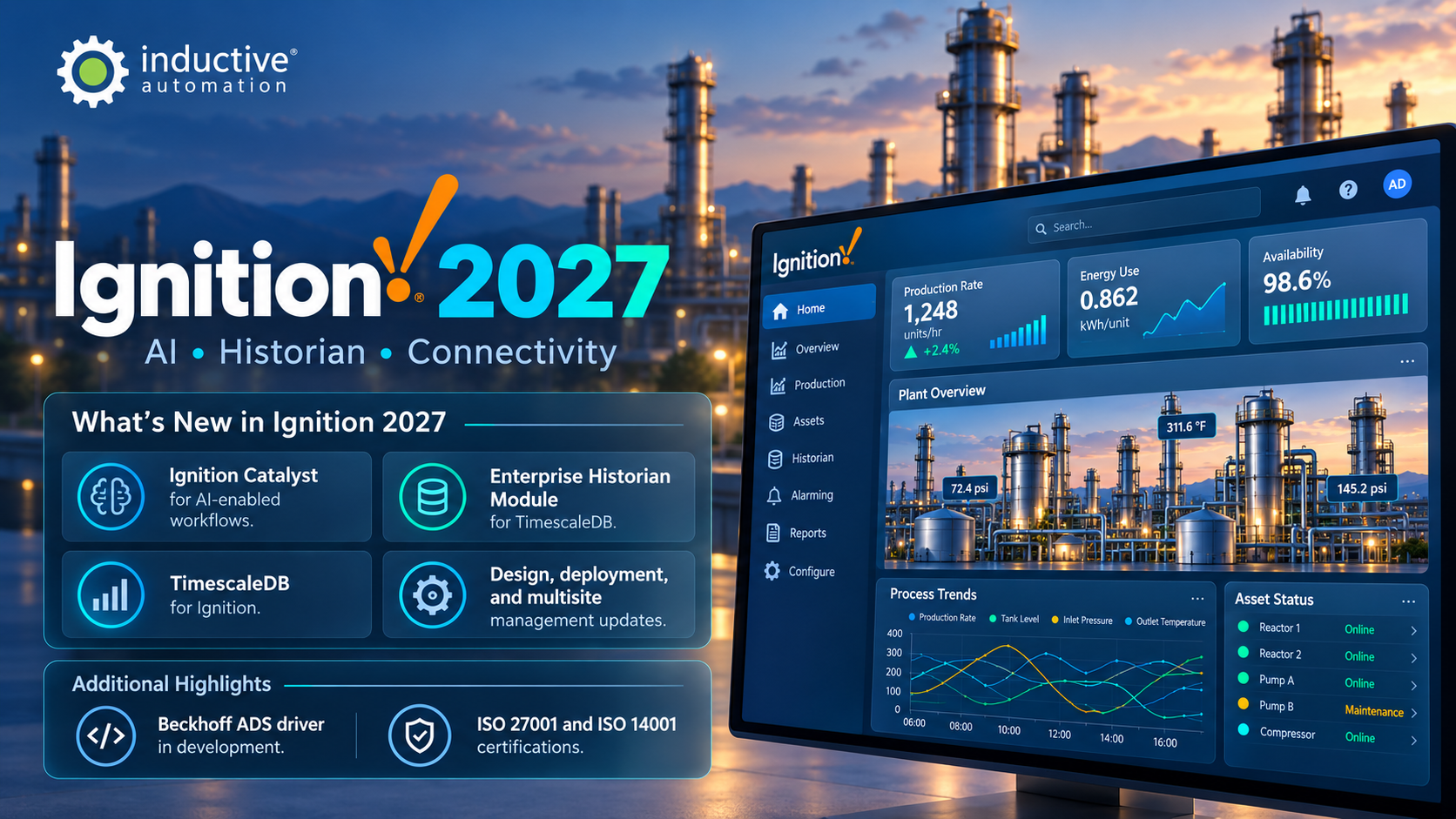
Inductive Automation announced Ignition 2027 at its 2026 Ignition Community Conference (ICC), held September 22–24 in Sacramento. The release introduces new capabilities for AI-enabled workflows, operational data management, automated deployments, and multisite system management. The company also announced a strategic partnership with Tiger Data, a Beckhoff Technology Provider relationship, ISO 27001 and ISO 14001 certifications, and new customer-support initiatives.
ICC 2026 also highlighted the continued evolution of Ignition beyond its traditional SCADA role toward a broader foundation for industrial applications, data operations, connectivity, and AI-enabled workflows. The direction reflects growing demand for industrial software platforms that can support modernization, enterprise-scale data architectures, and reusable deployment models while maintaining governance and operational reliability.
Ignition 2027 includes Ignition Catalyst, a framework for working with AI within the Ignition platform. Inductive Automation also announced a new Enterprise Historian Module for TimescaleDB and a new edition of TimescaleDB for Ignition.
The release additionally includes updates to design tools, automated deployments, and multisite management. These capabilities extend the platform’s focus beyond application development to include the management of distributed industrial systems and their underlying operational data.
Key announced capabilities include:
Ignition Catalyst: A framework for developing and using AI-enabled functionality within Ignition.
Enterprise Historian Module for TimescaleDB: A new module intended for larger-scale and high-availability historian deployments.
TimescaleDB for Ignition: A new TimescaleDB edition for use with the Ignition platform.
Deployment and Management Updates: Enhancements to design tools, automated deployments, and multisite management.
Taken together, these enhancements also reflect increased emphasis on lifecycle management, repeatable deployment, governance, and enterprise-scale standardization. Capabilities such as deployment automation and multisite management become increasingly important as organizations move from individual automation projects toward broader architectures deployed across multiple plants and operational environments.
The AI direction presented at ICC focused largely on assisting engineers and providing controlled access to industrial context rather than enabling unrestricted autonomous operations. Ignition Catalyst is intended to support AI-assisted development and user-defined AI capabilities while allowing organizations to choose the AI models they connect to the platform.
This approach reflects an emerging pattern in industrial AI. Near-term applications are increasingly centered on engineering assistance, diagnostics, contextual interaction with operational information, and other constrained workflows where AI can augment existing processes without assuming direct control of operations.
For industrial users, governance and control over data access will remain important as these capabilities develop, particularly as AI becomes more closely integrated with operational systems and production data.
Inductive Automation named Tiger Data as a Strategic Partner. The two companies collaborated on TimescaleDB for Ignition and the Enterprise Historian Module. Inductive Automation will sell and support the TimescaleDB offering for Ignition.
The announcement also reflects the changing role of industrial historians within broader data architectures. As organizations retain greater volumes of time-series data and connect operational information with analytics and AI applications, historian platforms are increasingly being evaluated for scalability, query performance, interoperability, and their ability to fit within enterprise data strategies.
The use of TimescaleDB, which is built on PostgreSQL, gives Inductive Automation a SQL-oriented foundation for addressing these requirements while extending its historian capabilities for larger-scale deployments.
Beckhoff has also joined Inductive Automation’s Technology Provider program. The companies are developing an ADS driver module for Ignition 2027 that will enable direct connectivity between Ignition and Beckhoff TwinCAT controllers. The module is intended to remove the need for third-party middleware or separate licensing for that connection.
More broadly, open architecture remained a recurring theme at ICC 2026. Technologies and standards including OPC UA, MQTT, Sparkplug, and emerging approaches to industrial data modeling address different layers of interoperability but share a common objective of reducing bespoke integration and making operational data easier to use across systems.
This becomes increasingly important as industrial organizations connect automation, industrial data platforms, analytics, and AI applications across heterogeneous environments.
Inductive Automation announced that it has achieved ISO 27001 certification for information security management and ISO 14001 certification for environmental management.
The company also announced an East Coast office in Maryland and a unified Client Services Team. The new team brings together sales, support, and community-management functions.
The announcements at ICC 2026 position Ignition 2027 around several related priorities: applying AI within industrial applications, managing growing volumes of operational time-series data, improving repeatability and governance across distributed deployments, and expanding connectivity across industrial automation environments.
ARC has been following Inductive Automation’s evolving platform strategy, including its focus on open architectures, industrial data management, software-defined automation, cybersecurity, and edge deployment. Related ARC coverage includes:
These related developments provide additional context for Ignition 2027 and the broader shift toward more open, scalable, and data-centric industrial software architectures.