Representative End User Clients







Representative Automation Clients







Representative Software Clients









As manufacturers move from connected operations toward more intelligent and autonomous production environments, the ability to build a strong digital foundation is becoming increasingly important.
At the Manufacturing Innovation Conclave during ARC Advisory Group’s 24th India Forum in Bengaluru, held July 9–10, 2026, Arun Gopalaswamy, Head of Digital Manufacturing at ITC, presented “The Art of Possible in Digital Manufacturing.” Drawing on ITC’s experience across multiple production facilities, he discussed how manufacturers can move beyond isolated AI initiatives and embed artificial intelligence (AI) within a broader digital transformation strategy.
ITC’s presentation, “The Art of Possible in Digital Manufacturing,” can be viewed on YouTube or here:
The central message was clear: while AI has the potential to reshape manufacturing operations, its success depends on the strength of the underlying digital foundation. Organizations seeking to unlock value from AI must first create connected, data-driven operations that enable informed decision-making at scale.
Artificial intelligence has become a strategic priority for manufacturers. From predictive maintenance and quality assurance to supply chain optimization and autonomous operations, organizations are exploring how AI can improve productivity, operational efficiency, and business resilience.
However, many manufacturers remain challenged by fragmented data environments. Production systems, maintenance records, quality data, and operational knowledge often exist in silos, limiting visibility across the enterprise. In such environments, AI cannot deliver its full potential. Technology alone cannot compensate for disconnected processes or inconsistent data.
As manufacturing evolves beyond Industry 4.0, the focus is shifting from connected factories to intelligent factories that can interpret information, generate insights, and support operational decisions. Achieving this vision requires more than deploying AI tools. It requires a structured approach to digital maturity.
A recurring theme throughout the session was the importance of establishing a robust digital foundation before embarking on large-scale AI initiatives. Manufacturing organizations generate vast volumes of data from machines, sensors, production lines, quality systems, maintenance activities, and enterprise applications. Yet data becomes valuable only when it is connected, contextualized, and accessible across functions.
Manufacturers that successfully leverage AI typically begin by integrating critical operational systems, improving data visibility, and standardizing workflows. Once this foundation is established, advanced technologies can be deployed more effectively and scaled with greater confidence.
The lesson is straightforward: AI is not the starting point of digital transformation. It is an accelerator built on strong operational processes, connected data, and a digitally mature organization.
The session highlighted several examples of how AI can support business value in manufacturing environments.
One of the most mature use cases is AI-powered visual inspection. Traditional quality-inspection processes often rely on manual observation, introducing variability and limiting consistency. By combining machine vision with advanced AI models, manufacturers can inspect products in real time, identify defects more accurately, and maintain consistent quality standards across production lines. These systems can improve inspection coverage while reducing reliance on manual intervention.
Another area gaining traction is predictive maintenance. By analyzing machine data collected through sensors, manufacturers can identify early indicators of equipment failure and take corrective action before breakdowns occur. Potential benefits include reduced downtime, improved asset utilization, and more efficient maintenance planning. Successful implementations focus not only on advanced analytics, but also on presenting information in ways that enable operators to make timely and informed decisions.
The discussion also explored autonomous process optimization, in which AI continuously monitors production conditions and adjusts process parameters to maintain product quality and operational efficiency. While fully autonomous manufacturing remains an evolving capability, organizations are increasingly deploying AI-driven systems that support operators and gradually build confidence in automated decision-making.
Digital twins are emerging as an enabler of intelligent manufacturing. By creating virtual representations of physical assets, production lines, or entire facilities, manufacturers can simulate operational scenarios and evaluate potential improvements before implementing changes in the real world.
These models allow organizations to optimize throughput, identify bottlenecks, evaluate alternative production strategies, and improve resource utilization without disrupting ongoing operations. As a result, digital twins can help reduce waste, improve efficiency, and support data-driven decision-making.
Rather than being viewed as a futuristic concept, digital twins are increasingly becoming an integral component of modern manufacturing strategies.
The value of AI extends beyond production operations. Supply chain management represents a significant opportunity for AI-driven transformation. Advanced forecasting models can analyze historical demand patterns, seasonal variations, customer behavior, and external market factors to improve planning accuracy and responsiveness.
Integrating external data sources, such as weather forecasts and logistics information, can also help manufacturers anticipate disruptions and manage operational risks proactively. These capabilities can support more resilient supply chains while improving service levels and inventory efficiency.
The session emphasized AI’s role in enhancing human capabilities. AI-powered knowledge systems can capture organizational expertise and make it available to employees through intuitive conversational interfaces. Operators can access troubleshooting guides, maintenance procedures, and technical documentation quickly and efficiently, often in their preferred language.
Similarly, wearable technologies and remote-assistance platforms can improve collaboration between experts and frontline teams, enabling faster problem resolution, enhanced safety, and more effective knowledge transfer.
AI is most effective when positioned as a tool for empowering people, improving decision-making, and augmenting human expertise.
For manufacturers evaluating their AI journey, the path forward begins with a clear understanding of operational priorities. Rather than pursuing large-scale transformation programs from the outset, organizations should focus on high-impact business challenges, establish strong data foundations, and build internal digital capabilities.
Targeted pilot projects can demonstrate measurable value, build organizational confidence, and provide a blueprint for broader adoption. As digital maturity increases, manufacturers can progressively scale AI applications across quality management, maintenance, supply chain operations, and production optimization.
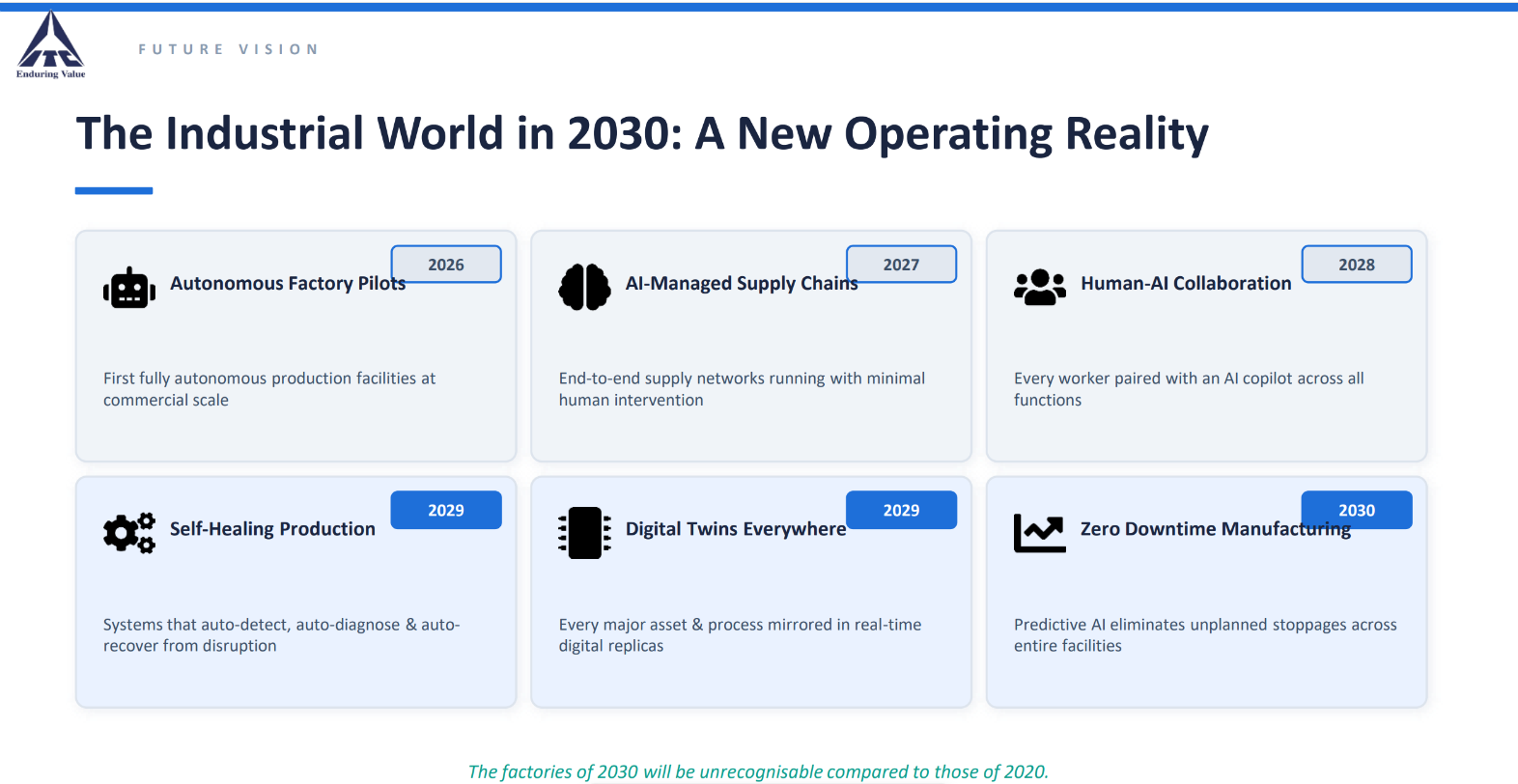
The future of manufacturing will be shaped by the convergence of connected systems, intelligent technologies, and skilled people. While AI has emerged as a powerful catalyst for transformation, its success ultimately depends on the quality of the digital foundation that supports it.
Manufacturers that invest in data connectivity, operational visibility, traceability, and workforce enablement will be better positioned to capitalize on the next generation of intelligent manufacturing capabilities. The key question is no longer whether AI will play a role in manufacturing, but whether organizations are building the foundational capabilities required to realize its full potential.