Representative End User Clients







Representative Automation Clients







Representative Software Clients








Over the years, I’ve been on many brewery and winery tours around the world – from Netherlands to Belgium to the US. The one thing that never ceases to amaze me is how much they could benefit from additional automation – even today – after 30 years of touring. While on a recent vacation this year in the US, I did not miss an opportunity for some additional tours; including two breweries and a winery.
One of the newest breweries in the US, Sierra Nevada in Mills River, NC, was built less than three years ago. Sierra Nevada invested over $110 million in the new production facility in 2014, which is designed to produce between 5,000 – 6,000 barrels of beer a week. The drive in to the facility was most impressive and included several bridges, stone retaining walls, and lovely landscaping. While clearly a showplace with lots of shiny new tanks, the 300,000-square foot, two-story brewery had numerous silos of automation and still required plenty of human intervention. As I had expect, this facility seemed to be a little more automated than the older facility, but not to the extent that I expected.
The tour schedule for Sierra Nevada required a reservation and was full, so we did the self-tour. While there appeared to be much to be impressed by, in my opinion, however, even newer breweries like this could use some automation updates.
The other brewery – the oldest brewery in the US, Yeungling, is located in an old building that is built into a mountain right in the center of downtown Pottsville, PA with some of the original manufacturing facilities still in operation. While this facility with it’s caves, had some older automation, circular charts and pressure indicators and older tanks, it still seemed to produce excellent tasting beer – and quite a lot of it! According to the tour guide, they only recently went from mostly manual controls to some automation. Cleaning in place for the Lauter Tank is now automated, although most of the other tanks are still manually cleaned three times a day. The mostly silos of automation that we could see as we toured appeared to be manual operations with a pushbutton setup.
Yeungling has two other breweries on line and has just purchased another brewery to meet demand. The plant I toured in Pottsville produced some bottles and can produce as many as 35,000 cases of beer per day according to our tour guide.
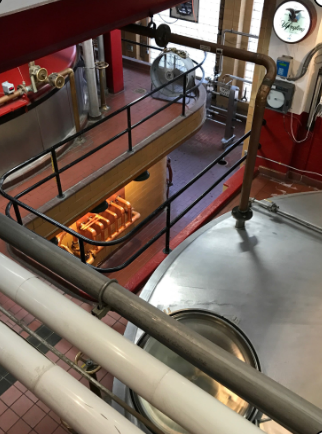
It was difficult to see if the company had an automated batch process but my guess would be that the newer tanks included instrumentation and automation that included clean in place for all of the tanks. Having an automated clean-in-place (CIP) system, eliminates the need to have an operator to climb inside the fermenter after each batch to scrub the tank. Some of the raw materials were left in the middle of the room and there appeared to be more human intervention that expected.
Packaging is always one of the most interesting areas because it seems to be the most automated and is always a fast moving area, and neither brewery let us down in this area. Both breweries had most of their automation in the packaging area. Both facilities seemed to meet their needs with newer equipment in this area.
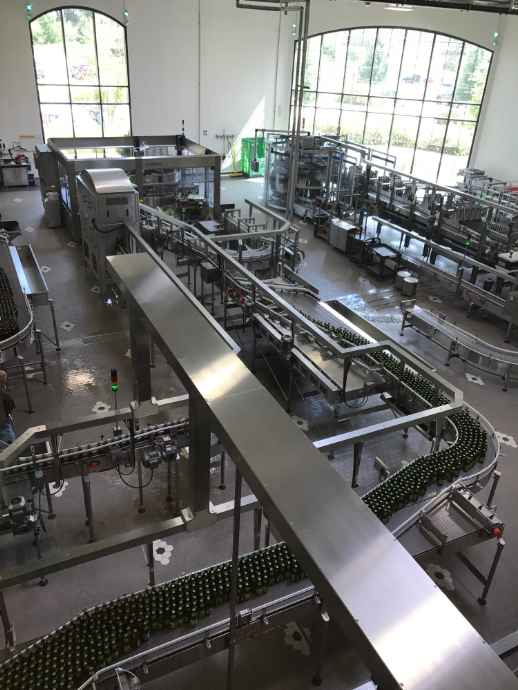
One thing that surprised me at the Sierra Nevada Brewery, was that the very automated packaging room still requires the operator to run from one end of the line to another to push the button that shuts down the line when there is a problem. I saw this happen three times in a few minutes. It surprised me because all the equipment, tanks and packaging lines were so shiny and new. I expected to see modern automation with mobile devices enabled. I did not see any lines shut down at the oldest brewery while I was there.
On the winery tour in Charlottesville, VA, I spoke with winemaker, Jonathan Wheeler, who said the reason they are not more automated is because it is more of an art and requires tweaking for the right taste, although he claimed that some of their Chardonnays and other white wines were more automated but they did not show this process.
I still think once the taste is perfected in the winemaking process – it should be possible to automate to a certain degree for consistency, improved quality, branding, and easier cleaning. Of course all the results for breweries and wineries are subject to variations from the raw materials – the grapes, hops, yeast, etc. I suppose the variation is part of the art of production. However other manufacturing processes in other industries deal with material variations and adjust the process automatically using operational analytics and automated controls to account for variations so that the product is consistent, of high quality, safe and produced efficiently at the lowest cost. I think that the US needs to catch up to some of the wineries and breweries in other countries that are more automated and run almost continuously with less human intervention. Still all of the tours were interesting – and the products I tried seemed to be of high quality and excellent taste.