Representative End User Clients







Representative Automation Clients







Representative Software Clients









ABB’s Innovation and Technology Day held at the company’s US robotics headquarters in Auburn Hills, Michigan highlights a commitment to US manufacturing. The timing for the event followed on the heels of the company’s astounding acquisition of B&R Automation.
 The purpose of this open house was to demonstrate the company’s commitment to North American manufacturing with the expansion of its robotics production in the local market. ABB remains one of the leading robotic suppliers globally and the robotics group has been riding the surge in demand for robotic automation in North America.
Robotic systems have benefited from the technological advances in computing power along with significantly lower price points, leading to adoption across a wider range of industries. Robotic solutions address the seemingly insatiable demand in manufacturing today to increase flexibility, improve productivity, and employ human operators only in tasks where they can add the most value.
ABB is expanding its own production operations to respond more rapidly to customers. By expanding the local production of robots in Michigan, the company will be able to support unique requirements for the local market, while also increasing its technical support capabilities. The demand for robotics has diversified across a broader range of industries, leading to a surge in the demand for robotics even in this mature region. While robotics is a relatively mature technology in the automotive industry, ARC is seeing increased usage in food & beverage, electronics, healthcare, and logistics. These industries bring a unique set of application problems that require more robust application deployment methods.
Robots on the Rise
ABB and other market participants anticipate continued demand for robotics into the foreseeable future. However, the race is on to develop and implement technology that will lower the cost of integration.
 The percentage of robotic deployments incorporating machine vision is improving the flexibility to some degree. The demand for flexible robotics is being met with technological advancements in “teaching” techniques, safe collaborative systems, and improving business fundamentals. The fundamentals in the robotics business demand depth in application expertise, short delivery times, and service - all close to the customer. North American manufacturers seek faster deployment times along with shorter delivery of automation products to expand local production to improve turnaround times when design changes are introduced in finished products.
While some competitors have been able to keep up with robotic application deployments by increasing the number of channel partners, this strategy will eventually run out of steam as the expertise in the market is limited.
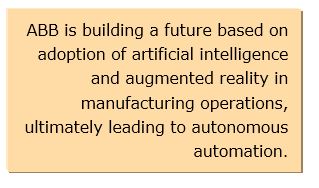
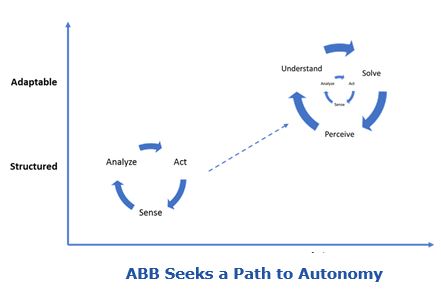
In contrast, ABB is building a future vision for manufacturing that includes more collaborative and adaptable robotics, artificial intelligence, and augmented reality; ultimately leading to autonomous automation. This is a step change in discrete manufacturing. Machine builders and system integrators understand how to incorporate flexibility and, in some cases, adaptability into automation systems. But autonomous automation requires artificial intelligence to enable systems to adapt to unplanned scenarios.
The vast majority of robotic deployments today assume a relatively rigid manufacturing environment in which production parts are uniform and a consistent strategy is applied for a robot to perform the necessary operations. Robotic “teaching” capabilities have been substituted for application programming to lower the technical skills required to deploy an application. In contrast, machine vision systems use a combination of conventional programming techniques and some teaching techniques. But in most manufacturing applications, these systems require redeployment every time there is a change in production. ABB envisions that artificial intelligence will displace “teaching” and “application programming,” allowing more rapid deployment. The cost of deployment should decline considerably, enabling small- to-medium-size businesses to adopt the technology.
Investments in Artificial Intelligence
ABB is investing in artificial intelligence through a series of ventures, which include the companies Vicarious, PointGrab, and Bonsai. Vicarious develops artificial general intelligence for robots that combine insights from generative probabilistic models with systems neuroscience. PointGrab’s sensing platform runs deep learning algorithms on a low-cost, embedded ARM-based processor. It is primarily designed for indoor occupant analytics and energy savings in commercial buildings. Bonsai provides a platform for machine teaching and machine learning to help automate the complex, low-level mechanics of machine learning. In addition, the company acquired NUB3D. NUB3D offers 3D digital scanning sensor technologies for quality control that can detect defects on a manufactured part with extremely high accuracy.
While these companies are not all directly related to robotics, they all focus on developing systems with the ability to learn about unstructured environments. Exactly how ABB plans to incorporate the intellectual property being developed at each of these ventures remains to be seen. However, the company does have a vision to amplify the human and machine potential with artificial intelligence.
Factory-floor operators will see a layer of artificial intelligence used to assist them with tasks that require human intervention; basically, amplifying the human potential. Artificial intelligence in robotic systems will displace “teaching” methods widely employed today. For example, artificial intelligence will enable robots to evaluate a new production piece independently, allowing them to determine how to pick up the part. No programming or teaching is required.
Conclusion
By expanding its robotics footprint along with the addition of B&R Automation’s base of discrete production systems expertise in North America, ABB is well-positioned to take advantage of the significant opportunities on this continent. The company has become a competitive alternative in North America for manufacturers seeking innovative, single-source production systems. The company’s impressive commitment to innovation and significant investments in related strategic acquisitions will lead to business growth.
Augmented reality and artificial intelligence are no longer over the horizon, but are viable technologies that all manufacturers should consider incorporating into their current operations. By building the bridge to autonomous automation sought by virtually all manufacturers today, it appears that ABB is bringing a sense of excitement back into manufacturing.
ARC Advisory Group clients can view the complete report at ARC Client Portal on Office 365 or Box.com or New Client Portal on this website
If you would like to buy this report or obtain information about how to become a client, please Contact Us
Keywords: Robots, Artificial Intelligence, ABB, Innovation and Technology Day, ARC Advisory Group.