Representative End User Clients







Representative Automation Clients







Representative Software Clients








Hi, Colin Masson here—Director of Research for Industrial AI at ARC Advisory Group—sharing some fresh thoughts. Over the years tracking AI’s evolution in the industrial space, I’ve seen technologies rise and fade, with moments of real promise and others where progress felt like feeling our way through a maze in the dark. Right now, I’m deep into conversations with end users and vendors for my upcoming Market Landscape and Archetype Reports on Industrial-Grade Data Fabrics. Amidst these discussions, a new development kept surfacing that I felt was worth highlighting. It’s a protocol that’s catching the attention of many exploring Agentic AI to unlock the full potential of Industrial AI: the Model Context Protocol, or MCP.
And yes, while the acronym 'MCP' might mean something else to some, in this case, it's all about making our AI systems smarter—nothing more, nothing less.
For quite some time, one of the key challenges in Industrial AI has been helping AI truly understand the complexity of the industrial environment. The data involved spans a wide range—from sensors and machines to historical logs and enterprise systems. While this data is abundant and valuable, its fragmented nature has made seamless integration with AI models a particularly difficult task.
Industrial AI is evolving at a rapid pace, bringing with it a surge of new data formats, communication protocols, and system architectures. In this increasingly intricate environment, it’s become critical for AI models to efficiently connect with vast and varied industrial data and tools. This is where the Model Context Protocol (MCP) comes in—a new standard that’s gaining significant traction in the industrial AI space. Originally developed by Anthropic to boost the capabilities of its Claude model, MCP has since been open-sourced, reflecting a strong push toward collaboration and standardization in AI. At its core, MCP acts as a crucial translator, allowing Large Language Models (LLMs) to seamlessly interact with the complex and diverse world of industrial data systems and operational tools.
To understand how MCP works, think of it as a universal translator. It provides a standardized way for AI applications to interact with a wide range of data sources. In the fragmented world of industrial AI—where systems and data often "speak" different languages—MCP introduces a common communication layer to bring coherence. Picture an AI assistant that can understand the complex terminology of Programmable Logic Controllers (PLCs) and SCADA systems without needing in-depth knowledge of every unique industrial protocol.
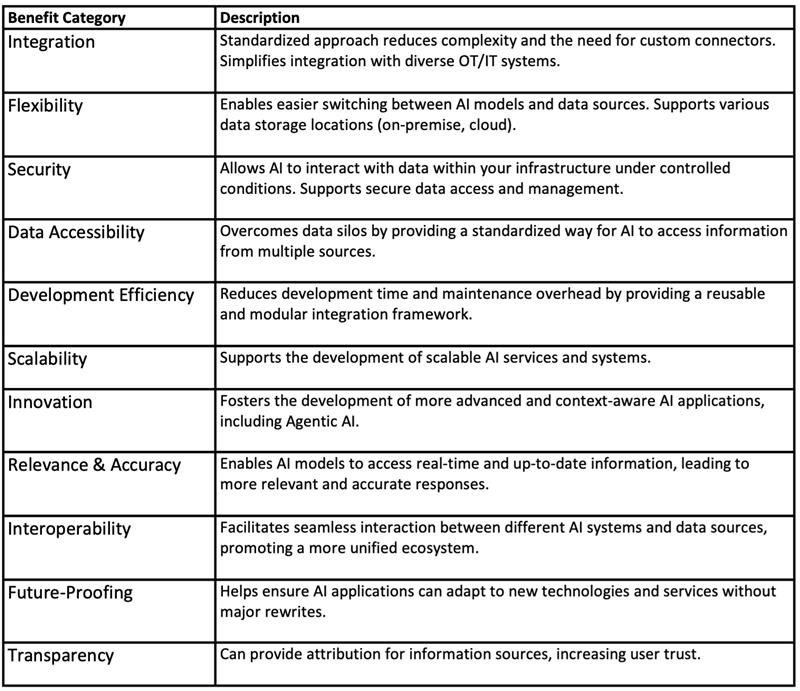
MCP brings several important advantages to industrial AI, particularly in the areas of standardized integration, flexibility, and security. By replacing the need for custom-built connections between AI models and industrial systems, MCP streamlines integration making it easier for AI to interact with various tools and data sources. Its flexible design allows AI to access data regardless of where it resides—whether on legacy on-premise systems or in the cloud—and supports smoother transitions between different AI models, helping to avoid vendor lock-in. Security is another key strength; MCP is built to ensure that sensitive industrial data remains within the organization’s infrastructure, while still allowing AI to process it securely under strict access controls.
A major hurdle in industrial operations is the presence of data silos, where vital information is trapped within individual systems or departments. MCP helps address this by serving as a bridge between these isolated data sources, making them more accessible to AI systems. With a standardized pathway to tap into various repositories, MCP enables AI models to build a more comprehensive view of industrial processes—cutting through the confusion of disconnected data and bringing greater clarity and context to decision-making.
Anthropic’s decision to develop and open-source MCP marks a significant step forward for industrial AI. By making the protocol freely available, the company has created space for innovation and collaboration across the community. This open approach encourages collective input and ongoing refinement, helping ensure that MCP continues to evolve in ways that address the unique and complex needs of the industrial sector.
Early insights indicate that MCP could play a transformative role in shaping the future of Industrial AI architectures. The idea of AI agents effortlessly operating within complex industrial settings—tapping into real-time data and making informed decisions through a unified protocol—is a powerful one. By introducing a standardized method for integration, MCP may be the missing link needed to unlock scalable, efficient, and truly intelligent AI solutions across the industrial landscape.
I hadn’t planned to kick off 2025 with a three-part series on MCP, but the momentum and enthusiasm surrounding its potential made it impossible to ignore. In the next part, I’ll dive into the critical role Unified Namespaces play in building a strong data foundation for industrial AI—and how MCP could seamlessly connect with this rich information layer. The final installment will look at what’s possible when MCP intersects with other emerging standards, potentially in collaboration with groups like CESMII, to envision what the future of Industrial AI could look like.
For ARC Advisory Group recommendations for Navigating the AI Wars, Closing the Digital Divide by Embracing Industrial AI, assembling your Industrial-Grade Data Fabric, and governing and guiding major decisions about enterprise, cloud, industrial edge, and AI software, please contact Colin Masson at [email protected] or set up a meeting with me, or my fellow Analysts at ARC Advisory Group.