Representative End User Clients







Representative Automation Clients







Representative Software Clients








Over the past three posts, we’ve explored the external fault lines fracturing the industrial landscape in 2026. We’ve examined the "Schism of Speed" separating the Pacesetters from the Laggards, the vertical realities that render generic AI ineffective on the plant floor, and the geographic borders that dictate whether you build a cloud software engine or a robot-dense fortress.
But to wrap up this series reflecting on the data-driven insights shared at the ARC Industry Leadership Forum 2026, we must address the elephant in the networking lounges: the internal fault lines. Because the truth is, the most difficult borders to cross are not international ones—they are the organizational borders between your IT, OT, and Business teams.
For decades, "IT/OT Convergence" has been the holy grail of industrial transformation, often discussed but rarely fully realized. However, as I looked out at the cross-functional teams sitting side-by-side in Orlando, it became undeniably clear: we have seen more practical progress on IT/OT convergence in the last 24 months than in the last two decades. What changed? The Business Decision Makers (BDMs) saw the exponential ROI of Industrial AI, and they forced the issue. AI is no longer an IT experiment; it is a board-level mandate.
During the Forum, my colleague Craig Resnick released his foundational Pacesetter Survey and Report, Convergence Unlocked: Transforming IT/OT/ET for the Future. Craig’s report clearly outlined the structural and technological imperatives for bringing these historically siloed domains together.
Just as the first blog in this series highlighted how our Q4 2025 Industrial AI, Energy, and Robotics Survey provided the granular, operational data backing up the Industrial AI Pacesetters 2026 Report, our role-based survey cuts do the same for Craig’s Convergence Unlocked insights. When we split the data by job role, we clearly mapped both the unprecedented alignment driving this progress and the human friction points—what we call the "Tripartite Tension"—that are actively stalling the Industrial AI (R)Evolution.
Before we look at the friction, it is crucial to acknowledge the progress. Historically, IT and OT could not even agree on what technology to buy. Today, our data shows a remarkable consensus on the foundational architecture required for the future:
The AI Mandate is Universal: Across all roles (IT, OT, ET, and BDMs), AI & ML is overwhelmingly ranked as the #1 impact technology for the next five years.
The "Plumbing" is Built (or Being Built): A massive 63 percent of the aggregate market considers "decoupling data from software" critically important. IT and OT now mutually recognize that monolithic, siloed architectures are a dead end, driving the surge in Industrial Data Fabric deployments.
The Goal is Capacity, Not Headcount Reduction: All sides agree that the demographic cliff is the primary threat. They are aligned on using AI to augment workers and orchestrate autonomy, not simply to automate jobs away.
The enterprise is aligned on what they need to achieve. The friction occurring now—the Tripartite Tension—is entirely about how to execute it safely, affordably, and quickly. They are speaking different languages and solving for entirely different risk profiles:
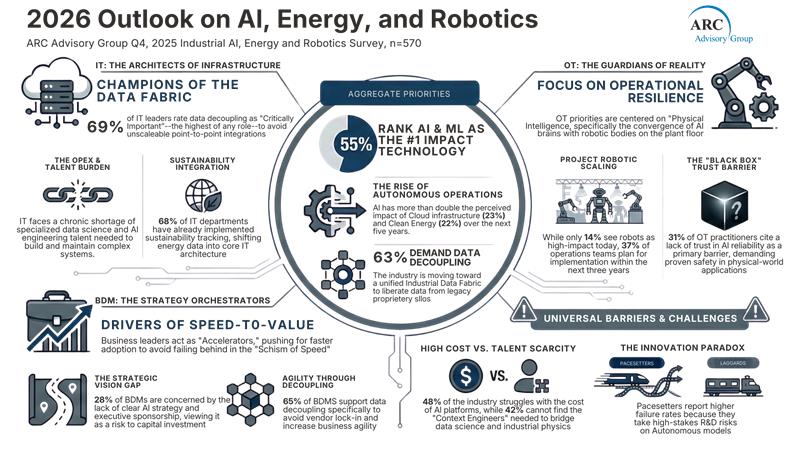
Business decision makers (the C-Suite, GMs, and VPs) are driving the accelerated convergence. They see the "Schism of Speed" widening and are demanding speed-to-value.
The Conflict: Despite driving the mandate, 28 percent of BDMs cite a "Lack of clear AI strategy" as their major barrier. They are frustrated. They fund large data infrastructure initiatives, only to watch deployments stall when IT’s cloud budgets escalate or OT refuses to let AI models interact with physical control systems.
Information technology leaders are tasked with building the digital foundation that BDMs demand, but they are increasingly challenged by the economics of scale.
The Conflict: IT overwhelmingly champions the Industrial Data Fabric to break vendor lock-in. However, 48 percent cite the high cost of AI platforms and compute power as their primary barrier. As they move from isolated pilots to widespread Generative AI and Agentic AI deployment, they are hitting the "Cost Wall" of cloud inference. They want to centralize, but the CFO is balking at unpredictable cloud bills.
Operational and Engineering Technology teams operate within the immutable laws of physics. They are the skeptics—and rightfully so.
The Conflict: OT’s top concern is trust and reliability (31 percent). They do not care about a cloud platform's compute efficiency; they care whether an AI "hallucination" could alter a PID loop or cause a safety incident. They act as the brakes on IT's rapid software deployment, demanding deterministic reliability, edge-based execution (for latency and security), and physical intelligence that respects the thermodynamics of the plant floor.
To maintain the momentum of the last two years and resolve this Tripartite Tension, organizations must focus on quick wins and universal barriers.
Internal friction thrives in a vacuum of reliable data. Stop arguing over whose dashboard is correct. By accelerating the deployment of an Industrial Data Fabric, you decouple data from legacy applications, providing IT with the scalable architecture it requires, OT with the contextualized data it trusts, and BDMs with the transparent visibility they demand.
Do not start your convergence journey by trying to give an LLM autonomous control over a chemical reactor. Build OT's trust in IT's infrastructure through high-value, low-risk deployments. Use AI Copilots to digitize maintenance manuals or deploy computer vision for automated quality inspection. These quick wins prove operational credibility, deliver immediate ROI for the BDMs, and build the cross-functional muscle memory required for more complex autonomous projects.
As I’ve noted before, the industrial sector needs Context Engineers, not Prompt Engineers. To scale your efforts, you must deliberately cultivate professionals (or upskill existing domain experts) who can bridge data science with physical industrial processes. You need talent that understands both the digital capabilities of IT and the physical realities of OT—ensuring that an AI model recognizes the critical difference between an ambient temperature sensor and a high-pressure reactor valve.
Navigating IT/OT/ET convergence is as much a political and organizational challenge as a technical one. If your leaders are relying on opinions and anecdotes, your transformation will stall. You need empirical data to align your stakeholders.
This is the ultimate value of ARC Advisory Group’s Voice of Market Service:
For Industrial Organizations: Our customized role-based benchmarking provides the objective, third-party data needed to de-hype the market, settle internal turf conflicts, and build a cohesive strategy. We help you understand exactly what OT teams need to see to trust IT's infrastructure, and what BDMs need to see to unlock funding.
For Technology Vendors and Service Providers: If your marketing message is tuned perfectly for an IT Architect, it will likely alarm an OT Plant Manager. Vendors leverage ARC's role-based insights to craft nuanced Go-To-Market strategies. We help map the complex buying committee and tailor product messaging to address the specific concerns of each persona.
The technology for the Autonomous Factory—from Data Fabrics to Agentic AI and Physical Robotics—is here. The progress over the last two years has been substantial, but the final hurdle is organizational. It is time to align your people, secure your data foundation, and begin compounding your innovation.
(To dive deeper into the data driving these trends, members of the ARC Executive Insight Service can access our full "Industrial AI Pacesetters 2026 Report" and selected insights from our "Q4 2025 Industrial AI, Energy, and Robotics Survey" via the ARC client portal. For customized benchmarking, vendor analysis, and specialized market intelligence, explore ARC Advisory Group's Voice of Market Service.)
For ARC Advisory Group recommendations for Navigating the AI Wars—including the Industrial Robot Wars—Closing the Digital Divide by Embracing Industrial AI, assembling your Industrial-Grade Data Fabric, and governing and guiding major people, processes, and technology decisions about enterprise, cloud, industrial edge, and AI, please contact Colin Masson at [email protected].
Or set up a meeting with my fellow Analysts and I, at ARC Advisory Group to find out more about our Executive Insights Service for Industrial organizations, and Industrial AI Insights Service for Vendors.