Representative End User Clients







Representative Automation Clients







Representative Software Clients








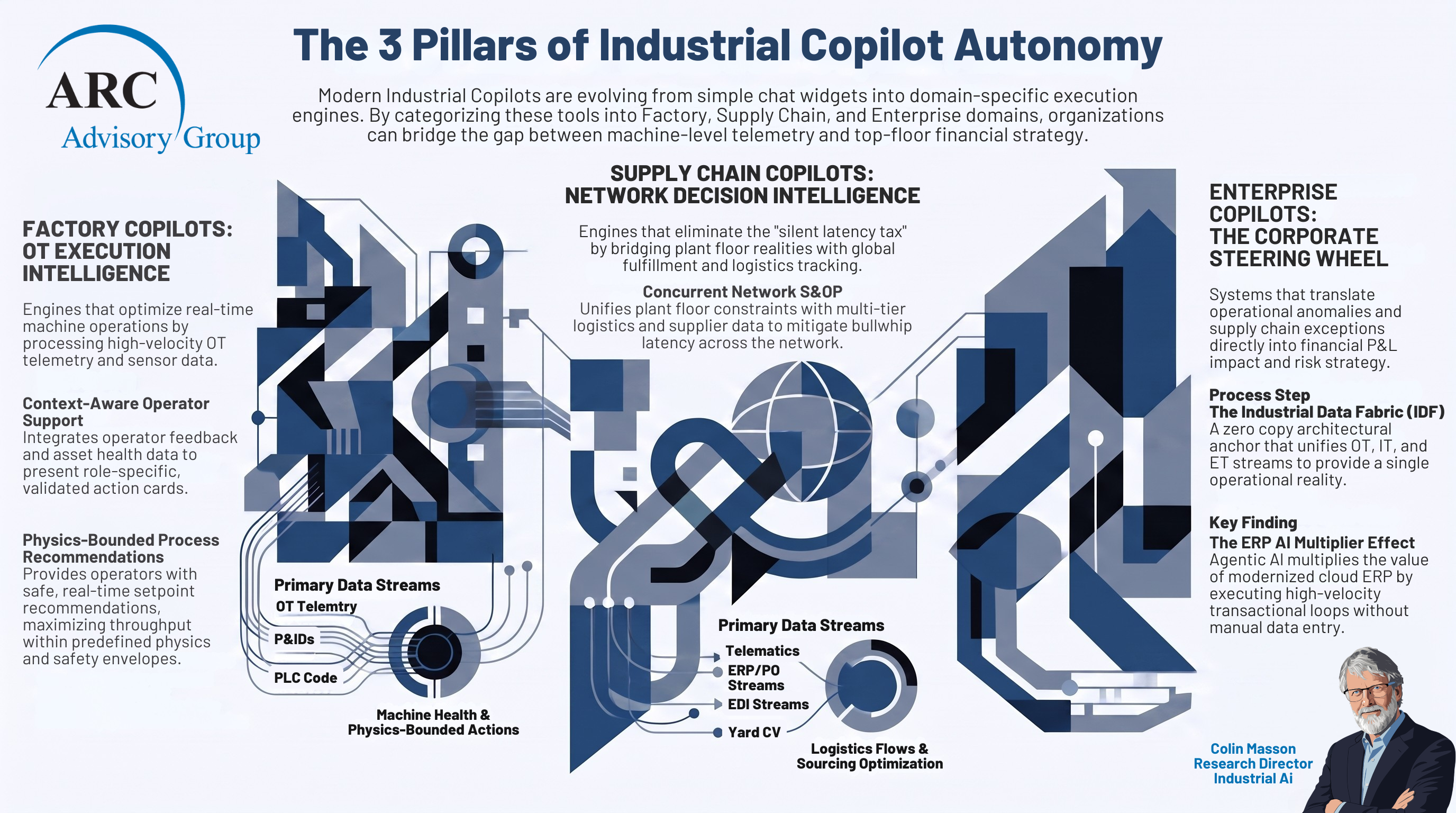
Factory Copilots operate in high-consequence operational zones where sub-second latency, deterministic accuracy, and physics-aware guardrails are non-negotiable. Exploring the market landscape requires evaluating direct PLC/historian ingestion without custom middleware, automated tag semantic mapping, guided 5-Why root cause analysis using site SOPs, and GxP/FDA 21 CFR Part 11 audit trails across representative automation incumbents, persona pioneers, and process innovators.
If Blogs 1 and 2 established why thin "LLM wrappers" crumble under enterprise stress and how open protocols (MCP, A2A, and CESMII i3X) prevent multi-vendor agent collisions, Blog 3 takes us straight into high-consequence operational zones where software code meets kinetic reality. When you step down to Levels 3 through 5 of the ARC 3-Axis Industrial AI Taxonomy—where digital reasoning connects with physical execution—the rules of engagement change fundamentally. In an office productivity environment, an ungrounded AI hallucination results in a typo-riddled email. In a continuous process chemical facility, an automotive stamping line, or a pharmaceutical packaging hall, a hallucinated setpoint isn't a minor inconvenience; it's a blown seal, batch contamination, or an emergency SIL safety trip.
This is precisely where our Refined August 2026 Definition of Industrial Copilots comes to life. On the factory floor, a copilot cannot remain a passive text box in the corner of an HMI screen. It must operate as an adaptive, context-aware Generative UI (GenUI)—synthesizing real-time OPC UA telemetry tags, 3D CAD meshes, and P&ID schematics to deliver hands-free, step-by-step diagnostic action cards at sub-second latency.
A natural architectural question arises when creating analyst taxonomies: Why categorize PLM, CAD, and physics simulation leaders—such as Siemens, Dassault Systèmes, PTC, and Ansys—under Factory Copilots rather than Enterprise Copilots?
ARC made this explicit classification decision in our inaugural Industrial Copilots MarketMap based on the reality of Engineering Technology (ET) to Operational Technology (OT) convergence. While PLM systems span global enterprise engineering teams, their operational AI value at the point of work is fundamentally anchored at the machine face. In an agentic cyber-physical environment, CAD geometry, P&ID schematics, virtual twin commissioning (Dassault DELMIA, Siemens TIA Portal/NX), and sub-second surrogate physics simulations (Ansys SimAI, Siemens Simcenter PhysicsAI) establish the physical and thermodynamic safety envelopes for shop-floor execution. Without these ET-native copilots supplying design intent and physical boundary limits, Factory Copilots operating at the machine face would risk making probabilistic setpoint recommendations in a physical vacuum.
| Control & Engineering Titans | Contextual & PLM Leaders | Process & Quality Innovators |
| Siemens | InSkill | Uptime AI |
| Schneider Electric | Augmentir | Velotic |
| Rockwell Automation | Cognite | Sight Machine |
| Yokogawa / ABB / Emerson | SymphonyAI | Oden / Quartic.ai |
| Ansys | Dassault Systèmes / PTC / AVEVA | TwinThread |
Siemens Industrial Copilot: Built atop TIA Portal, NX, and Senseye APM. Siemens' $10 billion acquisition of Altair Engineering and the release of Simcenter PhysicsAI natively embed first-principles physics and Physics-Informed Neural Networks (PINNs) into AI outputs. Siemens enforces an industry-positioned safety doctrine (User-Sanctioned Setpoint Revisions / USSR), requiring explicit operator confirmation and digital signatures before code alters physical machinery.
Schneider Electric (EcoStruxure Automation Expert Copilot): Built on IEC 61499 open automation principles, Schneider Electric's copilot accelerates control logic generation and virtual commissioning on Modicon edge IPCs. The approach has been demonstrated through over 6,000 hours of continuous autonomous green hydrogen operation at H2E Power in India.
Rockwell Automation: Features FactoryTalk Design Studio Copilot and Fiix CMMS. Rockwell leverages local edge SLMs (NVIDIA Nemotron Nano 9B running on industrial IPCs) to execute offline, sub-second inference—cutting overfill scrap by 50 percent at Unilever.
Emerson, ABB, Yokogawa, Beckhoff: Yokogawa's IA2IA (Industrial Automation to Industrial Autonomy) and CENTUM DCS copilot achieve Level 4 closed-loop reinforcement learning pilots at ENEOS refineries; Beckhoff's TwinCAT CoAgent brings C++/IEC 61131-3 code generation directly to the edge; Emerson's DeltaV Virtual Advisor and Project Beyond represent emerging vendor-positioned DCS assistant initiatives that bring conversational intelligence into control rooms.
Ansys (SimAI & AnsysGPT): Advances physics-informed AI (PINNs) and ultra-fast surrogate simulation models. Ansys SimAI learns from historical simulation datasets to deliver sub-second physics predictions, while AnsysGPT (Engineering Copilot) bridges 3D CAD design tolerances and structural analysis with real-time digital twin execution on the plant floor.
InSkill: Solves the "first-mile data context" problem in field service. InSkill builds dynamic equipment knowledge graphs directly in partnership with machinery OEMs (Mettler-Toledo, Instron, Xylem), guiding technicians through step-by-step diagnostic logic grounded in official SOPs.
Augmentir: A premier Connected Frontline Worker platform utilizing the Augie agentic suite for contextual troubleshooting, digitized training, and AI time/motion studies that boost frontline productivity by 3x.
Cognite Atlas AI/CDF: Leverages Cognite Data Fusion® and the Industrial Knowledge Graph (IKG) to contextualize time-series telemetry, 3D CAD meshes, and P&IDs into a single operational reality, powered by low-code agent building in Cognite Flows.
AVEVA (CONNECT AI Assistant): Operates natively across the AVEVA CONNECT cloud platform, connecting engineering diagrams (2D P&IDs), 3D asset models, and PI System time-series historian streams into an interactive operations assistant for plant engineers and reliability leads.
SymphonyAI: Features IRIS Foundry (Industrial DataOps) and IRIS Flows (300+ pre-built agents). Trained on a massive industrial dataset of 7 trillion data points, 1.1M+ connected assets, and 500,000+ FMEA templates, SymphonyAI offers custom Domain Language Models (DLMs) running on customer GPUs to eliminate token volatility.
Dassault Systèmes (3DEXPERIENCE Platform): Embeds AI-driven virtual companions (Aura, Leo, Marie) across the 3DEXPERIENCE platform and DELMIA. Dassault’s virtual twins inform the engineering "what and why" of product design geometry, material tolerances, and virtual commissioning before automation code is deployed to physical machines.
PTC (Windchill AI): Features Windchill AI embedded in PLM, enabling engineers and field service leads to query complex 3D CAD geometries, engineering change orders (ECOs), and service BOMs via natural language. PTC bridges product design intent, software lifecycle (Codebeamer), and service management (ServiceMax) across the enterprise.
Uptime AI: Deploys Rooty AI, combining first-principles thermodynamic reasoning with neural networks to predict equipment degradation weeks in advance.
Velotic: Formed under TPG capital, Velotic unifies GE Vernova's Proficy portfolio (MES, Historian, CSense ML) with PTC's divested Kepware (edge connectivity) and ThingWorx (IIoT analytics). Velotic's Proficy CSense provides deterministic ML anchors that eliminate false alarms.
Sight Machine: Features the Factory Namespace Manager and deep Microsoft Fabric integration to turn continuous sensor streams into normalized data products.
TwinThread: Delivers an AI-driven predictive operations platform engineered for process and hybrid manufacturing. Powered by pre-built domain modules (Perfect Batch, Perfect Quality, Perfect Centerline) and the TwinThread Advisor, it leverages predictive digital twins to optimize yield and eliminate process drift.
Ethon & Xplain Data: Pioneering Causal AI and object analytics to isolate exact root causes of quality defects across multi-stage manufacturing lines.
Oden Technologies, Quartic.ai, Falkonry, Augury, Factory AI, TrendMiner, Seeq, C3 AI, Dot Compliance ("Dottie"): A rich ecosystem of process analytics, vibration AI, predictive maintenance CMMS overlays, and regulated eQMS assistants. For instance, Dot Compliance's Dottie applies generative AI to life sciences eQMS change management, while Quartic.ai delivers closed-loop batch process optimization under FDA 21 CFR Part 11 auditability.
When evaluating and shortlisting candidate Factory Copilots, use these six essential diagnostic inquiries during vendor RFI reviews:
Direct OT Telemetry Ingestion: Does your copilot stream time-series OT telemetry directly from PLCs, historians, and UNS event brokers without requiring proprietary intermediate gateway code or manual tag mapping?
Physics & SIL Safety Envelopes: Are model setpoint recommendations bounded by hardcoded physical/thermodynamic laws (PINNs, Ansys SimAI) and user-sanctioned revision (USSR) e-signature gates before writing back to control loops?
Automated Tag Semantic Mapping: Does your contextual fabric automatically map cryptic, site-specific PLC tag slang into self-describing asset ontologies (like AAS or CESMII i3X Smart Profiles) without manual tag-by-tag coding?
ET/OT Design Intent Integration: How does your solution pull design tolerances and CAD/P&ID geometry from PLM systems (Siemens, Dassault, PTC) to contextualize active operational anomalies?
First-Mile Data Quality Filtering: How does your data fabric validate DQI at the edge to catch sensor drift or frozen tags before presenting recommendations to operators?
GxP & Regulatory Auditability: Does your platform generate immutable, time-stamped decision logs and step-by-step 5-Why root cause trails that satisfy FDA 21 CFR Part 11 or OSHA safety audits?
Having evaluated the machine-face realities of Factory Copilots, we now expand our aperture across the broader fulfillment network.
In our next installment, "Deep-Dive Category: Supply Chain Copilots—Network Decision Intelligence & Autonomous Execution," we examine how decision engines bridge plant realities ("Make") with global fulfillment networks ("Source & Deliver"). Stay tuned.
The Industrial AI (R)Evolution is moving faster than ever. To dive deeper into the frameworks and data shaping the future of the industrial sector, explore my latest research:
Navigating the AI Wars and the escalating Industrial Robot Wars
Closing the Digital Divide by Embracing Industrial AI
Assembling your Industrial-Grade Data Fabric
Charting the new frontier of Physical Intelligence and transitioning to a Cyber-Physical Industrial Architecture (CPIA)
Mapping your maturity and strategy with ARC's 3-Axis Industrial AI Models Taxonomy
Surviving the SaaSpocalypse and Taming the Tokenpocalypse by Mastering Multi-Agent Industrial Governance
Organizational Design and the Future of Industrial Work in the era of agentic AI
Take our Industrial AI Assessment to benchmark your organization's maturity, identify critical gaps in your IT/OT/ET convergence, and get actionable recommendations to accelerate your path to becoming an Industrial AI Pacesetter (and download the 2026 Report). If you think you’re already a Pacesetter, nominate your team for the ARC Industrial Pacesetters Awards!
Don't guess what your global operations or prospective customers need. Use empirical data to align your stakeholders and de-hype the market with ARC Advisory Group's Voice of Market Service.
For tailored recommendations on governing and guiding major people, process, and technology decisions across the enterprise, cloud, industrial edge, and AI, please contact Colin Masson at [email protected].
Or, set up a meeting with my fellow Analysts and I at ARC Advisory Group to find out more about our Executive Insights Service for Industrial organizations and our Industrial AI Insights Service for Vendors.