Representative End User Clients







Representative Automation Clients







Representative Software Clients








The warehouse management systems (WMS) market continues to grow, driven by e-commerce growth, increasing fulfillment complexity, faster delivery expectations, and the need for real-time operational visibility. Organizations are investing in WMS to improve inventory accuracy, throughput, and responsiveness to customer demand. Suppliers are driving WMS progress by implementing capabilities that allow customers to see their warehouse operations digitally, respond to disruptions more quickly, and address labor shortages before they arise.
WMS is shifting from a transactional system of record to a coordination layer across warehouse execution, orchestrating workflows across people, automation, and digital systems. This reflects broader changes in supply chain execution, where integration with robotics, AI, and adjacent systems is now a baseline expectation.
ARC research reinforces this view: WMS providers are increasingly expected to manage both manual and automated processes holistically, rather than operate in isolation from material handling systems or automation layers.
Automation as a Core Requirement: Warehouse automation is no longer an add-on; it is a central requirement shaping WMS development. Systems must integrate with robotics, autonomous mobile robots (AMRs), and material handling equipment while balancing human and machine workflows. WMS solutions are increasingly expected to learn from past decisions, recommend new ones, and look ahead to identify anticipated disruptions before they occur.
AI-Driven Execution and Decision Support: AI is increasingly embedded into WMS platforms to support predictive analytics, dynamic slotting, and operational decision-making. In many cases, this includes agent-based tools that help diagnose issues and simulate potential outcomes. Chatbots and agents allow warehouse operators to access information and data faster, reducing the time spent making decisions. Increasingly, companies are releasing solutions on low-code platforms that can be customized to an organization's specific needs.
Convergence Across Supply Chain Execution: WMS is increasingly part of a broader execution ecosystem that includes transportation, yard, labor, and order management. Vendors are positioning their solutions as part of integrated platforms rather than standalone applications. AI is playing a role in de-siloing systems. When systems are unified and data is accessible, AI can perform traditional processes, such as identifying stock-out scenarios, much faster than a supply chain planner because it can see across multiple systems, including inventory, shipping, and warehousing.
As these trends converge, the WMS market is becoming more difficult to define and evaluate:
Functional overlap between WMS, warehouse execution systems (WES), robotics platforms, and planning systems.
Increasing variation in how vendors describe similar capabilities.
Expansion of WMS into adjacent execution domains.
This creates a disconnect between traditional market analysis and how buyers actually evaluate solutions.
From ARC’s perspective, many legacy ways of analyzing the market, such as segmentation by tier or deployment type, do not fully explain how solutions differ in real-world performance or how they are evolving.
In response, ARC is shifting its research methodology to better reflect how buyers evaluate technology today. Rather than focusing primarily on market size, segmentation, and historical growth, the approach places greater emphasis on:
Functional capabilities, such as receiving, picking, optimization, and labor management.
Technical architecture, including modularity, scalability, cloud readiness, and interoperability.
Integration with automation and execution systems.
AI capabilities and data utilization.
Execution quality and measurable performance impact.
This approach aligns with ARC’s internal research scope for WMS, which includes both core execution processes, such as receiving, put-away, picking, and shipping, and add-on modules such as labor management, analytics, and optimization. The shift reflects a broader goal: moving beyond describing the market to understanding solution performance and differentiation at a deeper level.
To support this shift, ARC has introduced the MarketMap as a core analytical framework.
The MarketMap provides a structured, visual representation of supplier positioning in the WMS market, enabling more consistent and transparent evaluation across vendors.
Suppliers are assessed across two primary dimensions:
Includes:
Functional capabilities across warehouse processes.
Technical architecture, including cloud, scalability, and interoperability.
Integration with automation and adjacent systems.
Execution quality and support services.
Includes:
Product roadmap and innovation strategy.
Corporate direction and ecosystem alignment.
Customer base and growth trajectory.
These dimensions are equally weighted and supported by a structured scoring model that incorporates multiple sub-criteria across both capability and strategy dimensions.
The MarketMap reflects ARC’s view that the WMS market is no longer defined solely by functionality; it is defined by how well solutions integrate across the warehouse ecosystem. WMS solutions are being compared on their ability to support automation and AI-driven execution, as well as how well vendors are prepared for future supply chain demands. As markets grow and technology progresses, ARC also needs to develop new ways to analyze and understand market dynamics. By combining current capabilities and long-term strategy, the framework provides a more complete view of vendor positioning than traditional market rankings.
ARC has been conducting market research for over 30 years, and it has changed and adapted with the times and technology, moving from pen and paper to an online market analysis platform that allows for dynamic visualizations. ARC has adapted and progressed alongside the clients it serves, which is why it looks forward to delivering its first batch of MarketMaps this summer.
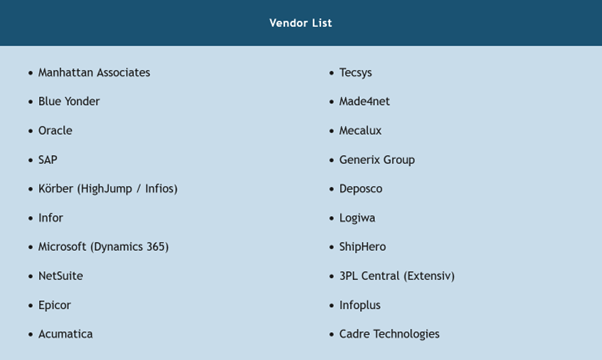
ARC is currently speaking with vendors in the warehouse management systems market to learn about each solution's differentiators, functional capabilities, and related areas. Vendors that would like to be added to ARC’s vendor list and included in its WMS MarketMap research should reach out to [email protected].