Representative End User Clients







Representative Automation Clients







Representative Software Clients








For this latest ARC Executive Interview Podcast, I had the opportunity to speak with Dr. Thai Lai Pham, President and CEO of Siemens ASEAN. That is his official title, but Dr. Lai’s responsibilities also extend to serving as Singapore country CEO, Vietnam country CEO, and Head of the Smart Infrastructure division. So, not surprisingly, there was plenty for us to talk about.
Southeast Asia’s importance to Siemens is anchored in both its size and growth trajectory. As Dr. Lai noted, the region collectively represents the world’s fifth-largest economy, with sustained growth of around 4.5 percent annually and strong future prospects driven by a combination of good demographics, rapid urbanization, an expanding industrial base, and rising infrastructure demand.
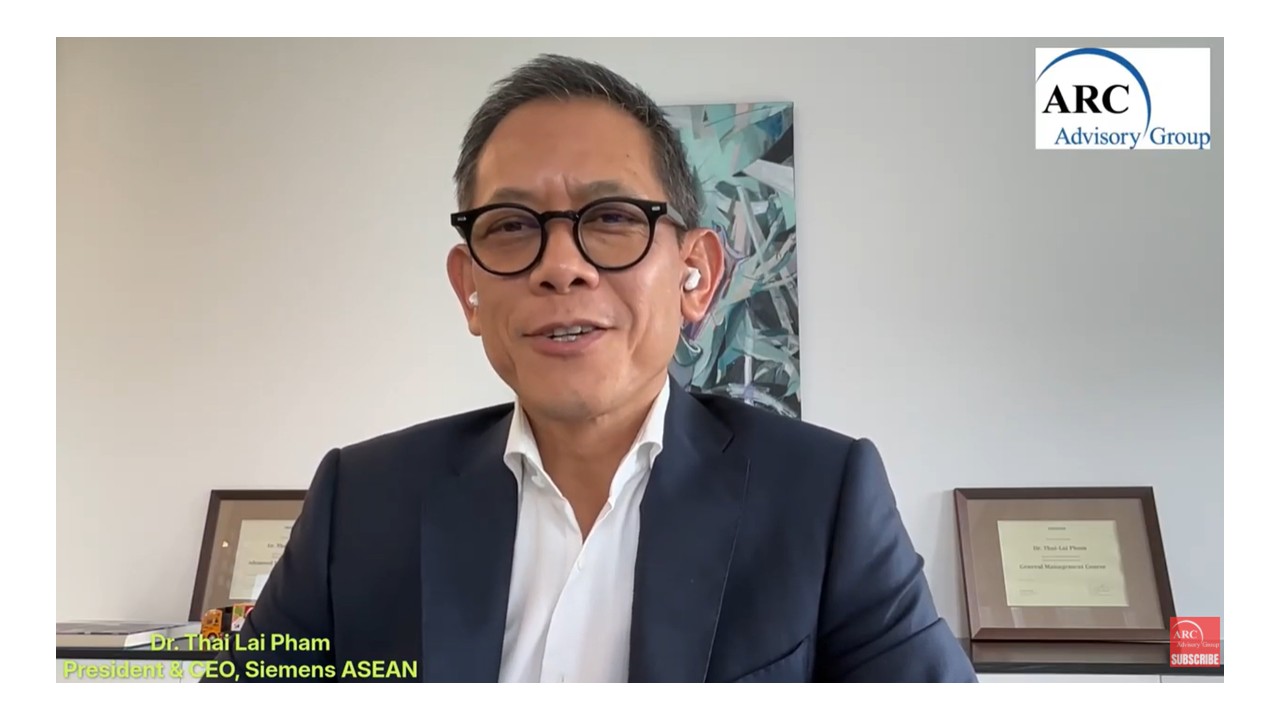
Our conversation provided a compelling view into how Siemens is positioning itself as a key enabler of industrial digitalization, increasingly sophisticated infrastructure, and the energy transition in a dynamic region that is home to more than 700 million people.
Siemens has reinforced this commitment through:
A strong regional headquarters in Singapore.
Manufacturing footprints in Indonesia and Vietnam.
A new factory under construction in Singapore, expected to be operational in 2028.
Offices and resources across all major Southeast Asian countries.
These investments highlight a clear objective: to stay close to customers while supporting regional innovation and industrial scaling.
Vietnam emerged as a leading topic in our discussion. Dr. Lai highlighted the country’s remarkable journey—from one of the world’s poorest nations in the 1990s to a fast-growing industrial economy today.
Key trends shaping Vietnam include:
Stellar GDP growth of 7–8 percent, with ambitions to reach double-digit growth by 2030.
Government reforms aimed at simplifying governance and accelerating development.
The increasing role of the private sector, especially “national champions” like Vingroup and THACO, in driving infrastructure investment.
Significant gains from global supply chain diversification and China+1 strategies.
For Siemens, the evolution of Vietnam opens opportunities across transportation, urban development, manufacturing, and energy systems. The rise of private-sector-led infrastructure development is particularly notable, creating new partnership models and accelerating project pipelines.
Over the past decade, Southeast Asia has steadily progressed along the industrial maturity curve, with a clear evolution toward increasingly automated, high-value operations.
Dr. Lai described a clear trajectory:
Initial manufacturing expansion.
Adoption of automation for productivity and quality.
The move toward digitalization and data-driven operations.
Integration of AI-enabled capabilities.
Siemens has been a major enabler of this shift, Dr. Lai said, as its deep industry expertise across multiple sectors combines with an expanding software portfolio to bridge the physical and digital worlds and provide technology solutions for clients’ needs.
A notable example is Siemens’ collaboration with Vingroup in Vietnam, where advanced product lifecycle management (PLM) systems and AI-driven analytics are supporting automotive design, manufacturing, and continuous improvement.
Elsewhere in Southeast Asia, Singapore is pushing even further, adopting AI, robotics, and advanced automation to maintain competitiveness and address labor constraints.
The rapid expansion of data centers is another defining megatrend across Southeast Asia. Markets such as Malaysia, Indonesia, Thailand, and the Philippines are seeing significant investment, driven by cloud adoption, digital services, and AI workloads. Indeed, Dr. Lai emphasized that the region is among the fastest-growing data center markets globally, with projections indicating substantial scaling in capacity.
The high investment numbers naturally attract many companies seeking a lucrative slice of the action. So, how does Siemens differentiate itself from its competitors? His response focused on the integrated nature of the company’s offerings for the data center market.
“We are uniquely positioned as a company that can integrate multiple technologies under one roof. On one hand, we provide electrification solutions; on the other, we offer advanced automation technologies. In addition, we deliver software and simulation capabilities."
“Beyond these, we also support our customers with financial solutions, including project financing and equity financing. In other words, from electrification and automation to simulation and funding, customers can access everything they need from a single, unified provider."
“When I look at the market, most companies tend to specialize in just one area—either electrification, automation, or software. However, the ability to combine all these capabilities is what makes us truly unique,” said Dr. Lai.
This holistic capability is particularly valuable for newer entrants, many of whom are not traditional data center operators but developers or investors entering the sector for the first time. Simulation tools, for example, allow customers to optimize energy consumption even before construction begins, improving efficiency and sustainability outcomes from day one.
While I suggested that sustainability seems to have gone out of fashion in the last couple of years, Dr. Lai countered that momentum remains strong—particularly at the operational level. Key observations in the Southeast Asia context include:
Continued investment in renewable energy sources such as solar and wind.
Growing emphasis on energy independence and resilience.
Strong sustainability commitments from multinational corporations extending into regional supply chains.
Adoption of energy-efficient technologies in buildings and manufacturing. For example, new industrial facilities—like LEGO’s investment in Vietnam—are being designed with high sustainability standards to align with global net-zero targets.
Siemens plays its part in sustainability initiatives through a portfolio that includes SF6-free electrical equipment, building management systems for energy efficiency, grid automation for integrating renewable energy, and digital tools for energy optimization.
A key takeaway from ARC’s interview with Dr. Lai is that Siemens’ strategy in Southeast Asia increasingly reflects the broader evolution of the region itself—dynamic, diverse, and increasingly sophisticated.
The convergence of AI, automation, and digitalization is redefining how industries operate, compete, and grow across the region, and the upcoming Siemens Tech Summit in Singapore on July 1 will showcase AI innovations from across its business units, including a new agentic AI tool that can automate PLC programming tasks.
From Vietnam’s industrial rise to the region’s data center boom and the steady march toward sustainability, Southeast Asia is entering a new and exciting phase of development. Companies that can integrate infrastructure, digital technologies, and sustainability solutions—at scale—will be best positioned to succeed. And as my conversation with Dr. Lai makes clear, Siemens intends to be leading that transformation.
Watch the Executive Interview Podcast video on YouTube or here: