Representative End User Clients







Representative Automation Clients







Representative Software Clients








For the past year, we have been living through what I call the “Industrial AI Wars.” Every vendor, hyperscaler, and consultant has bombarded the market with a consistent message: AI changes everything. Unfortunately, the subtext of that message is often Fear, Uncertainty, and Doubt (FUD)—the fear of being left behind or the fear of human obsolescence.
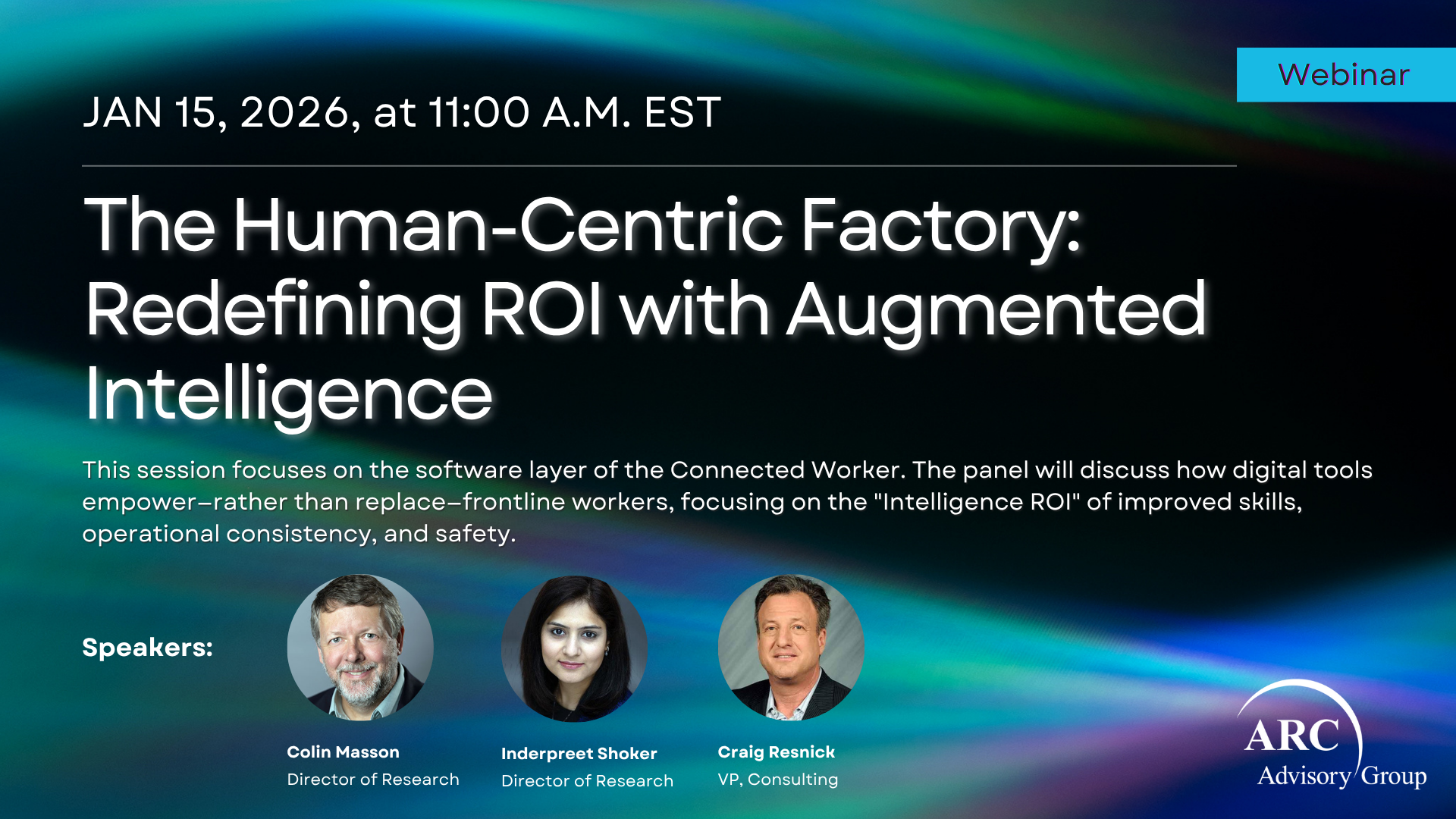
However, in the third and final webinar of our preview series leading up to the ARC Industry Leadership Forum, we flipped that narrative.
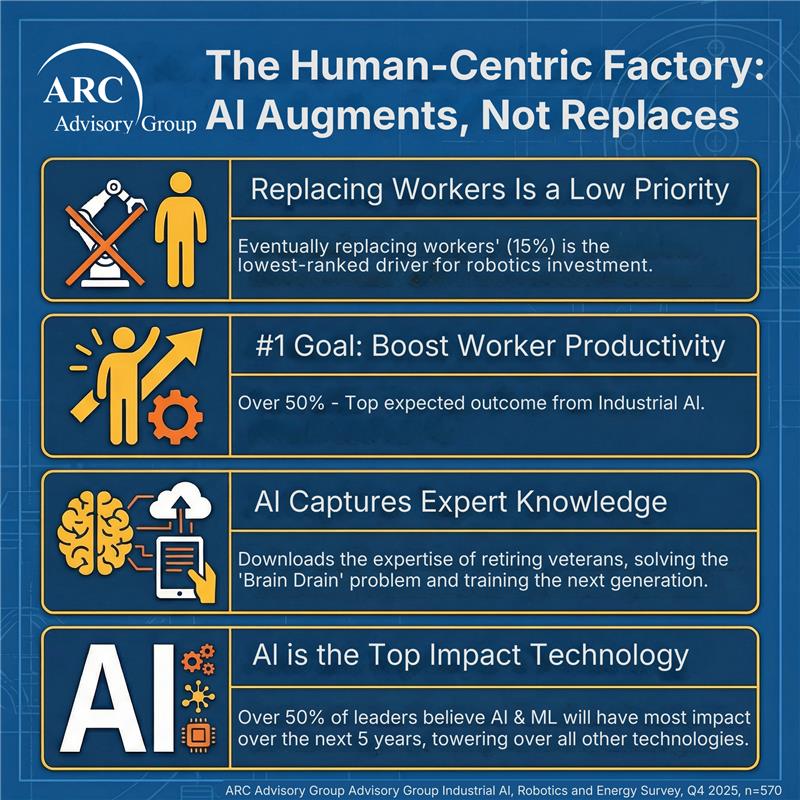
I was joined by my esteemed colleagues Craig Resnick, Vice President of Consulting, and Inderpreet Shoker, Director of Research for Connected Worker Technology, to analyze the findings from our Q4 2025 survey of 570 industrial respondents. The data revealed a stark reality that contradicts the “robots replacing humans” hype: the market isn’t asking for AI to replace workers; it is begging for AI to save them through augmentation.
If you missed the live session, I highly encourage you to watch the webinar on demand to see the full data breakdown and our analysis of the “Human-Centric Factory.”
Here are the key themes we explored during our discussion on why the future of the factory is human-centric, supported by insights from the team.
We kicked off by looking at the primary business drivers for investments in robotics and automation. While cost reduction remains a factor, “eventually replacing workers” sat at the very bottom of the priority list—cited by only around 15 percent of respondents. Instead, the focus is squarely on improving productivity, quality, and safety.
As Craig Resnick noted during the discussion, the ROI conversation has become far more complex than “machines versus people.” It is about ensuring uptime in an environment where machinery is becoming too complex for human senses alone.
“OEMs are building such technically sophisticated machines… that to maintain them requires a high level of diagnostics that is not something you can just do from getting information from sensors or just from having real-world experience. You really need a tool… to diagnose a problem and diagnose it fast… minimizing or eliminating unscheduled downtime.”
— Craig Resnick, Vice President of Consulting, ARC Advisory Group
A recurring theme in our research is the impending exit of the “Baby Boomer” generation and the immense loss of domain expertise that accompanies it. Inderpreet Shoker highlighted that AI and Connected Worker technologies are no longer “nice-to-haves” but survival mechanisms to bridge this skills gap.
“I have met people who mentioned that they can just listen to the pump and know what is wrong with it. We are going to lose that expertise… A lot of focus in the next few years from the end-user side will be capturing that tribal knowledge. But the first part of it is the AI assistant… bringing the right information at the right time when they need it.”
— Inderpreet Shoker, Research Director, ARC Advisory Group
One of the most interesting findings from our data mining was the regional divergence in drivers. While safety sits in the middle of the pack globally, in regions like Latin America and parts of Asia, it rises to the number one goal for automation—with nearly 60 percent of respondents prioritizing it.
As I noted during the session, this is a critical distinction for any technology supplier:
“You can’t sell safety to a German auto plant with the same urgency you can to a Chilean mine. Very different drivers.”
— Colin Masson, Director of Research, Industrial AI, ARC Advisory Group
We also discussed the evolution of the “Connected Worker.” While the hype cycle for futuristic wearables (like heavy VR headsets) has cooled, the demand for practical frontline connectivity via smartphones and tablets is surging. The goal is not to force workers into the metaverse, but to connect them to the Industrial Data Fabric—the unified source of truth across IT, OT, and ET—so they can make better decisions in real time.
Data only tells us the “what.” It doesn’t tell us the “how.” To truly understand how Industrial AI Pacesetters are deploying Human-Centric AI, you need to hear directly from the leaders doing the work.
The 30th Annual ARC Industry Leadership Forum is taking place February 9–12, 2026, in Orlando.
I will be hosting a Customer Executive Panel featuring leaders from PepsiCo, Jabil, NVIDIA, Siemens, and AWS. We also have dedicated sessions on Smart Manufacturing, Operational Resilience, Industrial Data Fabrics, and Physical Intelligence, where you can engage with peers across the IT, OT, ET, and Data Science domains.
Register for the ARC Industry Leadership Forum Today!
I look forward to seeing you in Orlando as we chart the next phase of the Industrial AI (R)Evolution.
For ARC Advisory Group recommendations for Navigating the AI Wars—including the Industrial Robot Wars–Closing the Digital Divide by Embracing Industrial AI, assembling your Industrial-Grade Data Fabric, and governing and guiding major decisions about enterprise, cloud, industrial edge, and AI software, please contact Colin Masson at [email protected].
Or set up a meeting with my fellow Analysts and I, at ARC Advisory Group to find out more about our Executive Insights Service for Industrial organizations, and Industrial AI Insights Service for Vendors.