Representative End User Clients







Representative Automation Clients







Representative Software Clients








The first half of this year has been a whirlwind through the industrial software space, with major vendors like SAP unveiling their latest visions for Industrial AI. My focus throughout has been to cut through the hype and identify who is building the foundational capabilities needed to make AI real and scalable. So, when I arrived at Siemens Realize LIVE Americas in Detroit, I wasn’t expecting flashy product launches. What I found instead was far more compelling: a clear, long-term strategy that directly tackles the industry’s biggest barrier to scaling AI—fragmented data.
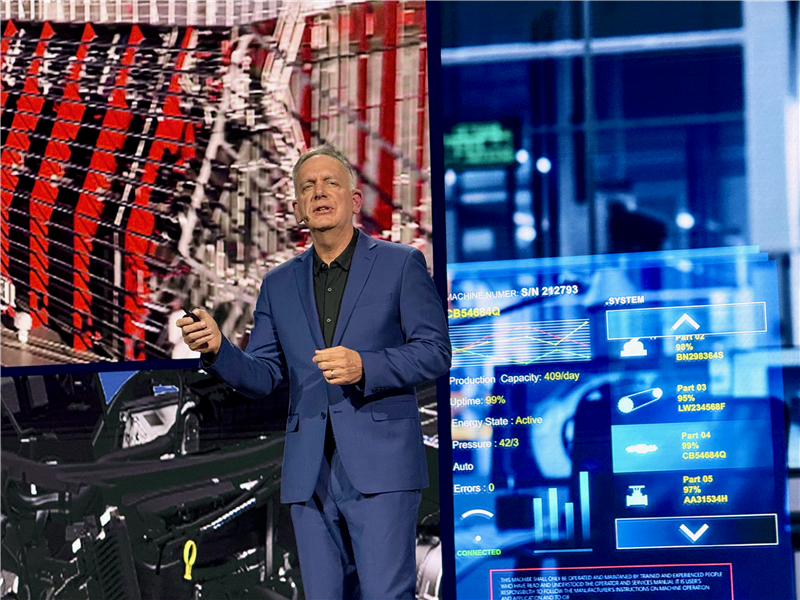
It confirmed a conviction I’ve been developing for some time. In my six-part blog series for ARC Advisory Group, Core Capabilities of an Industrial-Grade Data Fabric, I’ve been mapping the different architectural models emerging across the market. After Detroit, I’m more convinced than ever that Siemens is uniquely positioned to deliver a powerful new design-centric Industrial Data Fabric archetype—something few, if any, other vendors can match. This isn’t a speculative play; it’s a strategy grounded in massive, multi-billion-dollar investments. And it brings real substance to a sentiment often voiced by Tony Hemmelgarn, President and CEO of Siemens Digital Industries Software:
For years, we at ARC Advisory Group have seen industrial companies struggle with the same fundamental challenge. OT data from the plant floor, IT data from enterprise systems, and—critically for Siemens’ customer base—engineering technology (ET) data from design and simulation all exist in separate universes. An industrial-grade data fabric is the essential architecture that creates a unified, intelligent data layer to connect these sources, enrich them with context, and make them available for AI applications. This data fabric enables the digital thread, powering the convergence of IT, OT, ET, and the new data science audience.
Siemens’ strategy is to build this fabric with the comprehensive digital twin as its central organizing principle. The recent massive acquisition of Altair is a cornerstone, but it’s the combination of Altair's capabilities with Siemens' existing portfolio that reveals the full blueprint. This will be especially evident in discrete applications, an area where Altair has long been strong.
Here are the core components of this emerging Design-Centric Data Fabric:
Xcelerator Foundational Services: At the very core of the fabric are the common services being built for the entire Xcelerator portfolio. Led by the team under Siemens AG CTO, Peter Korte, these services for identity management, data, and API orchestration provide the underlying, horizontal plumbing that ensures all applications across all Siemens businesses can interoperate on a common foundation.
Teamcenter X as the Digital Thread Backbone: As Siemens’ enterprise PLM platform, Teamcenter provides the collaborative, version-controlled source of truth for all product-related data and processes. It is the essential digital thread that connects every stage of the lifecycle, from initial concept and design (ET) to manufacturing (OT) and service (IT).
Altair for the AI and Semantic Layer: The Altair acquisition brings additional expertise in discrete manufacturing and a powerful suite of tools, most notably from its own strategic purchases:
Cambridge Semantics: This provides the knowledge graph technology that forms the fabric’s semantic layer. It understands and maps the complex relationships between a 3D model, its simulation results, the real-world sensor data from its physical counterpart, and its maintenance records. This is how you create true context at scale.
RapidMiner: This is the end-to-end data science workbench. It empowers data scientists to build, deploy, and manage AI/ML models on top of the rich, contextualized data served up by the fabric.
Insights Hub for Real-World OT Data: Formerly MindSphere, Insights Hub is the Industrial IoT layer. It is responsible for ingesting, processing, and analyzing the high-volume time-series data from sensors on connected physical assets, closing the loop between the digital twin and its real-world counterpart.
Mendix for AI-Augmented Low-Code Application Development: A powerful data fabric is only useful if you can act on its insights. Mendix provides a low-code/no-code application platform to rapidly build and deploy user-facing applications that consume the unified data, putting the power of AI into the hands of operators, engineers, and decision-makers.
When you assemble these pieces, the picture becomes clear: Siemens is building a data fabric where the digital twin is not just an output; it is the living, breathing core of the entire industrial data ecosystem.
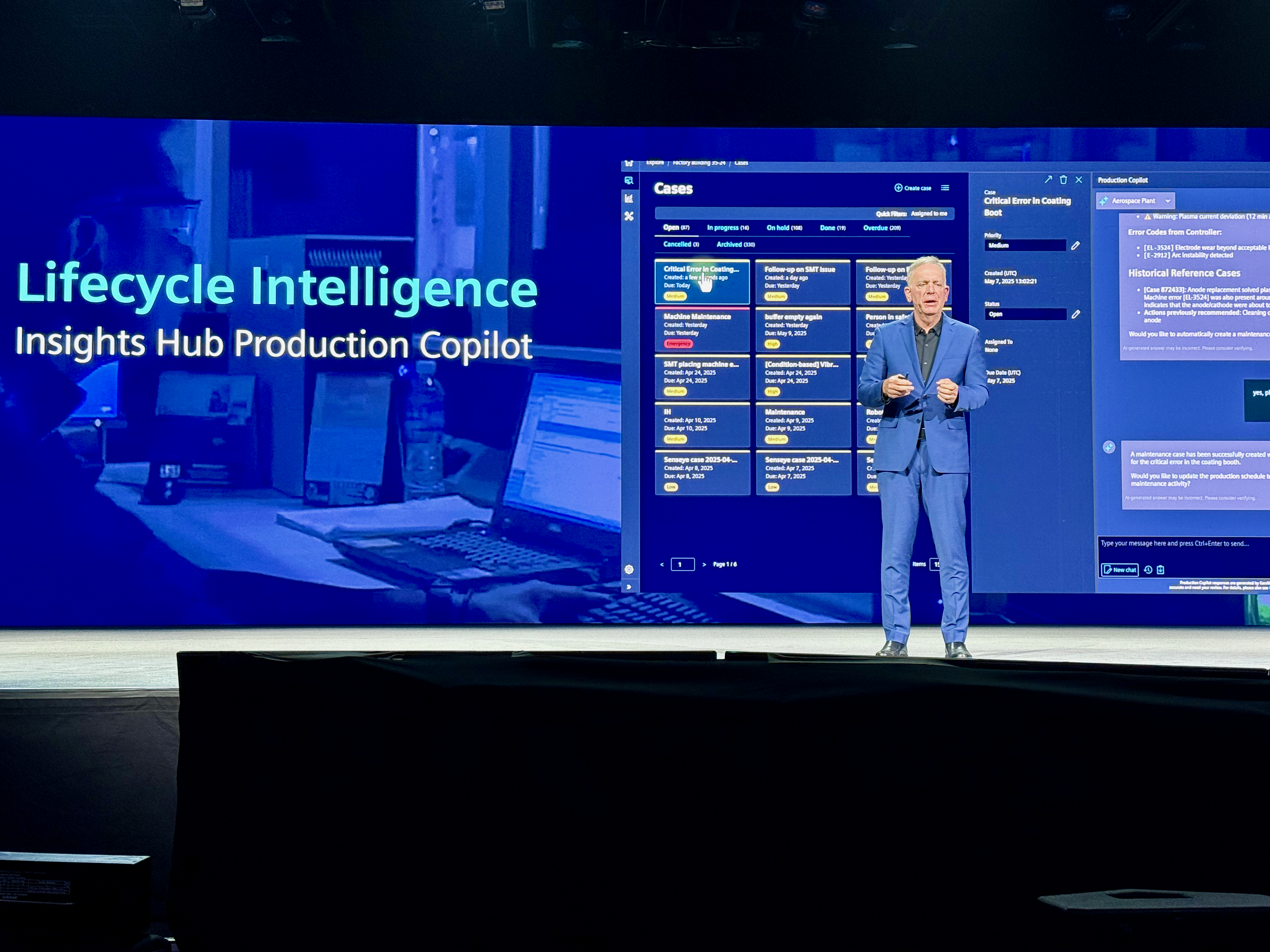
This brings us to the most forward-looking part of Siemens’ strategy: the Industrial Foundation Model (IFM). This isn’t just a project within the Digital Industries Software business—it’s a strategic, company-wide initiative led by Siemens AG CTO Peter Korte. As Executive Vice President for PLM Products, Joe Bohman, articulated so well at Realize LIVE:

The goal of the IFM is to create a massive, pre-trained AI model specialized in the language, physics, and logic of the industrial world—from 3D models and 2D drawings to material specs and process parameters. Because it’s a Siemens-wide effort, the IFM is intended to be used by every Siemens business, partner, and customer, becoming a foundational “AI for Engineering” service.
A foundation model is only as good as the data it is trained on. The data fabric Siemens is assembling is the very mechanism required to collect, cleanse, connect, and contextualize the vast and complex engineering data needed to train a trustworthy IFM. The fabric solves the immediate customer pain point of data silos and AI scalability, while simultaneously serving as the long-term data engine for Siemens’ most ambitious AI project.

I left Detroit with a clear conviction that Siemens’ AI journey is accelerating dramatically. The pieces are not just being collected; they are being strategically integrated. I fully expect we’ll hear Siemens begin to articulate its “industrial-grade data fabric” strategy more explicitly in the near future, explaining how it serves as the foundation for both scaling customer AI use cases today and powering their IFM tomorrow.
The final, fascinating question is the business model. Training an IFM requires a continuous stream of real-world data. How will Siemens incentivize its customers to allow their data to be used for this purpose? What will the value exchange look like? Answering that will be the next critical step in this journey.
For ARC Advisory Group recommendations for Navigating the AI Wars, Closing the Digital Divide by Embracing Industrial AI, assembling your Industrial-Grade Data Fabric, the Modern Industrial AI technology stack, and governing and guiding major decisions about enterprise, cloud, industrial edge, and AI software, please contact Colin Masson at [email protected] or set up a meeting with me, or my fellow Analysts at ARC Advisory Group.