Representative End User Clients







Representative Automation Clients







Representative Software Clients








Welcome to the third installment of our ongoing conversation on Industrial Systems Engineering in the Era of AI. In this series, I’m joined by my good friend and serial entrepreneur Rick Bullotta to unpack the profound shifts AI is driving in the industrial world.
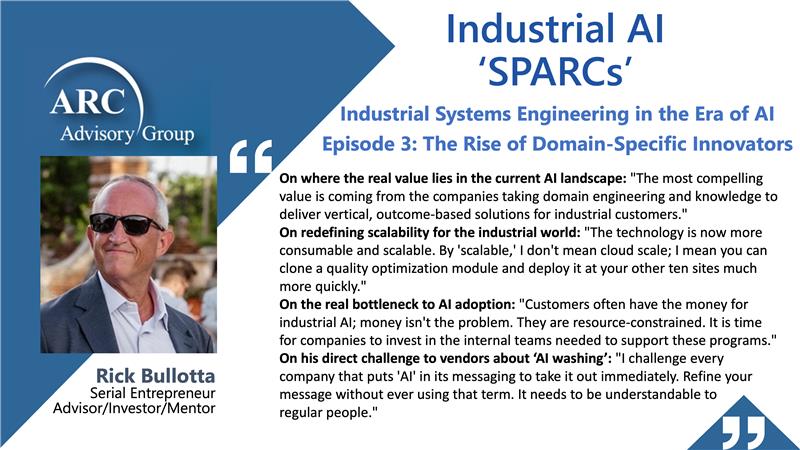
Our journey began in Episode 1, where we explored the historical evolution and foundational data challenges that have long constrained industrial operations. In Episode 2, we moved from problems to potential solutions, diving deep into the concept of the Industrial Data Fabric as the critical enabler for this new era. We laid the groundwork, discussing the need for openness, the limitations of traditional data lakes, and the shift in focus from assets to processes.
Now, with that foundation in place, we pivot from the theoretical to the practical. This episode gets to the heart of where immediate, tangible value is being created. We move beyond the hype surrounding large-scale infrastructure and generic AI platforms to focus on the agile, domain-focused startups that are translating AI’s potential into real-world industrial outcomes. These are the companies on the front lines—the "guerrilla innovators," as I’ve called them—who are demonstrating not just what AI can do, but what it is doing today to solve specific, high-value problems on the factory floor and beyond.
Experience the full, unscripted conversation with Rick Bullotta. You can listen to the podcast episode below or watch the video on our YouTube channel.
A central theme of our discussion was the emerging hierarchy of value in the industrial AI market. Based on a recent M&A and investment presentation Rick attended, the landscape is segmenting into three distinct clusters. At one end are the core infrastructure players—the Nvidias and OpenAIs of the world—building foundational technology. At the other end is a low-value group simply "slapping a chat front end on legacy stuff."
The most compelling and defensible value, however, resides in a vital middle tier. As Rick described it, this is the group that is "taking domain engineering, domain knowledge... and delivering vertical solutions for industrial customers." These companies command strong valuations because their offerings are tangible, difficult to replicate, and directly address specific business outcomes. This market segmentation signals a crucial maturation; the initial excitement around generic AI capabilities is being replaced by a more pragmatic assessment of value based on solving economically significant industrial problems. The capital from the investment community, a leading indicator of market trends, is flowing toward demonstrable ROI, not just technological buzz.
This also brings up the concept of a true "Industrial Foundation Model." While some large players like Siemens are making moves in this direction, a direct industrial equivalent to a general-purpose Large Language Model (LLM) like GPT-4 does not yet exist. The reason is fundamental. As Rick noted, the knowledge base of a general LLM is filled with information—from flight options to martini recipes—that is completely irrelevant to a manufacturing enterprise. This "junk" data is not just noise; it’s a liability in a deterministic industrial environment where an understanding of physics, chemistry, causality, and time-series data is paramount. A true industrial model must be built on a different data diet, one rich in CAD files, process schematics, and physics-based simulations. This creates an extremely high barrier to entry and suggests the future is likely not one monolithic model, but a federation of specialized models focused on specific physical domains.
The primary bottleneck to widespread industrial AI adoption is not technology or budget, but talent. Specifically, there is a critical shortage of individuals who are fluent in both the intricacies of data science and the physical realities of industrial operations. I’ve often referred to the need for "industrial grade data scientists," but the reality is that "they're going to be in very short supply for the foreseeable future."
This skills chasm creates the central market opportunity that specialized startups are built to fill. Rick offered a powerful definition of modern software as "intellectual property and knowledge encapsulated in algorithms and bits." Following this logic, these innovative firms are effectively productizing scarce human expertise. Their business model is not merely "Software-as-a-Service" but "Expertise-as-a-Service." They provide a scalable, on-demand solution to the talent shortage, allowing industrial companies to access world-class domain knowledge without having to compete for impossibly rare and expensive talent in the open market.
This dynamic directly addresses a major pain point for industrial clients. As we’ve heard from many end-users, "everyone is coming at them with AI solutions, but they don't have the skills or the people with the skills to actually validate the claims." This is compounded by the fact that even when "money isn't the problem," these organizations are often "resource constrained" internally. The logical strategy for industrial leaders, therefore, shifts from attempting to build a massive internal AI team from scratch to building a savvy team capable of identifying, validating, and managing a portfolio of these specialized solution providers.
This information asymmetry also explains the rise of "AI washing." Rick’s challenge to vendors to "take AI out" of their messaging is a call for clarity. Because customers struggle to validate the how (the AI model), they must be empowered to rigorously evaluate the what (the promised outcome). Vendors who can clearly articulate and quantify the economic value of their solution will build trust and win deals far faster than those who rely on opaque technical jargon.
To make these concepts tangible, our conversation highlighted several startups that exemplify this new wave of domain-specific innovation. These companies are not building generic platforms; they are delivering targeted solutions that address specific industrial challenges. Their work illustrates a functional disaggregation of the traditional, monolithic industrial software stack into a more agile and modular ecosystem.
For example, a company like HighByte provides the clean data foundation, Leela AI offers a new sensory input, TwinThread and Augury deliver the analytical "brain" for processes and assets respectively, and OpsMate AI provides the critical human-machine interface. This modularity allows a customer to adopt best-of-breed solutions rather than being locked into a single vendor’s ecosystem, reinforcing the importance of the Industrial Data Fabric as the interoperability layer that enables this new architecture to function.
The innovation here is not just in the algorithms but in the packaging and deployment. As Rick noted, the key is making these technologies "more consumable and scalable." Crucially, "scalable" in this context doesn't mean cloud scale, but the ability to "clone that quality optimization module and deploy it at your other 10 sites a whole lot more quickly." This represents a paradigm shift from the bespoke, site-by-site engineering projects of the past toward repeatable, rapidly deployable software solutions that can unlock value across an entire enterprise.

For startups looking to succeed in this space, our conversation distilled a practical playbook for navigating the unique challenges of the industrial market. Perhaps the most critical piece of advice from Rick was the need to "be able to deploy in the customer's tenant." This is not a preference but a near-universal requirement driven by deep-seated customer concerns over data security, intellectual property, and operational control. The fear of creating a "cybersecurity and IP nightmare" is very real for industrial clients, who cannot risk their "secret recipe" leaving the facility.
This single requirement has a cascading effect on a startup's architecture and business model. It necessitates a shift from a traditional multi-tenant SaaS model to a managed single-tenant or customer-hosted approach. Technically, it makes good hygiene like using Kubernetes and containerized approaches essential for enabling multi-cloud and on-premise deployments. Commercially, it complicates pricing, as the underlying infrastructure costs are variable and borne by the customer, making it difficult to offer a simple, predictable SaaS fee.
From a technology strategy perspective, being "AI agnostic" is evolving from a technical best practice to a core strategic imperative. Given the rapid pace of change in foundation models, hard-coding a solution to a specific proprietary model is a high-risk proposition. An agnostic architecture that abstracts away the algorithm engine allows a startup to pivot to more efficient, cheaper, or more capable models as they emerge, preventing vendor lock-in and ensuring they can serve customers regardless of their preferred cloud provider. This flexibility is a key source of long-term competitive advantage.
The central message of our third conversation is clear: while large players continue to build out foundational capabilities, the most immediate and tangible value in industrial AI is being delivered today by a vibrant ecosystem of domain-specific innovators. These are the companies that can bridge the chasm between data science and industrial operations, delivering real, measurable outcomes.
For industrial leaders, the path forward is not to wait for a single, magical solution from a behemoth provider. It is a dual mandate. First, as Rick advised, "it is time for people to invest in resources to support these projects and programs." The biggest barrier to adoption is often internal capacity, not budget. Second, leaders must actively seek out, pilot, and partner with the "guerrilla innovators" who can solve specific, high-value problems quickly.
The future of industrial systems engineering in the era of AI will be defined by a symbiotic relationship between savvy industrial customers and a focused ecosystem of expert solution providers. The key to success is finding those partners who, as we concluded, can truly "cross the industrial and AI domains and make it deliver real outcomes." We look forward to exploring this evolving landscape further in our next episode.
As we venture further into topics like building robust data infrastructures and modernizing architectures to effectively infuse AI, I highly recommend readers explore some of my existing research:
My blog series on "Assembling Industrial-grade Data Fabrics."
My series on "The Rise of A2A: Completing the Industrial AI Protocol Stack with OPC UA and MCP."
The article, "Core Capabilities of the Industrial-grade Data Fabric: Powering AI Infusion and Modernization," which is the sixth post in the Data Fabric series and delves into the essential solution services these fabrics enable.
These pieces offer a solid foundation for the themes Rick and I have been unpacking in this series.
We believe the best conversations include diverse perspectives. If you are an innovator in this space and would like to contribute to a future discussion, please reach out to Colin Masson at ARC Advisory Group.
For ARC Advisory Group recommendations for Navigating the AI Wars, Closing the Digital Divide by Embracing Industrial AI, assembling your Industrial-Grade Data Fabric, and governing and guiding major decisions about enterprise, cloud, industrial edge, and AI software, please contact Colin Masson at [email protected] or set up a meeting with me, or my fellow Analysts at ARC Advisory Group.