Representative End User Clients







Representative Automation Clients







Representative Software Clients








Omega Simulation Co., Ltd., a subsidiary of Yokogawa Electric Corporation, has revamped its OmegaLand plant operation simulation environment as the OmegaLand V4 dynamic digital twin platform and is releasing the first version, V4.1. While OmegaLand has traditionally provided the functionality needed to build operator training simulators, V4 offers greater integration with control systems, enabling users to identify issues in plant operations, develop solutions, and apply and operate them more efficiently in the field.
The plant operational environment has grown more complex in recent years due to intensified market competition, equipment aging, labor shortages, cybersecurity risks, stricter regulations, and supply chain changes. As industries enter a period of major transformation, expectations are rising that the use of AI and other advanced technologies will lead to autonomous operations. However, this will require the clear identification of issues and a phased transition in which risks are evaluated and optimization is performed. In turn, informed decisions will need to be made regarding the introduction of new technologies.
OmegaLand V4 is designed as a dynamic digital twin platform that maximizes the return on investment in building dynamic models and supports the autonomous operation of plants. By strengthening integration with Yokogawa’s CENTUM VP control system, dynamic simulation technology—traditionally used offline—can now be consistently applied not only to operator training, but also to the development, verification, implementation, and evaluation of AI models and other advanced control solutions that contribute to autonomous plant operations. Furthermore, even as operational autonomy advances and human intervention decreases, the platform provides a framework that combines operational risk assessment with a dynamic simulator, enabling the verification of hazardous scenarios and the formulation of countermeasures.
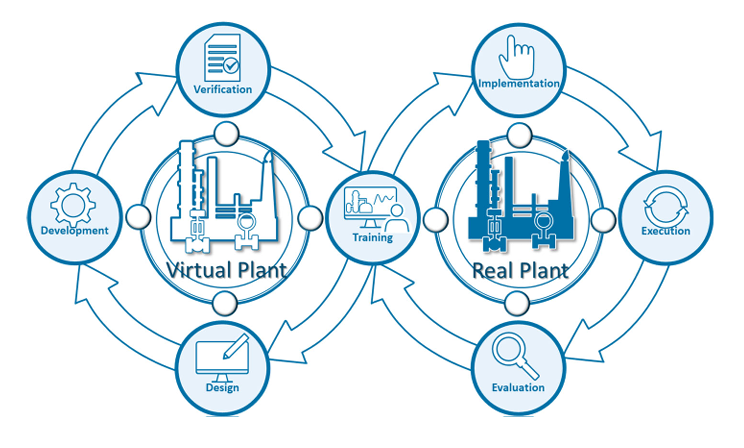
In line with the OmegaLand V4 concept, core functionality and integration with control systems have been strengthened as follows.
The case study function has been enhanced to allow users to test “what if” scenarios in a virtual plant environment. For purposes such as energy savings and efficiency improvements, users can register up to ten scenarios and simultaneously compare up to three test cases to evaluate changes in operating conditions or control procedures, improving testing efficiency and reducing costs.
Based on conditions such as plant operation control values and product specifications, this function helps eliminate waste in raw material and energy usage by identifying optimal operating conditions. When changes are made to operating conditions, it also presents patterns that reduce equipment load and support safe and efficient transitions. Rather than optimization at a single point in time (static optimization), sustained optimal operation (dynamic optimization) is achieved by flexibly responding to load fluctuations and changes in the external environment.
OmegaLand Plant Tracker, which visualizes plant status by providing online, real-time access to information such as changes in plant operations and operator inputs, has been added as a new solution. In addition, simultaneous synchronization of simulations with CENTUM VP improves the accuracy of the simulation environment used for operator training, risk assessment, and pre-operational reviews.
Oil, gas/LNG, chemicals, electric power, renewable energy, pharmaceuticals, food, pulp and paper, steel, water, and wastewater
Plant process and operations training simulators for operators and engineers.
Digital twin-based visualization for smart plant operations.
Development and validation of AI models and advanced controls.
OmegaLand V4.1 extends the use of dynamic simulation beyond traditional operator training to include validation, risk assessment, and operational analysis, enabled by closer integration with plant control systems. This approach allows structured evaluation of operational scenarios and control strategies as plants move toward more autonomous modes of operation.