Representative End User Clients







Representative Automation Clients







Representative Software Clients









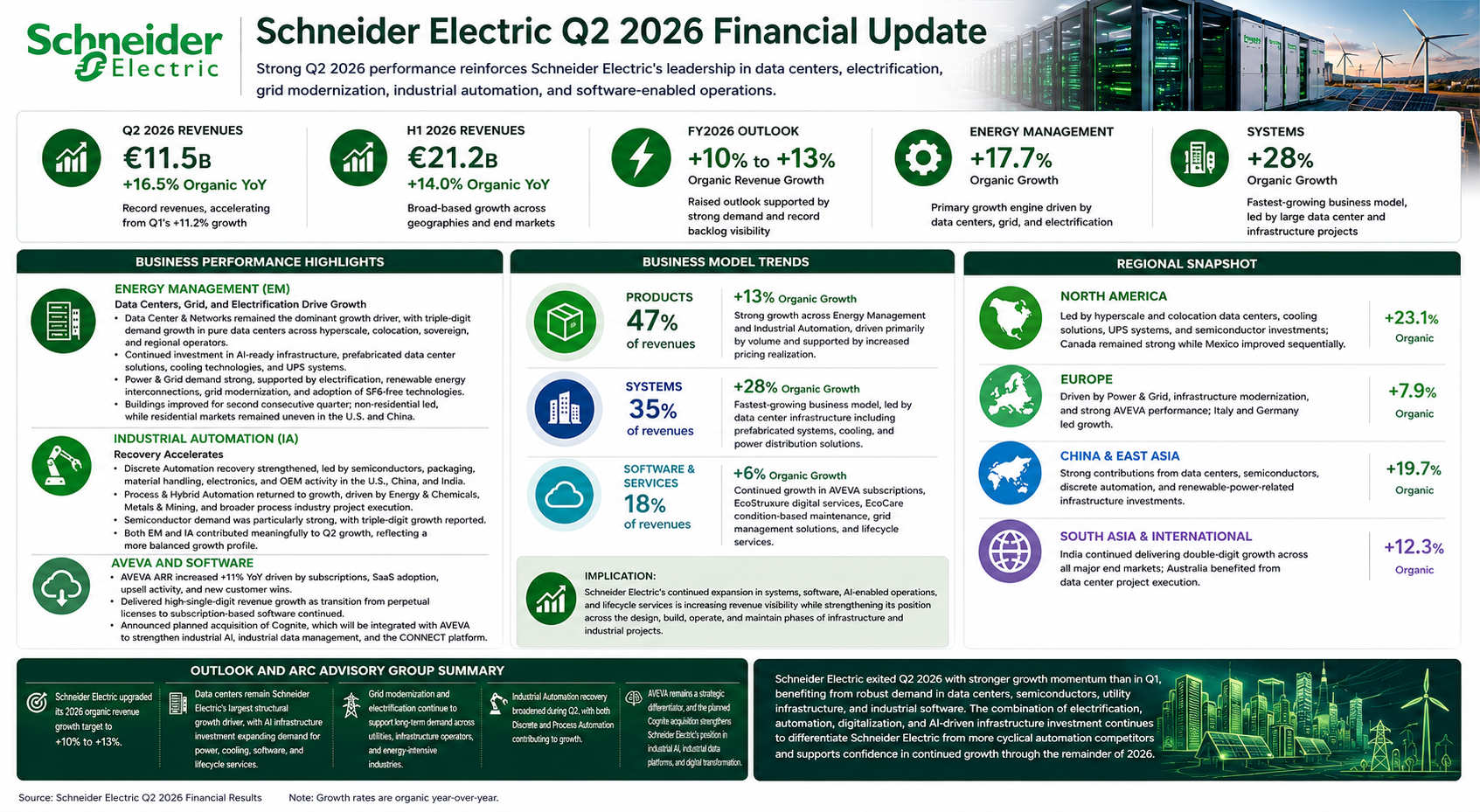
Schneider Electric reported record revenue for the second quarter of 2026 as sustained investment in data centers, electrification, grid modernization, and industrial automation supported growth across its businesses and geographic regions.
Second-quarter revenue reached €11.46 billion, representing organic growth of 16.5 percent and reported growth of 14.5 percent. Revenue for the first half of 2026 increased to €21.23 billion, up 14 percent organically. The company also reported first-half adjusted EBITA of €4.09 billion, with the adjusted EBITA margin increasing to 19.3 percent.
Schneider Electric upgraded its full-year financial target following the strong first-half performance, supported by sustained demand, a record backlog, and growth across electrification, automation, and digital solutions.
Energy Management revenue increased 17.7 percent organically during the quarter. Growth was supported by demand from data centers, electrical power distribution, grid infrastructure, and building markets.
Data Center & Networks remained the company’s strongest end market. Demand in the pure data center segment increased at a triple-digit rate, with activity spanning hyperscale, colocation, sovereign, and regional operators. Schneider Electric reported particularly strong demand for prefabricated data center systems, cooling technologies, and three-phase uninterruptible power supply systems.
Investment in AI infrastructure is increasing both the scale and complexity of data center electrical and cooling requirements. This creates opportunities not only for individual electrical products but also for integrated systems that combine power distribution, cooling, monitoring, control, and services.
Demand from power and grid customers also remained strong. Utilities and infrastructure operators continued investing in renewable energy interconnections, distribution capacity, grid modernization, and digitalization. Schneider Electric also reported continued adoption of its SF6-free technologies as utilities seek alternatives to equipment that uses sulfur hexafluoride.
The Buildings business recorded a second consecutive quarter of strong demand. Non-residential markets, including healthcare, public administration, and commercial real estate, led growth. Residential performance varied by geography, with strong activity in India and improving conditions in Europe, while the United States and China remained affected by economic and interest-rate uncertainty.
Industrial Automation revenue grew 11 percent organically in Q2, accelerating from the first quarter as conditions improved across both discrete and process automation markets.
Discrete automation growth was supported by semiconductor manufacturing, packaging, material handling, electronics, and industrial original equipment manufacturers. Demand was particularly strong in India, the US, and China and East Asia.
The semiconductor segment recorded triple-digit demand growth during the quarter. Schneider Electric benefited from its combined Energy Management and Industrial Automation portfolio, as semiconductor facilities require automation technology alongside extensive power distribution, monitoring, cooling, and infrastructure systems.
Process and hybrid automation also returned to growth. Activity increased across energy and chemicals, metals, mining and minerals, and other process industries as stronger demand recorded since the second half of 2025 began converting into revenue.
The improving performance of both discrete and process automation indicates that Schneider Electric’s Q2 growth was not limited to data center infrastructure. The broader recovery also reflects increased industrial investment in production capacity, electrical infrastructure, automation, and operational modernization.
Systems was Schneider Electric’s fastest-growing business model during the quarter, increasing 28 percent organically and accounting for 35 percent of Q2 revenue. Growth was led primarily by large data center and infrastructure projects involving prefabricated solutions, cooling systems, power distribution, and three-phase UPS technology.
Products, which represented 47 percent of quarterly revenue, grew 13 percent organically. Most of the increase came from volume, although pricing contributed more than it did in the first quarter. Product revenue increased at a double-digit rate across both Energy Management and Industrial Automation.
Software & Services accounted for the remaining 18 percent of revenue and grew 6 percent organically. Within this segment, Software & Digital Services increased 7 percent, while Field Services grew 5 percent. EcoStruxure advisors, power monitoring solutions, EcoCare condition-based maintenance services, grid software, and workplace management offerings contributed to digital services growth.
The growth of the systems business is strategically significant. Large infrastructure and industrial projects typically combine multiple products, engineering capabilities, software platforms, and lifecycle services. This can extend Schneider Electric’s involvement beyond equipment supply into project execution, operations, maintenance, and modernization.
AVEVA’s annualized recurring revenue increased 11 percent year over year as of June 30, driven by expansion among existing customers and new customer wins. Growth came from industries including power and grid, transportation, energy and chemicals, paper and packaging, and discrete manufacturing.
AVEVA delivered high-single-digit organic revenue growth, supported primarily by subscription revenue. Cloud-based software as a service grew faster than on-premise rental offerings as AVEVA continued moving away from perpetual software licensing.
The shift toward recurring subscription revenue can improve revenue visibility while allowing customers to adopt software and new capabilities more incrementally. It also supports Schneider Electric’s efforts to connect engineering, operational, energy, and asset information across industrial and infrastructure lifecycles.
Schneider Electric’s proposed $3.1 billion acquisition of Cognite would further expand this strategy. Cognite provides an industrial data and AI platform designed to integrate and contextualize engineering, operational, and enterprise data.
Subject to regulatory approval and customary closing conditions, Cognite will be integrated with AVEVA and reported within Schneider Electric’s Industrial Automation business. The combination is intended to extend AVEVA’s CONNECT platform with industrial data contextualization, knowledge graph technology, generative AI, and agentic AI capabilities.
North America delivered the strongest regional performance, with organic revenue growth of 23.1 percent. Growth was led by data center investment in the United States and Canada, including hyperscale, colocation, cooling, UPS, and AI-related infrastructure projects. Semiconductor demand also contributed, while residential building markets remained weaker.
Europe grew 7.9 percent organically. Power and grid infrastructure, non-residential buildings, and AVEVA subscription renewals supported the region. Italy and Germany were among the stronger-performing markets.
China and East Asia grew 19.7 percent organically, supported by data centers, semiconductors, discrete automation, and renewable power infrastructure. Schneider Electric reported strong data center project activity in markets including Malaysia, Indonesia, Thailand, and Japan.
South Asia and International revenue increased 12.3 percent organically. India recorded strong double-digit growth across all four end markets, with contributions from data centers, buildings, infrastructure, discrete automation, backup power, and energy storage. Australia also benefited from data center project execution and AVEVA growth.
Schneider Electric’s second-quarter performance reflects the increasing convergence of electrical infrastructure, automation, industrial software, and lifecycle services.
Data center investment remains the most visible growth driver, but the results also indicate strengthening demand across semiconductors, utilities, infrastructure, discrete manufacturing, and process industries. Schneider Electric’s presence across power management, cooling, automation, software, and services enables it to address a larger portion of these projects than vendors focused on an individual technology category.
The rapid growth of the systems business further demonstrates how customer spending is moving toward integrated infrastructure rather than isolated products. At the same time, AVEVA’s subscription growth and the planned Cognite acquisition show Schneider Electric expanding the software and data foundation needed to support industrial AI and software-enabled operations.
Although data center investment currently provides exceptional momentum, the broader recovery in Industrial Automation and continued strength in grid modernization give Schneider Electric a more balanced growth profile. Its combined electrification, automation, and software portfolio positions the company to participate across the design, construction, operation, and maintenance phases of industrial and infrastructure assets.