Representative End User Clients







Representative Automation Clients







Representative Software Clients








In the early days of integrating Artificial Intelligence (AI) with machine vision, the conversation was almost entirely centered on feasibility: “Can it actually do this?” Today, that question has been answered with a resounding yes. What is evident now is a fundamental shift in how manufacturers approach this technology. The industry is no longer in the “trial phase”; it has moved into an era of integration, scalability, and broad application.
The adoption of AI-powered vision systems is accelerating, not just because the technology is "smarter," but because it is becoming more practical and accessible for the modern factory floor.
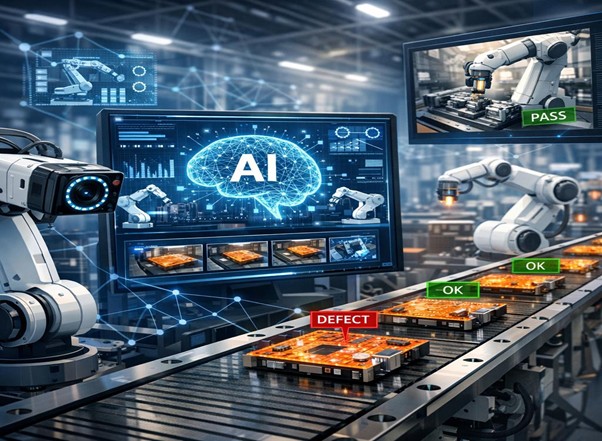
Another key factor accelerating machine vision adoption is the rise of data-centric workflows. Traditional machine vision systems often required extensive programming of explicit rules and tuning of algorithms—a time-consuming process that demanded specialized expertise. In contrast, AI-driven deep learning vision systems learn primarily from data: by training on large sets of labeled images, they can recognize patterns and defects without manual programming of every rule. This shift enables quicker deployment and immediate improvements in product quality.
The hardware powering these advancements has evolved just as rapidly as the software. Advancements in embedded systems technology are playing a crucial role in making AI more accessible. Modern embedded vision systems run AI software directly on onboard computing hardware, powered by specialized chipsets designed specifically for AI workloads. This "intelligence at the edge" eliminates the need for bulky external PCs, making systems easier to integrate into tight factory spaces.
The push for AI adoption is being led by sectors facing the most complex inspection challenges. Automotive, electronics, and logistics are at the forefront. These industries face intricate challenges that traditional, rule-based vision systems—which rely on rigid "if-then" logic—simply cannot solve. In these sectors, even a marginal gain in vision system performance translates to measurable benefits in throughput and waste reduction.
As AI-driven vision technology matures, manufacturers are advised to dust off previously shelved machine vision applications and give them a second look. Many inspection or automation tasks that were deemed too difficult or infeasible a few years ago can now be tackled effectively with the latest generation of AI algorithms. For instance, certain visually complex problems—reading unfamiliar characters on parts, spotting subtle cosmetic defects, or verifying intricate assemblies—were traditionally beyond the scope of rule-based vision systems. Today, deep learning vision models excel at these challenges, handling variations in textures, materials, and product presentation that once defeated classic algorithms. The combination of improved model accuracy and better usability of AI tools means that a problem considered “unsolvable” in 2018 might be readily solvable in 2026 with a modern vision AI platform.
We have moved past the experimental stage. AI-driven machine vision is now a mature, production-ready technology that eliminates the old trade-off between high performance and ease of use. By focusing on modular architectures and data-centric simplicity, manufacturers can finally unlock the full ROI of their automation investments. Looking ahead, experts predict that the competitive advantage in machine vision will come less from who has the cleverest algorithm and more from who can deliver the most usable and scalable solutions.