Representative End User Clients







Representative Automation Clients







Representative Software Clients








Summary
At the recent ARC India Forum, "Industry in Transition: The Information Driven Enterprise in a Connected World" in Bangalore, the  two presentations by Gold sponsor, TCS, resonated well with the theme of the event. The keynote presentation, "Driving Transformation through an Integrated Digital Enterprise," by Harish Mehra, delved into the drivers enabling transformation of manufacturing from plant-centric to an integrated and connected enterprise. In the second presentation, "Re-imagining Design to Manufacturing - Enabling Integrated Value Chain," Manickam Loganathan shared a digitally enabled design and virtually simulated manufacturing set-up. Both TCS presentations focused on integrating the pre-manufacturing environment and digitization of the manufacturing and connected enterprise to achieve incremental business benefits.
The key takeaways from the sessions include:
Driving Transformation through an Integrated Digital Enterprise
In his keynote presentation, Mr. Mehra, began by explaining integration of processes and digitization of design and manufacturing processes. He referred to plant operations and advocated the need for manufacturing transformation and how technology can be used effectively.
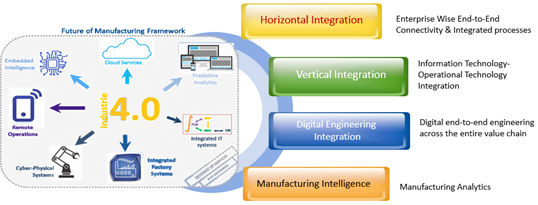
Industrie 4.0: Focus Areas (Source TCS)
Mr. Mehra talked about four factors that have forced manufacturing processes to change: globalization, cost competitiveness, innovation, and sustainability. He stressed that plants should be considered as an enterprise and companies should apply enterprise principles to plant operations. Based on his experience with manufacturing customers, he shared that the CXO community wants to revisit the plant facilities and add new aspects like mobility, cloud, remote operations, cyber-physical systems, integrated IT systems, and predictive analytics to operations wherever possible. He also put this in the context of Industrie 4.0, which is classified into four segments:
Horizontal integration: Connecting the whole ecosystem and making it demand driven cannot be achieved if facilities are in silos. Horizontal integration is about connecting to the ecosystem in an optimal way by integrating processes and extending the definition of enterprise to the plant facility.
Vertical Integration: Information Technology/Operations Technology (IT/OT) integration forces vertical integration of process control, production management, and business planning levels.
Digital Engineering Integration: Using detailed engineering definition, designing and prototyping can be simulated in a virtual environment, without requiring physical prototypes. Digital engineering integration has end-to-end engineering across the value chain.
Manufacturing Intelligence: By providing visibility into plant operations, manufacturing analytics can transform plant operations from reactive to proactive.
Digitization can achieve efficiency, business flexibility, and eventually drive a new business model that will show desired outcomes on the balance sheet. Mr. Mehra talked about such a business transformational model implemented for a TCS customer using its Manufacturing Operation Transformation Framework. This is a phased journey that begins with assessing functional and control system requirements and where the plant and processes stand today, and then identifying the low hanging-fruits to target for initial improvements. Benefits can be achieved once the company starts to deploy the standard practices.
Reimagining Design to Manufacturing (D2M) – Enabling Integrated Value Chain
In his presentation, Mr. Manickam began by explaining TCS's Digital Reimagination model. This focuses on five digital forces: analytics and Big Data, mobility and pervasive computing, social media and community network, cloud application services, and artificial intelligence and robotics. The model can be applied in six areas: workplaces, business models, product and services, customer segments, channels, and business processes.
Mr. Manickam focused on two themes - the emerging needs of Industrie 4.0 and the related digital transformation, in which digital flow provides an integrated source of product and manufacturing information. Both themes can be aligned to enable mass customization and meet changing customer expectations, leading to greater flexibility in the product development value chain.
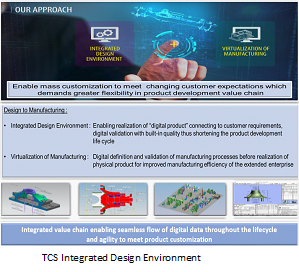
Integrated Design Environment: Through an example of an automotive axle transmission system and its design requirements, Mr. Manickam explained the requirements during the design phase. He explained that all specifications are captured considering end user requirements before developing the design process and validations. The detailed engineering process helps ensure built-in quality beginning at the design phase. In the traditional process these phases are carried out in isolation. But using an integrated, systems-based approach, they are carried out digitally, helping ensure everything is right in the design phase, so it doesn't have to be fixed further along.
He said that based on its industry knowledge and experience integrating design systems, TCS advocates use of digitally enabled systems, which enables product design to be performed via advanced simulation to help reduce manufacturing costs and ensure quality.
Virtualization of Manufacturing: Virtualization helps define manufacturing processes in a 3D environment, which validates the manufacturing process. Virtualization also checks the line feasibility for throughput, quality and ergonomics and validates if more than one different product can be manufactured on the same line. Mr. Manickam shared a 3D-based soft work instruction sheet that is sent to the shop floor. The work instruction has a GUI and other related information about the component and where it goes in to provide operators on the floor with a big picture, while connecting everyone.
Summarizing his session, Mr. Manickam shared an integrated approach from design to manufacturing and how TCS can help at every stage in the product lifecycle. He concluded by saying, "Model-based engineering is leading up to model-based enterprise with a digital thread."
Conclusion
ARC's thirteenth India forum highlighted the impact of digitization in manufacturing. ARC believes that TCS, with its broad and deep engineering services capabilities coupled with the disruptive technologies is well-positioned to help transform manufacturing. The company's approach to design-to-manufacturing, and phased approach towards operations transformation seems promising.
All signed-in ARC Advisory Group clients can view this report in pdf format at this Link
If you would like to buy this report or obtain information about how to become a client, please Request ARC Info
Keywords: Design to Manufacturing, Digital Transformation, Integrated Digital Enterprise, Integrated Value Chain, Tata Consultancy Services (TCS), ARC Advisory Group.