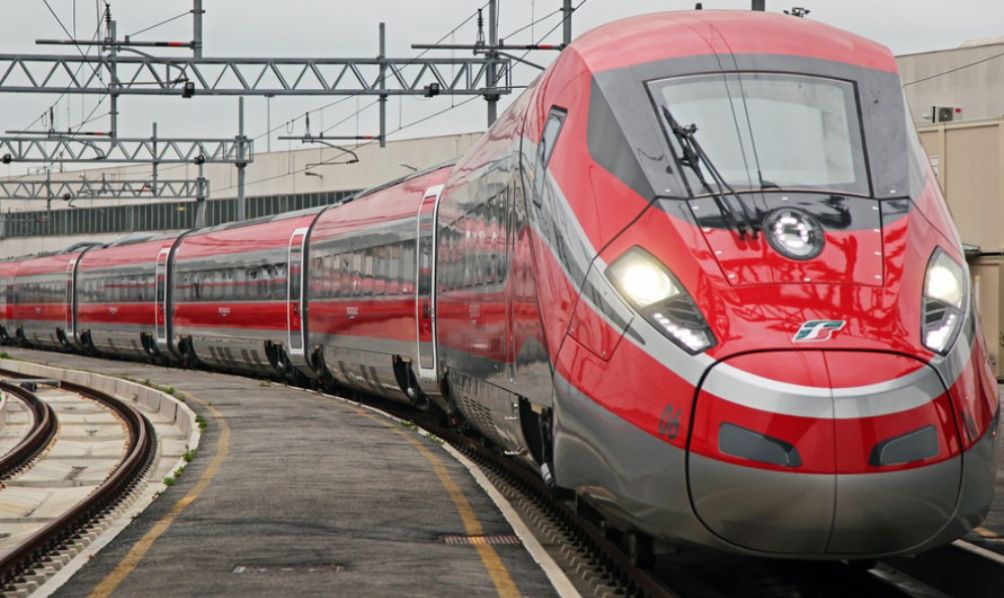
Trenitalia is Italy’s state-owned, public railway company with a 5.5 B Euro turnover. The company has gone through major technical and cultural changes during the past ten years. In 2006 the company had around 50.000 employees and
lost around 1B Euro per year. Today the company has 32.000 employees, operates more trains than in the past and has
earnings of 500M Euro per year.
Competition on High-Speed Connections
One of the key reasons for transformation according to Paolo Masini, Rolling Stock Engineering Director at Trenitalia, is the competition on the high-speed market, a quite unique situation in Europe. This implies the operation of two commercial companies on the same rails on high-speed connections. The company also competes with other transport modes. For example in the 500-600 km range, the market share of the rail increased at the cost of that of airlines that dropped from 60 to 30 percent.
A Combination Of Technical and Culture Change
A major contribution to becoming profitable and efficient is Trenitalia’s maintenance approach according to Mr. Masini, who also mentions the change of mindset the company’s personnel had to adopt. The company expects to ultimately see an 8 to 10 percent reduction in maintenance cost. By changing a traditional combination of corrective maintenance and mileage-based preventative approaches into a dynamic, component-based maintenance approach, the company is increasing availability and running the same mileage with less trains.
Corrective and Preventative Maintenance Are Less Effective
Corrective maintenance is not very positive for a rail company’s image, explained Mr. Masini. Image how you feel when you and get stuck for several hours related to mechanical or electrical issue before you can resume your travels. Availability is therefore not only an economic issue, but also one of comfort and brand image.
Trains run in very variable climate conditions ranging from Alpine to Mediterranean. Some trains travel short distances with a lot of breaking and acceleration, and opening and closing cycles of doors, while others travel large distances and make more wheel rotations. In addition, uneven wear on right or left wheels happens when trains lean more in one direction than another, causing unsymmetrical wheel accelerations. Classical mileage-based preventative maintenance is therefore not very effective, and too many inspections lead to ‘nothing found’ while not preventing breakdowns.
Dynamic, Component-based Maintenance
Trenitalia collects several thousand parameters per train each second, transmits them in real time via Internet and exploits them to better understand the health status of their fleet. Together with
SAP, the company brought those data into
SAP HANA and started analyzing them. Francesco Mari, SAP, Vice President IoT Business Innovation, noted that in this exploratory phase, all the data is being gathered in order to determine which are useful. Mr. Mari explained that for now it is not possible to predict the breakdown of a component with high accuracy.
However, more representative KPI’s can be determined than mileage such as door opening/closing cycles, and secondly, groups of components with higher or lower risk can be distinguished. With this information, Trenitalia is transitioning to a dynamic, component-based maintenance strategy, in which higher risk components, and components reaching limits of their KPI’s are checked and maintained more frequently while other components are checked and maintained less frequently. In some cases diverging KPI’s of components on the same train, can be balanced by choosing specific destinations. For example, trips causing more left wheel rotations and accelerations can be balanced with destinations leading to more right wheel accelerations. Trenitalia had to make its integrated travel and maintenance schedules much more granular to achieve the desired result, a massive increase in reliability and savings.
Conclusion
Trenitalia is proud that a typical old-economy type of business, can be transformed into a state-of-the-art, high-tech enabled and very efficient operation. The battle is not over though, according to Mr. Masini. New challenges are ahead in integrating new types of transportation such as driverless cars. For SAP, the co-development has been a source of inspiration in working with European clients on predictive maintenance and highlighting the SAP
Predictive Maintenance and Service solution.
From this inspiring testimonial, it becomes clear that change can require effort and pain during the transition. The massive overall work force reduction at Trenitalia related to the company restructuring mentioned in the introduction must have been a difficult period. Changing a company’s mindset is not to be thought lightly of either. On the other hand these transitions can create renewal as this case also shows, enabling the company to cover growth and profitability. It was not only the favorable combination of IIoT and asset analytics that have enabled Trenitalia’s success, but also the combination of vision, leadership, technology and culture change. ARC recommends operating companies to inspire themselves by this testimonial, and envision their own, unique positive change.
Note: This blog is based on the information in this
video by Mr. Masini (Trenitalia) and Mr. Mari (SAP).




















