Representative End User Clients







Representative Automation Clients







Representative Software Clients








 At the OSIsoft EMEA Users Conference held last October in Berlin, Germany, Felix Hanisch of Covestro, gave a keynote on the meaning of the Chemical Industry with Industrie 4.0 from Covestro’s perspective. Covestro, a specialty polymers company, was carved out from Bayer in 2015. Dr. Hanisch discussed what cloud, Big Data, and Industrie 4.0 mean for the process industry. The company aims to make the world “a brighter place," with smart ideas and smart products. Dr. Hanisch explained which aspects of Industrie 4.0 are new and how the chemical industry can take advantage of these. He laid out Covestro's digitalization roadmap.
The goal of Industrie 4.0 is to produce intelligent products using intelligent methods and processes. Platform Industrie 4.0 mentions that this is enabled through increased use of near-real-time data in the digital integration of value chains, seamless asset lifecycle information from plant concept to decommissioning, and business-to-plant production control.
The chemicals industry is torn between acting quickly to reap the benefits of Industrie 4.0 on the one hand, and remaining prudent by  making small moves, and thus risk missing opportunities on the other.
A closer look reveals that the industry already has many Industrie 4.0 technologies in place. Some cyber-physical systems enabling the intelligent plant are mainstream in the process industry. For example, most valves are operated by actuators under control of an algorithm in a digital process control system. The IoT "vendor-managed inventory" concept of the household refrigerator sending orders to a grocery store when items reach a low threshold, is commonly employed in the industry. Many chemical companies also already employ analytics based on first principles, empirical, and hybrid models. However, new data-driven analytics are emerging.
How about industrial Big Data (in the cloud)? Some companies provide their personnel and contractors with access to historical and real-time plant data via a private cloud. (Our reports on Novartis’s approach or ALCOA’s implementation provide two examples of this). So, is this Big Data, characterized by high volumes, high velocity and a large variety? As a good-sized plant generates in the order of a billion data points per day (with some parameters being sampled at sub-second frequencies), the volume and the velocity certainly are there. The variety comes from logged events, so-called unstructured data. Some cloud applications are therefore mainstream, but most operations management applications and process control are on-premise. And the industry wants to keep it that way.
Computing power is ever increasing, with many new and easy to use technologies. However, the key is to know where to focus and to recognize if expectations for these technologies are "a pie in the sky" or realistic, according to Dr. Hanisch. To decide where to focus, a company needs a digital strategy. Covestro believes this strategy must be organized along the company’s vertical and horizontal integration axes. The goal of the vertical integration is to make the right data accessible to the right people to be able to make the right decisions. The objective of the horizontal integration with suppliers and customers is to share data, improve cooperation, and improve order fulfillment and service levels. Opportunities arise when scrutinizing the processes and applications along these axes.
Covestro uses the “digital compass” that identifies value drivers related to the digitalization of the manufacturing sectors. Each of those can be influenced with applications and technologies. Estimations of the rang-es of added value per driver, even if approximate, are too important to be ignored, according to Dr. Hanisch. Examples of incentives to do so for companies such as Covestro include reduced downtime and improved reliability.

Chemical manufacturing differs in many aspects from discrete manufacturing, Chemical processes are highly complex and intermingled. Components in these processes are often produced by a network of companies. Components can be very toxic, making them difficult or impossible to transport safely. Chlorine, for example, is sometimes transported directly by pipeline from one company’s site to another’s. In general, safety considerations constrain supply chain flexibility considerably, and create stringent requirements for security and process safety.
The chemicals industry is also very asset intensive, with lifecycles of twenty to thirty years or more for major assets. According to the European Chemical Council, Europe’s chemicals output has been shrinking considerably both in absolute and in relative terms, with much production shifting to the Middle East, Far East, and Gulf regions. European chemical companies contribute to this shift by investing in other regions. Other challenges are access to (low-cost) feedstock and stringent regulations. Downstream manufacturing is also moving out of Europe and end clients are more demanding in terms of traceability, ecological footprint or the added value of the end product. This last aspect also represents an opportunity.
The strategic answer to these challenges is that “Chemicals 4.0” players can thrive when they simultaneously master the supply chain of feedstock and resources, manufacturing efficiency (including intensification and digitalization), as well as customer-specific application value. Covestro has three approaches to digitalization, with different time horizons. In the shorter term, the company aims to “optimize supply,” innovating its day-to-day business by improving reliability and supply chain performance. While this is the “low-hanging fruit,” Covestro still considers it challenging. In the midterm, Covestro wishes to leverage growth and innovate how customers do business with the company. This would involve using information and channels to improve customer experience. Longer term, Covestro considers completely new, digitally enabled business models.
Any improvement project in operations “supply” in Covestro’s terms, is about providing context to data and making these data actionable. The company identified safety, cost reduction, and improving uptime and quality as main targets. This means getting more quality product out of the existing asset in a safe manner.
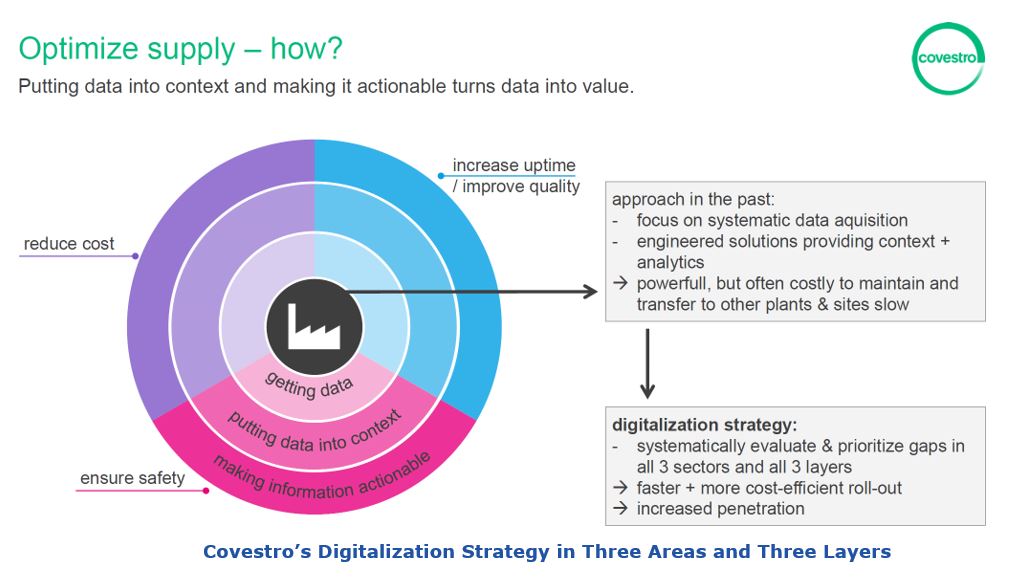
An enterprise agreement with OSIsoft and a successful global rollout helped the company standardize on the PI System, providing Covestro with efficient access to its data. As the company started focusing more on applications, it grew the number of tags considerably. Today 55 PI Servers track around 1.6 million tags for 58 production units. To put data into context and create applications has always required a huge effort in the past. Covestro now evaluates and prioritizes gaps in all three areas and layers, 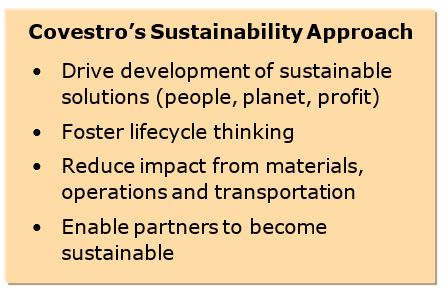 to engineer faster, and increase penetration of applications.
In the safety area, improving sustainability is very important for Covestro. The company not only works on the sustainability of its own operations, but also includes the supply chain and its impact on global environment and people. One example is the STRUCTese approach. This is used to discover energy efficiency projects and prioritize action plans, monitor the key consumers and create awareness, and report improvements in the form of KPIs with respect to targets. These efforts are mainly based on the PI System. The approach has been implement-ed in 60 plants and, to date, has resulted in a 30 percent reduction in specific energy consumption and a 39 percent reduction in specific CO2, or 450,000 tonnes of CO2 per year. By 2030, the company aims to further reduce the specific energy consumption to 50 percent compared to 2005, the first year the approach was applied.
To improve reliability, Covestro uses simple, but effective condition monitoring. For example, sensors are monitored to detect malfunctions. Pump runtimes are monitored to improve load scheduling. And heat exchanger fouling and valve cycles are monitored to improve maintenance scheduling.
The company inherited Bayer's IT systems and owns around 450 soft-ware applications in the production and technology domains. Now the company screens which ones they need for maintenance and production and makes sure that the right data for these applications are in the right master database. For now, it is time consuming for Covestro to compare data across assets. The company wants to better structure its operational information and make sure any new instances of an asset type will be automatically visible worldwide. The company plans to create a reference model enabling data comparison and application rollout.
Another challenge is the difference in innovation cycles of operational technology (OT) components. Distributed control systems (DCS) and safety integrated systems (SIS) have longer product cycles and create real challenges to modernize. Sensors and instruments have shorter cycles, with manufacturing execution systems (MES) in a similar range. Obviously, “in the Cloud” innovation cycles are much shorter.
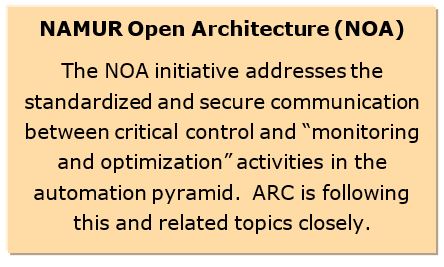
In modernizing its OT and IT landscape the company wants to be careful not to implement new solutions that are not interoperable, maintainable, and scalable; thus avoiding creating “future legacy systems.” Finally, the slow and incomplete adoption of standards in the DCS area makes it cumbersome to access data, according to Dr. Hanisch. However, organizations such as NAMUR are addressing issues related to adaptable open architectures, retrofitting the installed base, and adding new applications efficiently while maintaining security, and reliability.
In conclusion, Dr. Hanisch recommended that companies should not panic, since the industry has been using smart technologies for a long time and has been able to gain value from these.
 Opportunities arise when systematically scrutinizing the value creation network and the automation pyramids of the partners in the network for improvement and gains. These should be evaluated and prioritized to maximize the value of the project portfolio. Reducing CO2 exhaust considerably at Covestro is just one example and, as an industry, we can continue to innovate and improve.
A common data infrastructure is an advantage. However, a consistent asset data model can help organizations create value-adding applications with less effort and leverage them through fast deployment.
ARC Advisory Group fully supports the strategic and systematic approach taken by Covestro for business improvement in operations. We believe that while there is no “one-size-fits-all” approach, projects should support a strategy and help a company accelerate its progress on the road it has chosen.
If you would like to buy this report or obtain information on how to be-come a client, please Contact Us
Keywords: Industrie 4.0, Chemicals 4.0. Covestro, OSIsoft, Value Driver Map, Portfolio Management, Operational Data Model, Rapid Application Deployment, ARC Advisory Group.