Representative End User Clients







Representative Automation Clients







Representative Software Clients








China's 13th Five-Year Plan (2016-2020) targets reform of state-owned enterprises (SOEs) and corruption across manufacturing sectors, including oil & gas. Unlike previous management-level anti-corruption activities, this quiet reform is taking place at all levels 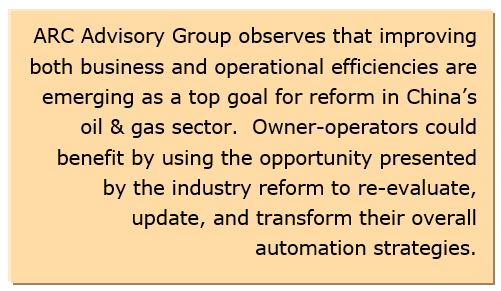 of China’s oil & gas sector. While China is a net importer of oil, the slide in oil prices has had a negative effect on the revenues and profits of China’s national oil companies (NOCs) and private oil & gas companies alike, making systematic top-down reform necessary to boost the sector.
ARC Advisory Group observes that efficiency improvement is emerging as a top goal for this sector’s reform. This appears to include easing controls on market entry in all parts of the industry and is expected to liberalize exploration & production (E&P) rights, pipeline operation, and crude oil imports.
Industrial organizations across all sectors in China must also boost productivity as they are about to face the toughest reforms since the 2009 economic crisis. ARC Advisory Group believes that industry participants could benefit by using the opportunity presented by the industry reform to re-evaluate, update, and transform their overall automation strategies.
The Central Government is still reviewing the proposed reform plan for China’s oil & gas industry, which is expected to come out this year. However, it has already announced a series of tentative steps, such as public tender in the E&P sector, mixed-ownership for pipelines, and opening crude imports to independent refiners. ARC believes that increasing competition in the domestic oil & gas market by lowering the barriers to entry will be the key focus of the reform. The reform will help transform upstream, midstream, and downstream business strategies to improve overall industry efficiency.
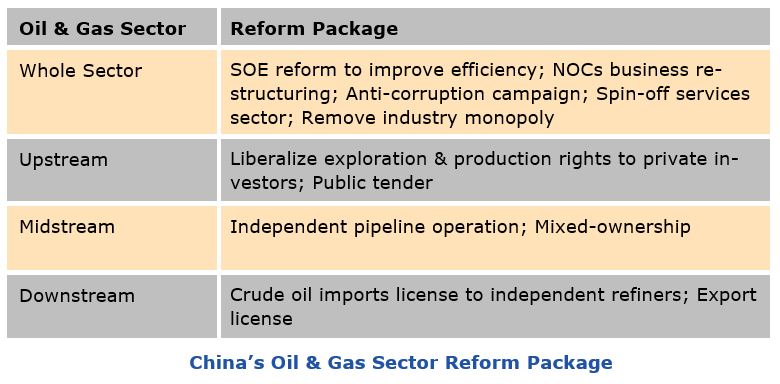
Historically, China’s “Big Three” NOCs – CNPC, Sinopec, and CNOOC - dominated the country’s upstream oil & gas sector. We’ve already seen several breakthroughs in opening up of the E&P sector. These include the public tenders of shale gas blocks and conventional oil and gas blocks in Northwest China in 2015. The further opening up of the sector may bring new opportunities for private and non-national oil companies to enter this previously monopoly-oriented industry. However, given the high barriers to entry, the NOCs are likely to maintain their dominant position into the near future.
Other potential reforms include separating CNPC’s and Sinopec’s oilfield services businesses from their respective E&P operations. However, CNOOC, which did so in 2012, has seen only indifferent results.
 It’s widely expected that the NOC’s pipeline assets will be spun off and restructured as a key element of the reforms, either as mixed-ownership entities, independently listed companies, or possibly even joined together into a state-controlled “management company.” Establishing a single national pipeline company would make it easier to supervise pipeline operations and control costs.
The goal is to make the pipeline business more market-oriented. In one example, CNPC, owner-operator of the country’s largest gas pipeline, sold off 50 percent of its interests in the western section of its West-to-East Pipeline Phase I and II project in 2013.
Reform will have small impact on state-owned refiners, but should have a hugely positive impact on China’s private and/or 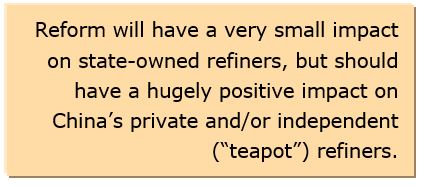 independent (“teapot”) refiners. Independent refiners have historically suffered from poor margins due to their relatively less sophisticated units producing lower-quality products. In addition, without access to crude oil, they must use more expensive imported fuel oil as feedstock. Their utilization rates hovered at 30 to 40 percent, much lower than state-owned refiners' utilization rate of around 80 percent.
Previous policies were aimed at closing the teapots’ smaller and less-inefficient refining units. However, in exchange for this, as part of an overall market reform by the Government towards a fully deregulated oil market, China has been opening up crude imports to independent refiners. With easier access to a variety of feedstocks and, in some cases, rights to export oil products, their utilization rate has risen gradually, recently approaching 60 percent, accounting for 30 percent of China’s total refining capacity. Higher production runs from independent refiners combined with domestic oversupply could lead to a further increase in short-term exports by the teapots.
ARC Advisory Group believes that these reforms will have some negative impact on many oil & gas industry participants in China over the short run, but with improvements in both business and operational efficiencies priorities for ongoing reform, this also represents an opportunity for end users to develop new business strategies, process strategies, and associated automation strategies.
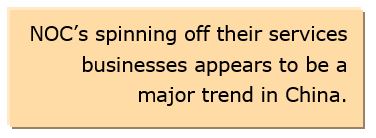
With a lean organization expected for the core business, companies and their human assets must specialize in what they do best. CNPC, for example, plans to spend the next two to three years restructuring its enormous services division and set up three or four new companies covering oilfield drilling, refinery engineering, and financial services. Spinning off services businesses appears to be a major trend in China.
While most end user organizations in China’s oil & gas sector have not lost their automation, engineering, and maintenance knowledge; outsourcing non-core functions to third parties would enable them to on their core business functions: E&P, refining, or  operating pipelines and storage terminals.
Since the reform package is likely to enable midstream pipelines to operate independently of a company’s upstream and/or downstream businesses, the newly spun off pipeline company/companies may find developing KPIs for maintenance functions and/or performance-based automation services contracts will help the new pipeline owner-operators fulfill their operational goals. In many cases, end users could even get metrics for overall equipment effectiveness (OEE) and other maintenance function-related KPIs from the suppliers and enter into performance-based contracts.
With the increased plant utilization rates, independent refiners could also justify outsourcing automation-related services to one degree or another. For example, depending on the level of in-house expertise available, independent refiners could outsource all or some portions of their APC, blending, or operating training simulator (OTS) functions, as most state-owned refiners have already done. End users could increase efficiencies and reduce costs by outsourcing engineering and maintenance functions to third parties with appropriate expertise and workers with the appropriate skillsets.
Over the past several years, a variety of reform plans have been launched, but the pace has slowed as the companies have been waiting for the Central Government to formally issue an overall reform plan. Reform is likely to give oil & gas owner-operators an edge in global competition, but will require incremental steps involving numerous pilot projects.
Industrial organizations in China’s oil & gas sector still have plenty of time to adapt to the new business cycle and develop appropriate new automation strategies. ARC recommends that owner-operators and technology suppliers should work together as partners, since long-term partnership agreements and performance-based service contracts can add value for both parties by leveraging automation suppliers’ expertise to help meet end users’ needs.
Planned reforms in China will pave the way to transform this sector’s business model. Owner-operators’ daily activities should shift to focusing on improving efficiency to achieve operational excellence.
If you would like to buy this report or obtain information about how to become a client, please Contact Us.
Keywords: China, Oil & Gas, Reforms, National Oil Company (NOC), Teapot Refiner, Automation Strategies, Exploration & Production (E&P), Pipelines, ARC Advisory Group.