Representative End User Clients







Representative Automation Clients







Representative Software Clients








When EU Commission vice-president Frans Timmermans was talking about hydrogen last July, he called it "The rock star for new energies all around the world, especially in Europe,". And it is not just Timmermans - these days, everyone in the energy sector is talking about the promises of this energy source. But, it is not just the energy providers that are involved with the topic.
Hydrogen was also among the key strategic value chains identified by the ‘Strategic Forum for 'Important Projects of Common European Interest’. As a result, the European Union announced the ‘European Clean Hydrogen Alliance’ as part of the new industrial strategy for Europe in March 2020. It is part of efforts to accelerate the decarbonization of industry and maintain industrial leadership in Europe. In autumn 2020, the alliance already included almost 400 companies, as well as public authorities, research organizations, and other societies and organizations. Many members are energy providers and their suppliers, but also major chemical companies, like BASF and Arkema. The alliance is also interesting for industrial manufacturers and automation provider as the rising membership numbers prove.
Siemens Energy joined the initiative right at the start. Just in the last two months, the company announced three major hydrogen-related projects. In September, Evonik and Siemens Energy commissioned a pilot plant sponsored by the German Federal Ministry of Education and Research (BMBF) that uses carbon dioxide and water to produce chemicals. The necessary energy is supplied by electricity from renewable sources. The pilot plant is located in Marl, in the Northern Ruhr area of Germany, and its innovative technology of artificial photosynthesis should contribute to the success of the energy revolution. It is an essential part of the Rheticus 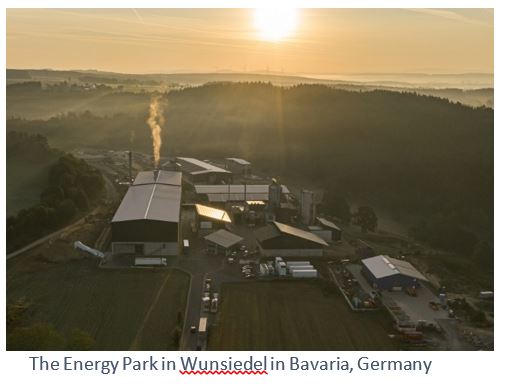 I and II research projects, which are sponsored by the Federal Ministry of Education and Research (BMBF) with a total of 6.3 million euros.
A few weeks later, Siemens Smart Infrastructure and WUN H2 GmbH signed a contract to build one of the largest hydrogen production plants in Germany. It will be built in Wunsiedel in the north of Bavaria. With a power intake of six megawatts in the initial development phase, the plant will run solely on renewable energy and will be CO2-free. The electrolysis plant from Siemens Energy will have the capacity to produce over 900 tons of hydrogen per year in this first phase. When fully expanded, it will be able to supply up to 2,000 tons. Groundbreaking is scheduled for the end of this year and commissioning at the end of 2021.
In early October, Siemens Energy and Siemens Mobility signed a Memorandum of Understanding to jointly develop and offer hydrogen systems for trains. The agreement was signed by Albrecht Neumann, CEO of Rolling Stock at Siemens Mobility, and Armin Schnettler, Executive Vice President (EVP) of New Energy Business at Siemens Energy. The project aims to jointly develop holistic hydrogen solutions for rail transport and offering them to customers to promote the hydrogen economy in Germany and Europe and support decarbonization in the mobility sector.