Representative End User Clients







Representative Automation Clients







Representative Software Clients









Industrial automation professionals across all industries are waking up to the numerous incremental value propositions 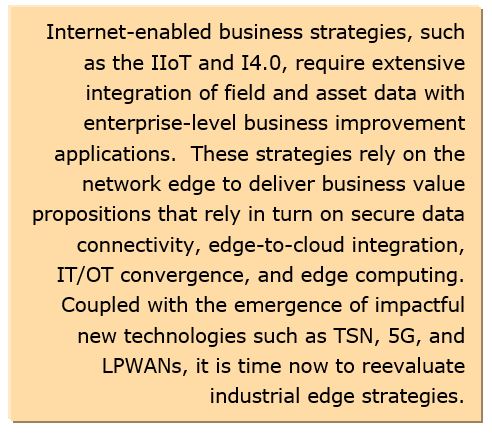 associated with industrial internet-based strategies. Initiatives such as the Industrial Internet of Things (IIoT), Industrie 4.0 (I4.0), IT/OT convergence, smart manufacturing, Smart Cities, and others are viewed as paths to increase revenues, reduce costs, optimize assets, drive business innovation, and so on. This recognition extends to the C-Level, where executives increasingly recognize the potential business impact of these initiatives.
Connectivity, transparency, and remote access are primary enablers of many of today’s internet-enabled business improvement strategies. Cloud integration; convergence between information (IT), operational (OT), and engineering (ET) technologies; and the overall need to feed data from the field to enterprise-level applications are central to achieving these business objectives. The emerging “digital twin” concept promises the ability to develop, share, and continuously refine a digitized view of the product and the process throughout their respective lifecycles. Each of these concepts relies heavily on the industrial network edge as its information conduit.
These prospects herald the dawning of a new era at the industrial network edge, one that must be addressed as manufacturers prepare for and implement internet-based business strategies. This preparation extends to ensuring that what enterprise applications view as “the network edge” meets the requirements for successfully executing connectivity-enabled business strategies.
This has numerous implications throughout the network edge architecture, including:
The term “industrial network edge” sparked some initial confusion due to operational technology (OT) professionals’ familiarity with distributed automation & control and pre-Internet requirements for delivering information to higher-level enterprise applications, such as ERP. When the “edge” term first emerged, many respected engineering professionals  associated the Industrial Internet’s cloud integration requirements with legacy MES.
This is understandable from the perspective of legacy plant floor integration requirements in service of data-hungry enterprise applications. Networked devices linked to each other and higher levels of the automation hierarchy via an automation network infrastructure have long existed.
The rise of the term “industrial network edge,” however, coincided with migration toward cloud-based enterprise applications that rely on data from the field to generate the desired operating performance improvements. Only with the advent of cloud-based applications has the “edge” term come into widespread usage. This reflects a top-down perspective from the enterprise level that results in field-level equipment appearing at the outer edge of the architecture. The important distinction relative to distributed automation & control lies in the fact that the term “edge” references service to cloud-based enterprise applications, or what those at the enterprise level see as the perimeter of their top-down view of the architecture, and not execution of traditional distributed automation.

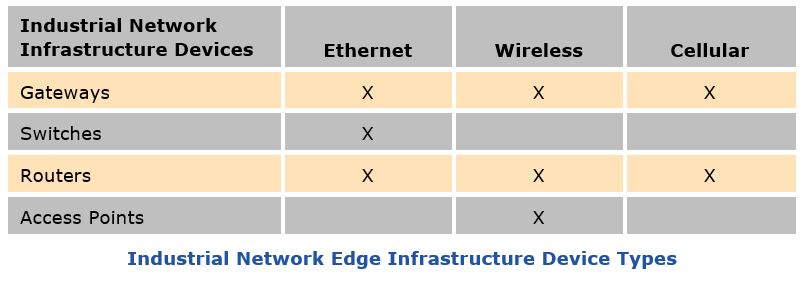
ARC Advisory Group’s definition of industrial network edge devices encompasses two primary categories: IP-based network edge infrastructure and end devices. In both cases, the functionality includes the ability to connect to and/or execute applications that normally reside in the cloud. The infrastructure tier is populated by devices such as Ethernet, wireless, and cellular gateways; Ethernet switches and routers; and wireless access points (WAPs). A new category of IIoT infrastructure nodes is also emerging that combines traditional interface functionality with built-in cloud integration and software-based management capabilities.
Network edge infrastructure devices play an increasing role as middleware entities that connect the field to the enterprise. These products have traditionally been relied on to bridge IT and OT environments, bring automation devices onto the enterprise backhaul, and/or bring legacy equipment into automation or enterprise architectures. An industrial gateway, for example, may be used to interface automation-specific machine networks to Ethernet backhauls, while a cellular router or gateway may link remote oil and gas installations to corporate operations.
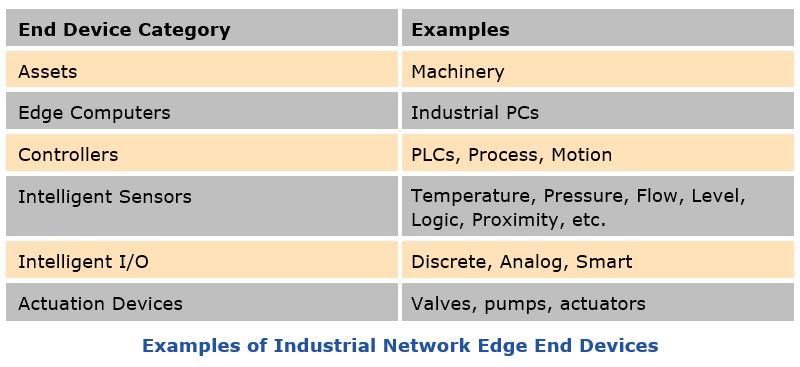
End devices such as logic, motion, and process controllers; drives; I/O; and sensors, typically reside below the network infrastructure tier in the industrial automation hierarchy. These devices are relied upon for the sensing, control, data acquisition, and related functions associated with automated manufacturing processes.
End devices incorporated into IIoT/I4.0 applications must typically be able to connect to the Industrial Internet via Ethernet, industrial Ethernet, or IP-based wireless or cellular interfaces. Many automation devices, particularly within the installed base of legacy applications, employ serial, analog, or other non-Internet-capable networks and rely on gateways or other devices at the network infrastructure tier to incorporate into the industrial Internet.
Devices that populate the industrial network edge typically differ from their commercial brethren both by their application and ability to operate under harsh industrial conditions. This includes features such as extended environmental, shock, vibration, and surge ratings as well as industrial form factors, such as DIN rail-mounting.
Organizations today increasingly see initiatives such as the Industrial Internet of Things (IIoT), Industrie 4.0 (I4.0), China 2025, and Smart Cities as the means to reduce downtime, increase flexibility, and achieve an open, connected and  secure infrastructure. In today’s environment, target outcomes for internet-enabled strategies can range from reduced operations or maintenance costs to reduced machine downtime, increased production flexibility, or migration to a service-oriented product offering. These benefits extend throughout the value chain to suppliers, OEMs, system integrators, and end customers. To achieve these objectives, manufacturers must be able to dynamically access, monitor, manage, control, and optimize the associated assets, machines, processes, and/or connected end products. The industrial network edge and the devices associated with it have emerged as primary vehicles for delivering these capabilities.
The IIoT requires extensive integration of field and asset data with enterprise-level business improvement applications, many that reside in the cloud. Cloud-based enterprise-level business improvement strategies in the Industrial Internet age need data from edge machines, processes, and other assets to feed data-driven activities such as analytics. These cloud-based architectures rely on the network edge to provide data communications, application integration, and security, among other key roles.
This trend is evident as companies are already escalating connectivity requirements in their request for proposals (RFPs), using these new capabilities to achieve initial benefits in areas such as remote monitoring, diagnostics, and energy management that typically require remote access and incremental data gathering. New project requisitions around the world and across industries provide concrete evidence of the need for multifold increases in edge connectivity.
Migrating cloud-based enterprise applications to the network and end device levels is one of the main pressures driving change at the industrial edge. Edge-to-cloud integration currently serves many purposes. These include device  configuration and management, remote access and monitoring, data storage, and/or application execution.
Most data needed by analytics and other enterprise cloud applications originate in the sensors, controllers, and other components related to edge assets. As a result, the network edge must be able to feed data into the Cloud and the applications that reside there. Automation professionals, suppliers, system integrators, original equipment manufacturer (OEM) machine builders, and other members of the manufacturing value chain increasingly recognize the integration demands these requirements present and their impact on the evolution of the network edge architecture. With edge and fog computing, some of the functionality traditionally associated with the enterprise level is migrating into edge devices, a further evolution.
Enterprise applications are emerging as primary consumers of data generated at the industrial edge. But the sheer volume of data generated by these devices and processes makes cloud-based execution unrealistic in many cases. Edge applications may not be able to tolerate the latency inherent in delivering data back and forth to the Cloud for analysis and feedback. What’s more, some customers are not willing to serve their data up into a cloud due to security, bandwidth, or cost concerns.
Formerly isolated, OT-centric installations must now respond to the need to integrate data with information technology (IT) and engineering technology (ET) when serving cloud-based enterprise applications. In response, the technologies associated with each of these previously separate activities are converging, with commercial-off-the-shelf (COTS) and standard IT technologies extending further into the architecture.
Industrial edge devices are taking on the characteristics of their IT brethren in areas ranging from use of standard microprocessors and operating systems to support for IT protocols and enterprise platform agents. Most manufacturing organizations now realize the potential for a common infrastructure throughout the organization, resulting in the need for IT and OT to collaborate effectively and ensure appropriate performance, availability, and cybersecurity. Central to this migration is the need to determine where and how data is sourced, processed, accessed, and viewed within the architecture and how that impacts the functional requirements of edge devices going forward.
In these early days of IIoT/I4.0 development and adoption, ARC sees a clustered or hour-glass architecture emerging to meet the needs of edge-to-cloud integration. Numerous causal factors are at play for what may be an interim strategy. These include using gateways or routers as the focal point for IT/OT convergence, cloud integration, incorporating legacy devices, and security. This is evident in the positioning associated with products such as the Intel IoT gateway platform, which is resold by original equipment manufacturers (OEMs) such as Advantech, Dell, GE, HPE, etc., where the gateway plays a crucial role in providing these functionalities.
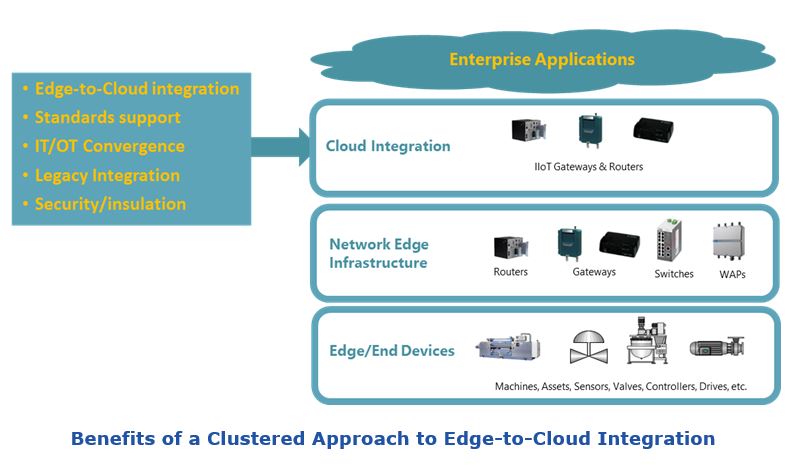
Through their protocol conversion capabilities, gateways make it easy to integrate legacy automation protocols. They also help insulate OT assets from the IT environment, thereby addressing OT security concerns about device or machine access.
During this interim stretch, relying on gateways for cloud integration mitigates several immediate needs. These include the need for other network edge infrastructure devices to migrate to the standard microprocessors and operating systems necessary to achieve cloud integration, support IT-oriented integration protocols, and ultimately host IIoT platform agents and edge computing applications. This migration is already under way in some quarters, with edge infrastructure products increasingly incorporating standard, COTS-based hardware and operating system platforms to prepare for these anticipated requirements.
Further evolution of the edge-to-cloud integration phenomenon includes emergence of edge or fog computing strategies. With this approach, some of the application execution traditionally associated with the enterprise level is migrating into the edge devices. Edge computing differs from traditional distributed automation and control in that it  emphasizes execution of applications typically resident in the cloud rather than local control programs.
One way to distinguish traditional distributed industrial automation from the IIoT-driven trend toward edge computing is to focus on where different functions are being executed. In the control environment, the emphasis is on local process, logic, and motion control programs that execute based on the numerous inputs from, and outputs to, machinery, processes, and field automation equipment. Edge computing, on the other hand, entails local or distributed execution of applications traditionally associated with higher levels of the architecture, particularly cloud-based applications.
Edge analytics, one of the earliest “killer apps” in edge computing, is an example of this difference. Cloud-based analytics applications have been available for some time, but with the advent of the IIoT some of their functionality is migrating out of the cloud and onto the network edge. This is particularly true for the predictive analytics that help reduce downtime, maximize performance, enhance production operations, and deliver other important IIoT business value propositions. Availability of analytical feedback on or near the target assets delivers speedy (ultimately even real-time) feedback.
Edge computing applications provide important feedback to the control process to these ends, but typically do not execute the control logic or algorithms. This emphasis on bringing higher-level, typically cloud-based functionality to the edge, as well as support of device-to-cloud integration, are primary differentiators between edge computing and today’s control and HMI environment.
Two primary drivers contribute to the emergence of edge computing: the need to process data locally to prevent a data deluge from operations to the enterprise; plus, the speed, security, and other advantages inherent in executing applications close to their data source and target execution environment. Ongoing price/performance improvements in edge devices, including convergence of connectivity and compute capabilities, in turn facilitate continued migration toward edge computing.
 Edge computing solves the issue of overburdening enterprise applications and communication links by processing data at the edge and driving further distribution of the architecture. For example, edge computing can help identify and flag data anomalies that may be associated with problems in the device and/or process, plus filter, offload, and store data not immediately required by the enterprise application.
Edge applications themselves may not be able to tolerate the latency inherent in delivering data back and forth to the Cloud for analysis and feedback. Some customers are also not willing to serve their data up into a cloud.
Pursuit of industrial internet-enabled strategies necessitates a departure from the siloed, “IT vs. OT” perspective that has historically pervaded manufacturing firms. Success with internet-enabled business improvement requires true convergence of information technology (IT), operational technology (OT), and engineering technology (ET) to implement the access, transparency, security, and execution capabilities needed to deliver on its significant promise.
Discussions of IT/OT convergence in the industrial networking realm typically focus on migration of IT technology into the OT or automation and control domain. Extension of standard Ethernet networks and operating systems, such as Linux and Windows, into industrial automation architectures are some of the more prominent examples of this convergence in recent years.
Rising use of edge computing is extending the definition of IT/OT convergence to the merging of computational power and connectivity, or compute/connect. Network edge infrastructure devices whose primary traditional role has been to enable data connectivity between and within different layers of the architecture now add compute power to meet the emerging demands of edge computing. At the same time, the need to process and deliver pre-processed OT data to cloud-based enterprise applications drive compute capability down in the architecture and closer to the edge.
Edge devices need to meet three criteria to be candidates for edge computing: deploy standard microprocessors, standard operating systems (or containers), and support standard IP connectivity. Cloud connectivity can be achieved by support of either an embedded cloud platform agent (e.g., Predix Machine or Cisco IoX) and/or via use of standard connectivity protocols, such as MQTT or OPC UA.

A clustered approach to edge-to-cloud integration further enables compute/connect convergence. Traditional IT suppliers such as Dell and HPE offer industrialized network infrastructure products with significant edge computing power, industrial network protocol support, and embedded software that supports leading manufacturing and public  clouds. At the same time, traditional industrial network infrastructure players such as Cisco and Advantech are adding incremental compute power, support for standard operating systems and/or containers, and the ability to host cloud platform agents.
One caveat here is that the emphasis on edge computing conducted at the network infrastructure layer could ultimately lead to this functionality migrating into the end devices themselves. While this migration will take time, ARC sees emphasizing the infrastructure layer as the platform for cloud integration edge computing as an interim approach. Ultimately, ARC anticipates further distribution of both cloud integration and edge computing capabilities into end devices, starting with high-end devices such as controllers, robots, and other devices that already possess significant compute power and data integration capabilities.
Implementing architectures to support migration toward IIoT-enabled business strategies are currently top-of-mind for many manufacturing customers, but concurrent technology developments will also impact future edge-related purchases. These include SDN’s downward migration, TSN’s impact on industrial Ethernet networks, and new developments in 5G wireless and LPWAN.
In another example of developments in the IT realm having significant implications for industrial applications, Software Defined Networking (SDN) holds tremendous potential to improve network configuration, management, maintenance, change control, and security relative to current network implementations. SDN adds incremental value-added  functionality in areas such as creating mesh-based field networks, cloud-based web filtering, and the ability to provide ID flow to the edge. SDN’s separation of the control and data planes enables decoupling of data from devices, allowing applications to extract data from the infrastructure rather than the hardware device. This enables more efficient network configuration, least-cost routing, and improved control distribution as data is no longer tied to the end device.
Industrial use of SDN is also being pursued due to its greater value proposition in security applications relative to traditional point-to-point VPNs, which do not differentiate their network traffic. Two SDN technologies, OpenFlow and Host Identity Protocol (HIP, RFC 7401), offer the potential to improve cybersecurity for both new and existing industrial control systems. Both SDN techniques have already been employed in actual industrial installations, with products released to the industrial market using these techniques. Either might well prove to be the most promising advancement for industrial cybersecurity since the invention of the firewall.
SDN is particularly well suited for use in dynamic networks with large numbers of devices. It is also driving further commoditization of infrastructure hardware as value migrates from hardware to software.
True real-time industrial Ethernet performance has traditionally been the realm of vendor- or protocol-specific implementations like PROFINET IRT or EtherCAT. Among other drawbacks, this specificity limits the supply base, raises costs, and limits interoperability. The IEEE 802.1 TSN (Time-Sensitive Network) standardization activity brings the prospect of true real-time operation to standard, unmodified Ethernet networks.
Originally driven by audio/visual bridging requirements, the TSN standards could soon enjoy widespread adoption as an automotive in-car network. Service to this segment will give industrial applications a large body of experience from which to gauge the standard’s performance in harsh real-time environments.
TSN addresses legacy drawbacks of industrial Ethernet networks in areas such as perceived reliability, fault tolerance, scalability, latency, and ability to configure deterministic control loops. At the same time, it adds incremental benefits like central configuration and the prospect of network convergence. TSN promises to bring real-time deterministic behavior to IEEE standard Ethernet, eliminating the need for vendor or protocol-specific implementations. Support for this activity through the core IEEE 802 standardization effort, rather than vendor-specific initiatives, holds tremendous promise in industrial applications.
At issue, however, are the numerous individual specifications that make up the standard and the prospect for non-interoperability due to differing implementations. TSN covers only Layer 1 and Layer 2 of the network protocol stack and does not extend into the network protocol or higher layers.
ARC believes that the industrial network protocol organizations will therefore play an important role in defining capabilities and guaranteeing TSN interoperability, with organizations such as PROFIBUS International and ODVA (EtherNet/IP) certifying TSN products that support their respective protocols. Organizations such as the AVNU Alliance and the Industrial Internet Consortium (IIC) also offer the means to evaluate interoperability of differing implementations,  an important issue given the number of standards-within-the-standard.
Proponents of OPC UA have launched an aggressive campaign championing the combination of OPC UA and TSN as a universal industrial Ethernet stack. Industrial suppliers such as ABB, Bosch Rexroth, B&R, Cisco, General Electric, KUKA, National Instruments, Parker Hannifin, Schneider Electric, SEW-EURODRIVE, and TTTech are promoting the use of OPC UA and TSN as a unified means to provide cloud integration for industrial devices. The European plastics industry group EUROMAP already recommends use of TSN with OPC UA.
The emerging 5G cellular standard promises revolutionary ability to deliver multi-Gigabit speeds and massive bandwidth capacity. This is leading developers to target new applications that require the delivery of very large amounts of data over short distances. ARC expects 5G to be a good fit for fixed industrial installations due to its high bandwidth and  capacity. We further expect it to accelerate the migration of edge computing toward the extreme edge of the architecture, catalyzing the move beyond the clustered approach to IIoT integration.
Prospects for migration to 5G will benefit from its targeted use in automotive in-car and similar applications, which exhibit many of the same requirements as industrial installations in areas such as latency, escalating bandwidth and capacity, and environmental ruggedness. In-vehicle applications will also drive significant volume, ultimately resulting in more widespread component availability and lower cost.
LPWAN (Low Power Wide Area Network) technologies, such as Sigfox and LoRA, are emerging new options for low-bandwidth applications. LPWANs are attractive due to their simplicity, affordability, and energy efficiency for applications such as low-end sensor inputs, but vary in business model and ecosystem construction. For example, Sigfox tightly controls its network value chain, while multiple network operators and hardware/software vendors can participate in LoRA networks. NB-IoT and LTE-Cat-M1 are also targeted for use in these applications.
LPWAN has competitive benefits in lower cost and energy consumption as well as potential to serve indoor wireless applications. Major differentiators in this emerging sector include node cost, power consumption, network reliability, capacity, data rates, geographic network availability, and supplier ecosystem.
Based on its research and analysis, ARC recommends the following actions for industrial organizations evaluating an industrial network edge strategy in the age of IIoT:
Information for this report was assembled from ARC’s ongoing primary research into IIoT and associated hardware, software, and applications. Readers are encouraged to explore further resources, including relevant market analyses, selection guides, blog posts, and reports at www.arcweb.com.
If you would like to buy this report or obtain information about how to become a client, please Contact Us