Representative End User Clients







Representative Automation Clients







Representative Software Clients









International oil companies (IOC) and national oil companies (NOC) are both competing and cooperating for the constant race to recover hydrocarbons. Oil and natural gas will continue to comprise a sizeable, and growing, share of the energy source mix that 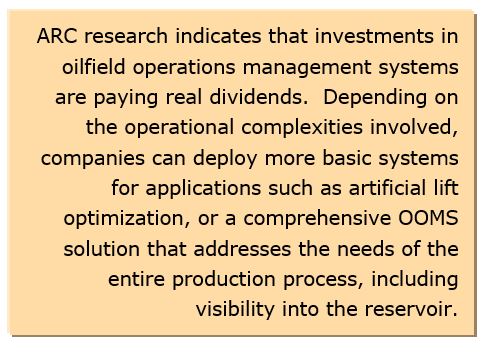 includes coal, nuclear, hydroelectric, solar, and wind, and oilfield operations management systems provide value-based applications. Technology advancements, more streamlined operational processes, and the emergence of unconventional shale in the US, oil tar sands in Western Canada, and an increasing reliance on deepwater offshore and subsea fields have led to a surge in oil & gas production that began to exceed demand in the middle of 2014.
The global upstream oil & gas segment has been suffering an unprecedented downturn for more than two years, which has seen CapEx reduced by over $700 billion since the summer of 2014 and well over 100 companies filing for bankruptcy. Layoffs exceed 350,000 people, and a growing wave of consolidation in the upstream segment has also created an environment in which companies are being forced to embrace automation and new technologies such as oilfield operations management systems (OOMS) to survive.
ARC expects an increasing number of companies to resume investing in these solutions as oil prices begin to slowly recover and the supply-demand equilibrium regains its balance. These systems can help them lower costs, enhance production, improve and/or enhance recovery, and ensure more efficient operations with fewer experienced personnel; making them a vital investment that typically translates into material ROI and continued competitive survival.
Recent ARC Advisory Group research indicates that investment in oilfield operations management systems can provide significant operational value and ROI. Major applications include:
Oilfield operational management systems are typically comprised of one or more applications or modules that are integrated with other applications to create a more comprehensive solution.
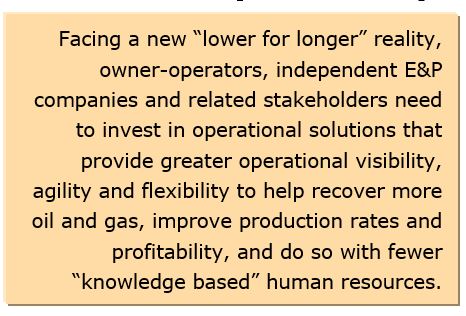 Oilfield operations management systems are designed to empower owner-operators and independent E&P companies to lower costs per barrel of oil equivalent (BOE); enhance operational efficiency; optimize production; enhance profitability; and provide real-time operational visibility, agility, and flexibility. These systems can help maximize production, improve recovery rates in new wells, enhance oil recovery in more mature wells, and open up production on a broader array of well types and application locations subsea, offshore, and onshore. Depending on the production level of an individual well (or field) the financial benefit of increasing operational performance by even 2 percent to 3 percent can translate into millions of dollars per year for very large projects.
The specific operational requirements for an OOMS solution may vary somewhat by end user, project location, or various operational parameters. However, the main drivers for adoption include the desire to:
Several suppliers have developed their respective operations management in large part by collaborating with major owner-operators and independent E&P companies through joint industry projects.
ARC advises E&P companies to work closely with suppliers during the installation and implementation phase to learn and better understand any potential nuances that may exist. Users that lack the needed in-house technical expertise or level of resources 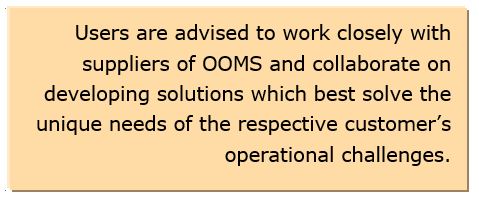 necessary to effectively maximize the full benefits of an operations management system should consider outsourcing some or all operational activities to a capable and proven third party, such as one of the leading oilfield service suppliers.
ARC’s research determined that, while there is significant disparity between the comprehensiveness and sophistication of different suppliers’ oilfield operations management systems, all will likely meet at least some of most companies’ requirements.
ARC believes that owner-operators and others cannot afford not to invest in solutions that – when properly implemented and applied -- can enhance production and/or enhance recovery rates in today’s very challenging upstream environment and tight skills market.
Potential users should evaluate the technology on a small scale and actual business/operational benefits prior to widespread deployment.
If you would like to buy this report or obtain information on how to become a client, please contact us.
Keywords: Production Operations Management & Monitoring; Production Optimization & Allocation; Production Analysis and Diagnostics; Production Design, Simulation and Modeling, ARC Advisory Group.