Representative End User Clients







Representative Automation Clients







Representative Software Clients








KEYWORDS: Automation Engineering, PLC Programming, Software-Centric Engineering, IEC 61131-3, Structured Text, DevOps, Git-Based Collaboration, Reusable Libraries, TIA Portal, Industrial Software Lifecycle
Industrial automation engineering is entering a transition similar to what enterprise software experienced years ago. Control applications are growing in size and connectivity, machine portfolios are becoming more variant-driven, and engineering organizations are increasingly distributed. Yet many PLC development workflows still rely on proprietary, project-centric tools and late-cycle validation during commissioning, which can limit reuse, traceability, and safe parallel development as software complexity increases.
This ARC View examines the market drivers behind Siemens’ move toward software-centric automation engineering, explains what SIMATIC AX is and who it targets, and outlines how it is intended to complement TIA Portal within the broader SIMATIC ecosystem.
For much of the past several decades, industrial automation engineering tools have been optimized for commissioning-centric workflows: engineers build control logic inside proprietary project containers, validate primarily on real equipment, and rely on a combination of graphical languages (ladder logic, function blocks) and vendor-specific tooling to deliver deterministic, high-availability control. These methods became widely established as PLCs matured from the 1980s through the 2000s, and they continue to dominate many factory environments today because they prioritize reliability and familiarity.
SIMATIC AX signals a shift from commissioning-driven PLC programming to a more deliberate, repeatable software lifecycle, helping teams deliver change faster, with greater confidence, across machines and plants.
However, the role of control software has expanded: programs are larger, systems are more connected, and machine portfolios often involve many variants that must be updated and supported over long lifecycles. In this context, practices that work well for a single machine and a single engineer can become limiting when applied across multi-team, multi-site development, especially when software reuse, change control, and regression prevention become central requirements rather than “nice to have” capabilities.
Traditional programming practices can increase cost and risk in ways that are not always visible during initial commissioning, but recur across iterative improvements, machine replication, and long-term maintenance. Common disadvantages include:
The industry’s operating context is now closer to enterprise software development than to the isolated control systems of the past. Manufacturers face faster product cycles, more configuration variants, distributed engineering teams, and higher expectations for cybersecurity and update discipline. At the same time, reliability requirements remain non-negotiable, creating pressure to improve quality and speed simultaneously rather than trading one for the other.
Siemens has addressed this challenge with SIMATIC AX, a set of engineering tools that treats PLC software as a first-class software product. This means source-centric engineering, Git-friendly collaboration, reusable packages, automated quality checks, including unit tests, and pipeline automation through command-line workflows. In effect, Siemens is positioning AX to help move automation engineering from project-by-project programming toward standardized, testable, and continuously improvable software assets that can be leveraged across TIA Portal-based machine projects. This approach is intended to reduce rework during commissioning, improve maintainability over the machine lifecycle, and help engineering organizations scale delivery without sacrificing control-system robustness.
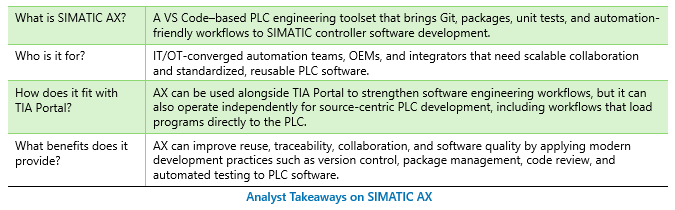
SIMATIC AX (Automation Xpansion) is Siemens’ IT-oriented PLC engineering toolset, bringing Git-based collaboration, package management, automated testing, and CI/CD-friendly workflows into SIMATIC controller development. Built on Visual Studio Code, it focuses on text-first engineering and aims to make PLC software easier to develop, review, reuse, and maintain at scale, especially for distributed teams and organizations standardizing libraries across machines and plants.
At its core, SIMATIC AX provides an engineering environment for IEC 61131-3 Structured Text with an emphasis on modularity and reuse. It supports workflows more familiar to software engineers than to traditional PLC teams: projects are represented as human readable source files, dependencies can be managed as versioned packages, quality can be improved through unit tests, and build/deploy steps can be automated from the command line and in pipelines. Siemens positions AX as a way to reduce engineering effort, speed iteration, and help address skills shortages by making automation development approachable for IT savvy engineers.
Siemens is also extending the SIMATIC AX concept beyond PLC logic with SIMATIC AX WinCC Unified Elements, an IT-like engineering application for WinCC Unified HMI and SCADA solutions. Based on Visual Studio Code, Unified Elements supports visual and code-based engineering, human- and machine-readable text structures, Git-based version control, AI-assisted engineering, and CI/CD pipelines. This broadens the AX proposition from source-centric PLC development toward a more integrated software-engineering approach for both control logic and operator-interface engineering.
The primary target audience is machine builders and system integrators who need to manage growing software complexity and want to apply standardized development practices across many similar machines. AX is particularly attractive for teams that already rely on Git and code review, want to build and maintain reusable libraries, or need to enable parallel development by multiple engineers. It also aligns well with organizations pursuing DevOps-style release management for automation software (for example, continuous integration checks on libraries before deployment).
SIMATIC AX can operate alongside TIA Portal within the broader Siemens automation ecosystem, and it can also be used independently for PLC software development workflows that emphasize source code, version control, reusable components, and automated quality practices. In its more software-minded mode, SIMATIC AX Logic Control Engineering can support the full PLC engineering workflow, including loading the program to the PLC. Teams can also combine AX with TIA Portal when they want to bring IT-style development practices and OT engineering closer together.
TIA Portal remains the central environment for end-to-end project engineering tasks such as hardware configuration, network/device setup, technology objects, safety configuration, HMI engineering, drives, and many commissioning and diagnostic workflows. SIMATIC AX, by contrast, targets the PLC software lifecycle, creating and maintaining source code and reusable software components using software-engineering methods. In practical deployments, many users will employ AX to develop and version libraries (and, in selected scenarios, application logic), and then consume those software assets within TIA Portal projects to complete full machine and line engineering.
SIMATIC AX reflects a broader shift in industrial automation: control software is increasingly treated as a long-lived product that must be engineered with the same discipline as enterprise software. Traditional PLC engineering practices have delivered exceptional reliability, but they can struggle to scale when teams are distributed, variants proliferate, and expectations rise for traceability, reuse, and rapid yet safe change.
By bringing Git-friendly, source-centric development, reusable packages, and automated quality practices into the Siemens ecosystem, AX is positioned to complement TIA Portal (not replace it) by strengthening the software engineering portion of the lifecycle while TIA continues to serve as the end-to-end engineering backbone for hardware, HMI, and commissioning. If Siemens executes well on interoperability and adoption, SIMATIC AX could help move the industry toward more repeatable, scalable engineering practices without compromising the reliability that automation users require.
ARC Advisory Group clients can view the complete report at the ARC Client Portal.
Contact Us if you would like to speak with the author.
Obtain more ARC In-depth Research Market Analysis.