Overview
In this report, ARC Advisory Group includes the most recent quarterly results for major automation suppliers that publicly report their results. To convert the revenues of non-US suppliers to US dollars, we average exchange rates for foreign currencies used for the entire quarter.
With this latest automation supply side-market update, ARC has increased the number and breadth of automation suppliers covered, based on a combination of publicly reported data and ARC’s own extensive research database. We have also added selected business intelligence visualizations. Readers should contact their ARC client managers if they would like to gain additional access to this market intelligence as it applies to both regional and sector-specific supply side automation market trends.
Introduction
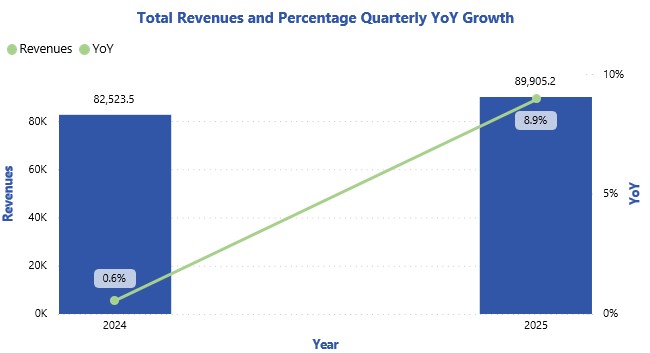
- In Q4 2025, the global automation supplier landscape demonstrated resilient growth compared to Q4 2024, supported by sustained investments in digital manufacturing, infrastructure modernization, and supply chain automation despite ongoing macroeconomic uncertainty.
- Automation suppliers are increasingly shifting from standalone hardware offerings toward integrated, software-driven portfolios that combine control systems, analytics, AI, and lifecycle services to deliver higher customer value.
- Artificial intelligence and machine learning have become core differentiators among suppliers, with a strong focus on embedded intelligence for adaptive control, anomaly detection, predictive maintenance, and autonomous optimization.
- Suppliers are expanding modular and platform-based automation architectures, enabling customers to scale deployments incrementally, reduce integration complexity, and future-proof systems against rapid technology changes.
- The adoption of digital twins has accelerated significantly, with suppliers positioning simulation, virtual commissioning, and continuous performance optimization as standard capabilities across automation projects.
- Cloud-enabled and hybrid automation platforms are gaining wider acceptance, as suppliers address customer needs for centralized visibility, remote diagnostics, multi-site coordination, and faster deployment across global operations.
- Edge computing continues to be a strategic focus area, with suppliers enhancing real-time processing, deterministic performance, and local autonomy while balancing cloud connectivity requirements.
- Autonomous systems, including mobile robots and intelligent material handling solutions, are now central to supplier strategies in discrete manufacturing, logistics, and warehousing, driven by labor constraints and efficiency goals.
- Cybersecurity has emerged as a critical competitive factor, with suppliers embedding security-by-design principles, offering secure connectivity, and aligning automation solutions with industrial cybersecurity standards.
- Sustainability has become a core pillar of supplier roadmaps, with automation offerings increasingly aligned to energy efficiency, emissions monitoring, asset optimization, and regulatory compliance requirements.
- Suppliers are also investing heavily in ecosystem development, including partnerships, open APIs, and developer platforms, to support interoperability and accelerate innovation across the broader industrial value chain.
- Workforce enablement is gaining prominence, with suppliers expanding digital training, simulation-based learning, and AI-assisted tools to help customers address automation skills gaps.
ARC Advisory Group clients can view the complete report at the ARC Client Portal.
Contact Us if you would like to speak with the author.
Obtain more ARC In-depth Research Market Analysis.